
Physical Constraints and Failure Modes
Digital transformation often looks strongest on paper. The architecture appears elegant, the policies seem complete, and the execution plan may even look well coordinated. Yet many transformation efforts still fail for a simple reason: the physical environment was treated as a detail instead of a design input. That is the central lesson of this lecture. Ignoring physical constraints causes transformation failure, especially when edge realities expose the limits of cloud-centric assumptions.
For enterprise architects, public-sector leaders, and transformation practitioners, this is not an argument against digital ambition. It is an argument for judging digital design in context. A system that works in a controlled data center or a centralized cloud model may behave very differently when it is deployed into remote offices, operational sites, or tactical edge environments. The operating environment matters, and it shapes what the architecture can reliably do.
Why physical reality matters
The lecture frames the Physical Domain as the place where hidden assumptions become visible. When people assume that connectivity is always available, that latency is always acceptable, or that everything can be accessed anywhere, they risk building execution models that break as soon as reality becomes less convenient. Physical constraints are not side issues. They are first-class inputs to architecture.
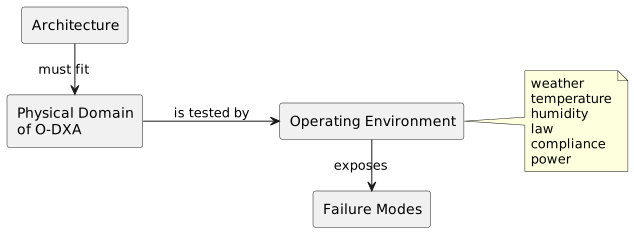
The same digital approach can succeed in one environment and fail in another because the environment changes the conditions of use. A remote site, a moving vehicle, a far-flung operational location, or a weather-affected facility may force a different answer than a centralized office setting. If you do not understand the operating environment, you cannot reliably map the physical domain or predict where failure modes will appear.
This is where governance and architecture intersect. Policy choices are not abstract rules floating above reality; they must fit the conditions where systems actually run. Execution that ignores local constraints may look disciplined at headquarters and still fail at the edge.
The main physical constraints
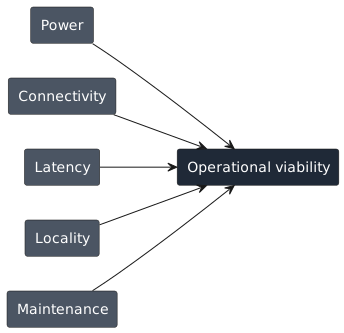
The lecture names the key physical_constraints directly: power, connectivity, latency, locality, and maintenance conditions. These are not theoretical concerns. They shape whether a system can operate, recover, and remain sustainable over time.
Power is the most basic example. If a site does not have reliable power, or depends on unusual power sources, continuity assumptions change immediately. Connectivity and latency are equally important. A design that assumes stable high-bandwidth communication may work well in a central environment but struggle when a site is intermittent, remote, or subject to delays. Locality matters because location affects what can be done where the system operates. Maintenance conditions matter because systems that are difficult to reach are harder to repair, inspect, or keep reliable.
The lecture also broadens the meaning of environment. Weather, temperature, humidity, vibration, dust, seasonal variation, local laws, permits, and safety rules can all affect viability. A location may look acceptable on paper and still be poor in practice. That difference matters because digital transformation is not only about technical intent; it is about whether the design can survive the actual environment.
One useful way to think about this is by recognizing that not all operating settings are alike. A data center, an enterprise workspace, a remote field location, and a tactical edge environment each place different demands on the system. Some settings are relatively controlled. Others are intermittent by nature. Some can tolerate delay. Others cannot. The architectural mistake is to assume those differences away.
How failure modes appear at the edge
The edge reveals what centralized assumptions conceal. In a controlled setting, it is easy to believe that every location behaves the same way. At the edge, that assumption breaks down. The lecture emphasizes that edge conditions expose dependencies on power, connectivity, and other environmental realities that were invisible in the central model.
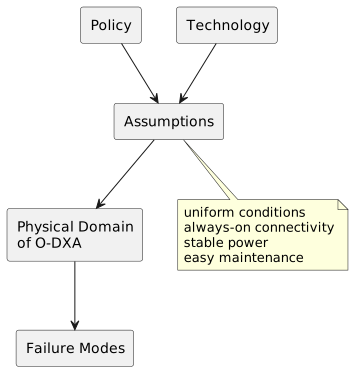
That is why failure_modes should be discovered deliberately, not discovered by accident during an outage. Failure analysis begins with the environment, then traces how technology choices and policy choices behave in that environment. A policy that assumes uniform conditions across all sites may work in one setting and fail in another. A technology choice that assumes constant connectivity may produce problems when connectivity is unstable or deliberately intermittent.
The lecture also draws a distinction between disaster recovery and business continuity. That distinction matters because they reflect different tolerance for interruption and different architectural commitments. Failure analysis helps leaders decide what level of risk they are willing to accept and what level of resilience they truly need. Good architecture is not about pretending nothing will fail. It is about understanding how the system fails and deciding whether that failure is acceptable.
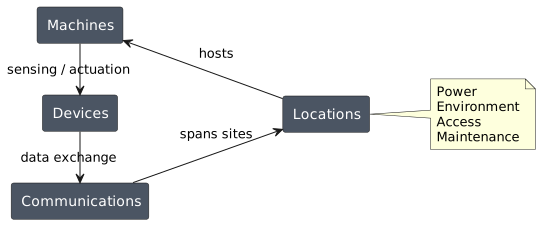
This is especially important in edge environments where machines, sensors, vehicles, or remote facilities depend on coordination across physical and digital systems. A floodgate controller, a camera network, a moving delivery asset, or a water treatment site may all behave differently once connectivity weakens, power becomes unstable, or maintenance becomes difficult. The system may be digitally elegant and still fail in practice because the environment is less forgiving than the design assumes.
Why policy and technology must fit the environment
One of the lecture’s strongest points is that policy choices and technology choices both interact with physical realities. Policy does not float above the environment, and technology does not escape it. If a policy is written as though all locations are identical, it may be brittle in the real world. If a technology assumes perfect connectivity or uniform infrastructure, it may create hidden operational risk.
This applies across different kinds of locations, from centralized facilities to enterprise workspaces to edge environments. The more distributed and physically constrained the setting, the more important it becomes to align decision-making with actual conditions. In practice, that means making tradeoffs explicitly. Some environments may warrant stronger continuity planning; others may tolerate more brittleness. The point is to choose consciously rather than assume away the problem.
The transcript gives a helpful reminder here: location may be viable on paper but not in practice. That is a governance issue as much as a technology issue. It is easy to approve a design when the assumptions are implicit and the environment is idealized. It is harder, but more honest, to ask how the same policy or system behaves when the network drops, the site is hard to reach, or local conditions make maintenance costly.
That is also why “cloud-first” thinking can become misleading if it is treated as a substitute for environment-aware design. Centralization can reduce some complexity, but it cannot erase power constraints, latency, physical access limitations, weather, or regulatory conditions. The edge makes those realities visible whether we are ready or not.
Architectural implications for sustainable transformation
The conclusion is clear: treat physical constraints as first-class design inputs. That means mapping the Physical Domain carefully, recognizing the operational conditions at each location, and evaluating how policies and technologies behave under those conditions. It also means building architectural judgment around failure analysis, not optimism.
This is what makes transformation sustainable. If the architecture is elegant but brittle, it may impress in presentation and fail in practice. If it is designed with power, connectivity, latency, locality, maintenance, and environment in mind, it is more likely to hold up under real operating conditions. Sound architecture in the Physical Domain requires that discipline.
For leaders responsible for governance and execution, the lesson is practical: do not separate digital ambition from physical reality. The physical context determines whether a system can be trusted. Failure analysis is therefore essential to sound architectural judgment, and it is one of the clearest ways to improve digital transformation outcomes.
If your organization is evaluating a new system, ask a few simple questions: Where will it run? What happens when connectivity is intermittent? How do latency and locality change the user experience or operating model? What power and maintenance conditions will shape reliability? And, most importantly, what failure modes become visible only when the system leaves the controlled environment?
Those questions do not slow transformation down. They make it more credible. They move the conversation from abstract confidence to practical execution.
Go Deeper
-
Full lecture episode: Lecture 7: Physical Constraints and Failure Modes
-
Series blog summary: See the accompanying blog post for a shorter, more structured overview of the lecture’s main points