
The Digital Domain: Platforms, Software, and Data as Architecture
Digital transformation frequently stalls not for lack of technology, but because digital systems are treated as isolated IT implementations rather than integrated architectural components. Within the Open Digital Transformation Architecture (O-DXA) framework, the Digital Domain represents the technical backbone of modern services—integrating software, data, and infrastructure into a coherent whole. This whitepaper establishes the Digital Domain as the technical foundation of digital transformation, examines its seven interdependent layers, and explains why application-centric thinking fails to deliver systemic outcomes. We show how platforms and data become strategic assets when governed architecturally and how FORGE (Find, Observe, Reconcile, Ground, Enhance) provides a repeatable method for designing a resilient digital architecture across the Transformation Dimensions of people, process, policy, and technology.
The Modernization Paradox: Why Application-Centric Thinking Fails
The recurring failure in digital modernization is the belief that replacing a legacy application with a modern one constitutes transformation. Most organizations approach modernization as a series of disconnected software upgrades, cloud migrations, or tool selections. This application-centric mindset optimizes individual systems while ignoring the structural relationships between platforms, data, and operating outcomes [1].
When technology is treated as an implementation layer outside the core architecture, the organization accumulates "digital debt"—fragmented data, inconsistent security, redundant platforms, and brittle integrations. Transformation stalls because the underlying digital architecture cannot support the speed, scale, and intelligence required by the business.
This is the core error: confusing software replacement with architectural transformation. To break this cycle, digital systems must be reframed as architectural assets. They are not merely tools; they are the structural components that define the capacity, resilience, and agility of the enterprise.
In the GEAR: Transformation Operating System (TOS) [2], the Digital Domain is the structural domain of the O-DXA (Open Digital Transformation Architecture) model [3] that provides the technical foundation. It enables processes, organizational structures, and physical assets to operate as a coherent system.
The Digital Domain: Systems as Architecture
The Digital Domain encompasses the software, data, and infrastructure that carry and constrain the work of the enterprise. It is the architectural home for platforms because these elements shape how digital value is produced, governed, and scaled.
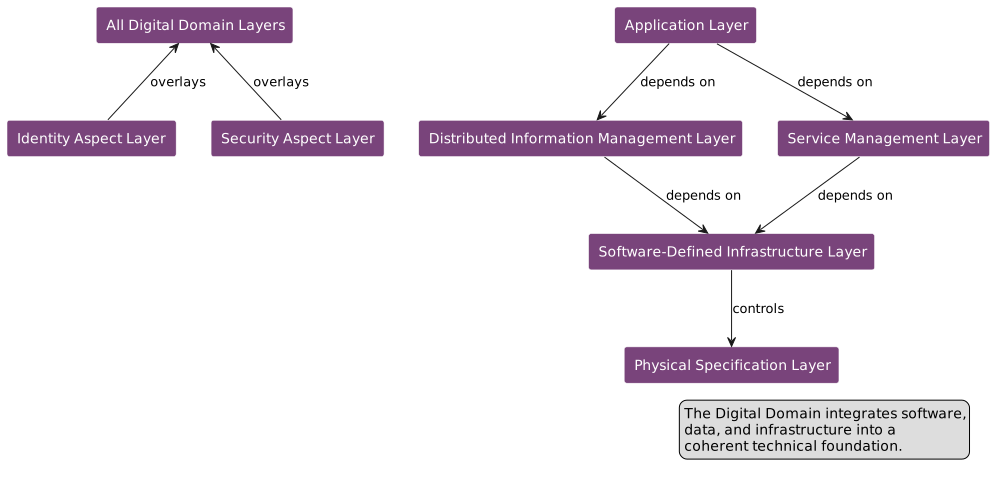
It is composed of seven interdependent layers, including five functional layers and two cross-cutting "aspect" layers:
-
Application Layer
-
Distributed Information Management Layer
-
Service Management Layer
-
Software-Defined Infrastructure Layer
-
Physical Specification Layer
-
Identity Aspect Layer (Cross-cutting)
-
Security Aspect Layer (Cross-cutting)
Application Layer
The Application Layer enables user-facing and machine-facing interactions. It is not merely "the software," but the set of capabilities that deliver multi-channel experiences, business domain logic, and intelligent automation. Modern application architecture prioritizes modularity, API-first design, and platform enablement over monolithic system replacement.
In architectural terms, this layer should be treated as an experience and capability composition layer, not a persistence or infrastructure layer. Applications should consume shared identity, data, and service capabilities rather than embedding those concerns locally. The most resilient designs keep domain logic explicit, interfaces stable, and deployment boundaries small enough to evolve without large-scale rewrites.
When this layer is weak, organizations experience channel inconsistency, duplicated business rules, and release bottlenecks. A practical design check is simple: can a capability be exposed to web, mobile, partner API, and AI agent channels without re-implementing core logic? If not, the application architecture is still too coupled to delivery mechanics.
Distributed Information Management Layer
This layer structures, governs, and exposes data as a shared enterprise capability. It moves the organization from "data as a byproduct of applications" to "data as a strategic asset." It includes data definition frameworks, data management services, and common data services that ensure intelligence can be scaled across the organization.
Its primary responsibilities are semantic consistency, lifecycle governance, and reliable access patterns. That means canonical definitions for critical entities, clear stewardship for quality and lineage, and interoperable interfaces for analytics and operational use. In mature environments, data products are treated as managed assets with owners, service levels, and explicit consumer contracts.
Failure in this layer appears as conflicting reports, fragile integrations, and stalled AI initiatives caused by low trust in data. Architectural maturity can be evaluated by asking: are key decisions based on shared, governed datasets, or on local extracts and spreadsheet reconciliation? The answer reveals whether data is truly a platform capability or still an application exhaust stream.
Service Management Layer
The Service Management Layer orchestrates and monitors the services and their runtime environments. It ensures that digital capabilities are observable, reliable, and manageable as they flow across various cloud and on-premise infrastructures.
This layer is where operational reliability becomes architectural discipline. It defines how services are cataloged, deployed, versioned, observed, and supported through incidents and change windows. Core capabilities include telemetry standards, service-level objectives, dependency mapping, incident response workflows, and automated remediation where appropriate.
Without strong service management, platform scale creates operational chaos: unknown dependencies, slow root-cause analysis, and recurring outages. A useful architectural indicator is whether teams can answer, in near real time, what is degraded, who is affected, and what dependency is responsible. If they cannot, the architecture is not yet operationally coherent.
Software-Defined Infrastructure (SDI) Layer
SDI abstracts compute, storage, and network resources into programmable, software-controlled infrastructure. It is the mechanism by which infrastructure becomes as agile as the software it supports, enabling automated scaling and resilience.
Architecturally, SDI converts infrastructure from a ticket-driven utility into a policy-driven execution substrate. Provisioning, configuration, segmentation, and resilience patterns are codified, versioned, and enforced through automation. This supports repeatability across environments and reduces drift between development, test, and production.
Weak SDI manifests as environment inconsistency, manual provisioning delays, and recovery procedures that depend on individual expertise. A strong SDI layer can recreate critical environments predictably, enforce baseline controls automatically, and scale services under defined policies rather than ad hoc intervention.
Physical Specification Layer
The Physical Specification Layer represents the logical view of the underlying hardware resources—from mobile devices and edge sensors to datacenter servers and public cloud regions—that the SDI must manage and control.
Although often invisible in cloud-first narratives, this layer defines the real-world constraints that architecture must respect: latency envelopes, geographic placement, power and connectivity limits, hardware trust boundaries, and regulatory residency requirements. It is where digital design meets physical reality.
If this layer is underspecified, organizations overpromise performance and resilience while underestimating operational risk. Mature architecture practices explicitly map critical workloads to physical constraints and failure domains, especially for edge scenarios, industrial systems, and safety- or compliance-sensitive operations.
Identity and Security Aspect Layers
These cross-cutting layers provide the trust foundations of the Digital Domain. Identity services (authentication, authorization) and Security controls (encryption, threat detection, compliance) must overlay every other layer. In a mature digital architecture, security is not a late-stage review but a designed-in property of every system.
Identity determines who or what can act; security determines what is permitted, monitored, and recoverable when conditions change. Together they enforce least privilege, establish accountability, and preserve system integrity under stress. This includes human users, service accounts, machine identities, APIs, devices, and automated agents.
Architectural quality here depends on consistency across layers: centralized identity patterns, policy-as-code enforcement, end-to-end auditability, and integrated detection-response loops. When identity and security are fragmented, every other layer inherits hidden risk. When they are unified, the Digital Domain gains the trust needed for scale, automation, and AI-enabled decisioning.
Platforms and Data as Strategic Assets
Digital transformation matures when platforms and data move from being local technical conveniences to shared architectural capabilities.
At this stage, the architectural question shifts from "Which tool should this team buy?" to "Which capabilities should the enterprise standardize so every team can move faster with less risk?" That distinction separates tactical modernization from strategic digital architecture.
Designing for Reuse and Scale
An application-first mindset produces "silos of excellence" where each team selects its own tools and manages its own data. This creates a fragmented Digital Domain that is expensive to maintain and impossible to secure consistently. A platform-centric architecture prioritizes shared capabilities—identity, integration, orchestration, and storage—that support multiple use cases. This shift enables reuse, reduces technical debt, and accelerates the delivery of new outcomes.
Architecturally, reuse must be intentional. Shared platforms should publish clear service boundaries, usage contracts, and reliability expectations so product teams can compose capabilities without negotiating bespoke integration every time. Reuse without standards simply relocates complexity; reuse with standards compounds delivery speed over time.
A practical maturity test is whether a new product initiative can stand up by assembling existing capabilities for identity, telemetry, integration, and data access, or whether it must recreate these foundations from scratch. If every initiative rebuilds the same plumbing, the platform strategy is incomplete.
Data as an Enterprise Capability
Data creates value when it is governed, shared, and usable across domains. In the O-DXA model, the Distributed Information Management Layer ensures that data is not trapped within individual applications. By standardizing data definitions and access patterns, the organization builds a foundation for Artificial Intelligence (AI) and advanced analytics. AI value is directly dependent on the quality and accessibility of these platform and data foundations.
Treating data as an enterprise capability requires explicit ownership, quality controls, and lifecycle policy at the architectural level. This includes canonical definitions for critical entities, lineage from source to decision, and access models that balance openness with security and compliance. Without these controls, AI and analytics efforts produce local optimization rather than enterprise intelligence.
Leaders should also distinguish between data availability and data usability. Data may exist in many systems but still be unusable due to inconsistent semantics, unclear provenance, or unstable interfaces. The architectural target is not merely to centralize data, but to make trusted data products discoverable, consumable, and governable across domains.
FORGE Practices for Digital Architecture
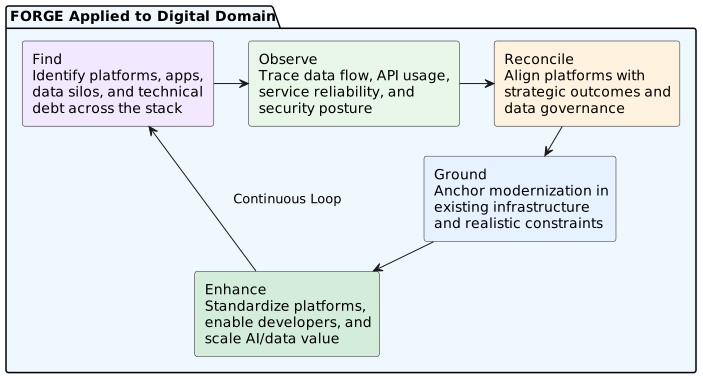
Digital architecture only matters when it changes execution. The FORGE methodology turns Digital Domain principles into repeatable architectural action, guiding decisions and trade-offs without collapsing into tool selection.
Find: Mapping the Digital Landscape
The Find stage identifies the digital assets as they exist today. This includes identifying shadow IT, redundant platforms, fragmented data sources, and the actual dependencies between applications and infrastructure.
Done well, Find creates an evidence-backed map of digital reality rather than a catalog of intended architecture. It should capture ownership, cost, criticality, and coupling depth so leaders can see which components are strategic, which are transitional, and which are liabilities. This baseline is essential for prioritizing modernization work that improves system coherence rather than just visible symptoms.
Observe: Measuring Architectural Health
Observe traces how data and services actually move through the system. It examines latency, reliability, security vulnerabilities, and where the lack of platform standardization creates friction for developers and users.
Observe turns architecture into measurable behavior. The focus is on runtime truth: where failures cluster, where handoffs introduce delay, where policy is bypassed, and where developer effort is wasted on non-differentiating integration work. The goal is to expose recurring friction patterns that cannot be seen in static diagrams.
Reconcile: Aligning Technology with Intent
Reconciliation is where the architect makes the hard choices about which platforms to standardize, which legacy systems to retire, and how to align technical investments with the Strategic and Process domains of the enterprise.
This stage forces explicit trade-offs. Not every legacy component should be removed, and not every new platform should be adopted. Reconcile should produce decision records that clarify why a capability is retained, replaced, consolidated, or deferred, tied directly to business outcomes, risk posture, and operating model constraints.
Ground: Building on Stable Foundations
Grounding ensures that modernization is not a "rip and replace" fantasy. It anchors digital change in the existing infrastructure, security requirements, and operational realities of the organization.
Grounding also protects transformation from organizational rejection. Changes that ignore trusted operating practices, regulatory commitments, or workload criticality create avoidable resistance and service instability. By anchoring modernization in what already works, teams can introduce new architecture incrementally while preserving reliability.
Enhance: Scaling Digital Value
Enhance moves the organization toward a platform-centric model. It involves building developer-friendly portals, automating infrastructure through SDI, and ensuring that data is usable for intelligent automation and AI.
Enhance is where the architecture starts to compound value. Capabilities are hardened, documented, and productized so reuse becomes easier over time. Typical outcomes include self-service platform workflows, policy-as-code guardrails, consistent observability, and data products that support both operational decisions and advanced analytics.
The quality check for Enhance is repeatability: can teams deliver faster with fewer incidents while maintaining security and compliance constraints? If speed improves only for one team or one use case, the enhancement is local. If speed and reliability improve across domains, the architecture is maturing.
Final Takeaways for the Practitioner
For practitioners, the Digital Domain should be managed as an integrated system of capabilities, constraints, and trade-offs. Progress comes from disciplined architectural choices repeated over time, not one-time modernization programs.
-
Digital systems are architectural components. Stop treating technology as an implementation layer and start treating it as the structural foundation of the enterprise.
-
Modernization is not application replacement. Shifting an application to the cloud without changing the underlying architecture is not transformation; it is relocation.
-
Platforms are strategic assets. Shared platforms for identity, data, and service management reduce friction and enable scale.
-
Data must be governed architecturally. Data value depends on accessibility and governance beyond the boundaries of a single application.
-
Security is a cross-cutting aspect. Trust foundations must be designed into every layer of the digital stack, not added as a perimeter defense.
-
FORGE is the path to digital maturity. Use the Find, Observe, Reconcile, Ground, Enhance loop to continuously evolve the Digital Domain toward resilience and intelligence.
The central discipline is coherence: every design decision should improve the alignment between platform capabilities, operational reliability, governance requirements, and strategic outcomes. That is what turns digital investment into transformation capacity.
Looking Forward: The Physical Domain
The Digital Domain establishes the technical foundation for modern services. But digital systems must eventually interact with the physical world—hardware, locations, networks, and environmental constraints. The next paper in this series, The Physical Domain: Connectivity, Edge, and Environmental Architecture, will examine how the O-DXA framework extends to the physical dimension of digital transformation.
This transition matters because architectural quality is ultimately tested at the digital-physical boundary: latency, safety, uptime, geographic resilience, and regulatory constraints all materialize there. A strong Digital Domain prepares the enterprise to manage those constraints deliberately rather than reactively.
References
[1] P. Forth, P. Romano, and others, “Flipping the Odds of Digital Transformation Success,” McKinsey & Company, 2022, [Online]. Available: https://www.mckinsey.com/capabilities/bcg-x/our-insights/flipping-the-odds-of-digital-transformation-success.
[2] D. W. Pulsipher, “Governing Enterprise Architecture Realization (GEAR): Logical and Physical Representation,” Intel Corporation, 2023. [Online]. Available: https://cdrdv2-public.intel.com/790385/GEAR%20Logical%20and%20Physicalv2.pdf.
[3] Embracing Digital Transformation, “Digital Transformation: The O-DXA Framework.” 2024, [Online]. Available: https://embracingdigital.org/en/digital-transformation/index.html.