
The Process Domain: Turning Intent into Repeatable Execution
Digital transformation does not scale because leaders approve a strategy, fund a platform, or launch a pilot. It scales when the organization can repeatedly translate intent into coordinated work, governed decisions, measurable delivery, managed risk, and sustaining support. Within the Open Digital Transformation Architecture (O-DXA) framework, the Process Domain is the architecture of that translation. It defines the workflows, governance mechanisms, innovation practices, operational routines, risk controls, and support structures that convert strategic and organizational intent into reliable execution. This whitepaper establishes the Process Domain as the execution engine of digital transformation, examines its five interdependent layers, explains why execution breaks down when those layers drift apart, and shows how FORGE (Find, Observe, Reconcile, Ground, Enhance) gives practitioners a repeatable method for designing process-driven transformation across the Transformation Dimensions of people, process, policy, and technology.
- 1. The Execution Architecture Problem
- 2. The Process Domain: Five Layers of Execution Architecture
- 3. Where Execution Breaks Down
- 4. Value Streams as Architectural Objects
- 5. Governance as an Execution Property
- 6. FORGE Approaches to Process-Driven Transformation
- 7. The Repeatable Execution Organization
- References
1. The Execution Architecture Problem
The recurring failure pattern in digital transformation is not a shortage of ambition. Most organizations can describe the future they want. They can name the platforms they intend to modernize, the data capabilities they want to build, the customer experiences they want to improve, and the operating models they want to adopt. The breakdown occurs between aspiration and repeatable execution [1].
Pilots succeed because a small group can compensate for missing process architecture with attention, urgency, and personal coordination. Transformation stalls when that same work must scale across functions, teams, geographies, vendors, systems, policies, and operational constraints. At that point, effort is no longer enough. The organization needs a process architecture that makes work repeatable, visible, governed, and resilient.
This is the core insight of the Process Domain: transformation only becomes durable when the organization can design how work flows, how decisions are governed, how innovation is scaled, how risks are managed, and how support capabilities sustain execution.
In the GEAR: Transformation Operating System (TOS) [2], the Process Domain is one of the structural domains of the O-DXA (Open Digital Transformation Architecture) model [3]. Where the Strategic Domain governs intent and the Organizational Domain governs people, structure, and accountability, the Process Domain governs the repeatable mechanisms by which intent becomes action.
Without process architecture, transformation remains aspirational. It may produce isolated wins, compelling demonstrations, or temporary acceleration, but it cannot become the normal operating pattern of the enterprise.
2. The Process Domain: Five Layers of Execution Architecture
The Process Domain defines the workflows, governance, and support mechanisms that enable strategic and operational activities within the system. It ensures that processes are aligned, optimized, and resilient enough to support efficient service delivery and systematic operations.
It is composed of five interdependent layers:
-
Governance Layer
-
Innovation Management Layer
-
Operational and Delivery Layer
-
Risk Management Layer
-
Support Layer
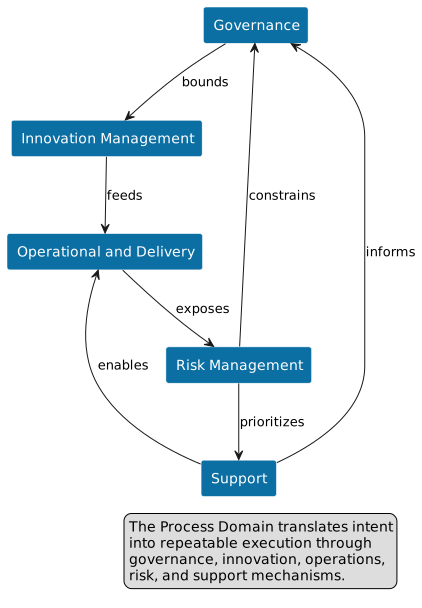
These layers should not be treated as a checklist. They form an execution system. Governance defines the rules and decision rights. Innovation Management explores and scales new ways of working. Operational and Delivery practices produce the actual value. Risk Management preserves continuity and resilience. Support capabilities sustain the whole system.
2.1. Governance Layer
The Governance Layer encompasses the rules, policies, and oversight mechanisms that guide behavior and institutional accountability across the organization. Governance is often misunderstood as a control function added after work has already been designed. In process architecture, governance is part of the design of work itself.
Effective governance defines:
-
Rules and policies that ensure operational decisions align with strategic objectives.
-
Oversight mechanisms that monitor compliance, enforce standards, and maintain transparency.
-
Decision-making frameworks that enable timely decisions while preserving systemic obligations.
The Governance Layer gives execution its boundaries. It determines what must be standardized, what can be delegated, what must be escalated, and what evidence is required before decisions can be made. In digital transformation, weak governance produces two opposite failures: uncontrolled local variation or centralized decision paralysis. Both prevent scale.
Governance in the Process Domain must be connected to policy and technology, but it cannot be reduced to either. A policy without workflow is shelfware. A workflow without governance is drift. A platform without decision rights simply automates ambiguity.
2.2. Innovation Management Layer
The Innovation Management Layer focuses on fostering and scaling innovative capabilities so the organization can adapt in changing conditions. It includes exploration, development, and scaling.
The layer must support:
-
Exploration: Identifying emerging technologies, methods, and practices that may improve capability.
-
Development: Translating ideas into pilots, prototypes, or proofs of concept.
-
Scaling: Expanding successful innovations into durable, repeatable operating practices.
Innovation Management is the bridge between experimentation and institutional adoption. Many organizations are good at pilots and poor at scaling. They can create a proof of concept under special conditions, but they cannot convert it into standard work, governed practice, operational ownership, support processes, and risk controls [4].
This is why Innovation Management belongs inside the Process Domain. Innovation is not just ideation. It is a managed process for discovering, testing, selecting, integrating, and scaling better ways of working.
2.3. Operational and Delivery Layer
The Operational and Delivery Layer encompasses the day-to-day activities and workflows necessary for delivering high-quality services and outcomes. It is where transformation becomes visible to customers, constituents, employees, partners, and the broader ecosystem.
This layer includes:
-
Service delivery practices that ensure services meet stakeholder needs effectively and efficiently.
-
Workflow optimization that reduces redundancy, delay, rework, and handoff friction.
-
Performance monitoring that creates feedback loops for assessment and refinement.
Operational and Delivery practices are the heart of repeatable execution. They are also where the consequences of upstream design become obvious. If governance is unclear, operations stall. If innovation is not scaled, operations accumulate disconnected pilots. If risk is not integrated, operations become fragile. If support is underdesigned, operations degrade under load.
The Process Domain therefore treats operations as an architectural concern, not only a management concern. Workflows, queues, handoffs, metrics, controls, and escalation paths are all part of the system design.
2.4. Risk Management Layer
The Risk Management Layer identifies, analyzes, and mitigates strategic and operational risks so the organization can preserve continuity and resilience. Risk management is not a separate compliance ritual. It is a core part of process execution.
This layer includes:
-
Risk identification processes for uncovering threats, vulnerabilities, and dependencies.
-
Risk analysis practices for evaluating impact, likelihood, and mitigation options.
-
Mitigation strategies that reduce exposure and keep systems operational during disruption.
In digital transformation, risk often enters through process assumptions: a manual step that does not scale, a data dependency that is not governed, a vendor handoff that lacks clear ownership, a model output that no one validates, or a policy exception that becomes normal practice. These are not abstract risks. They are process design failures.
The Risk Management Layer makes those failures observable before they become incidents. It constrains Governance, informs Support, and shapes Operational and Delivery practices.
2.5. Support Layer
The Support Layer consists of the services and structures that enable and sustain operational functionality. Support is not peripheral. It is the backbone that determines whether process improvements survive contact with everyday work.
Support capabilities include:
-
IT support for availability, maintenance, security, and incident response.
-
Human Resources for workforce management, recruiting, onboarding, and professional development.
-
Procurement for acquiring goods, services, and infrastructure.
-
Facilities management for physical environments and logistical requirements.
Support services determine the load-bearing capacity of the Process Domain. A redesigned value stream cannot function if procurement cycles block delivery, if HR cannot staff the roles, if IT cannot support the platforms, or if facilities constraints make the workflow impractical.
The Support Layer enables operations and informs governance. It reveals the practical constraints that determine whether a process design is executable.
2.6. The Layer Relationship Model
The five layers of the Process Domain operate as a system of dependency and feedback.
| From | Relationship | To | Architectural Significance |
|---|---|---|---|
Governance Layer |
bounds |
Innovation Management Layer |
Rules, policies, and decision rights determine which experiments are permissible, fundable, and scalable. |
Innovation Management Layer |
feeds |
Operational and Delivery Layer |
Successful experiments must become repeatable workflows, standards, and operating practices. |
Operational and Delivery Layer |
exposes |
Risk Management Layer |
Execution surfaces constraints, incidents, delays, and failure modes that require risk treatment. |
Risk Management Layer |
prioritizes |
Support Layer |
Risk posture determines which support capabilities require investment, hardening, or redesign. |
Support Layer |
enables |
Operational and Delivery Layer |
Support functions provide the people, tools, procurement, facilities, and technology continuity required for delivery. |
Risk Management Layer |
constrains |
Governance Layer |
Risk evidence shapes policies, controls, escalation paths, and decision frameworks. |
Support Layer |
informs |
Governance Layer |
Support constraints reveal which governance rules are practical, costly, or unsustainable. |
The Process Domain bridges strategy and execution by structuring governance, innovation, risk management, operational workflows, and support capabilities into a coherent execution system.
3. Where Execution Breaks Down
Execution breakdowns are rarely isolated events. They are usually layer coherence failures. A workflow appears inefficient, but the root cause is unclear governance. A pilot fails to scale, but the root cause is missing support. A risk event occurs, but the root cause is operational handoff ambiguity. A team misses a deadline, but the root cause is a process that was never designed across organizational boundaries.
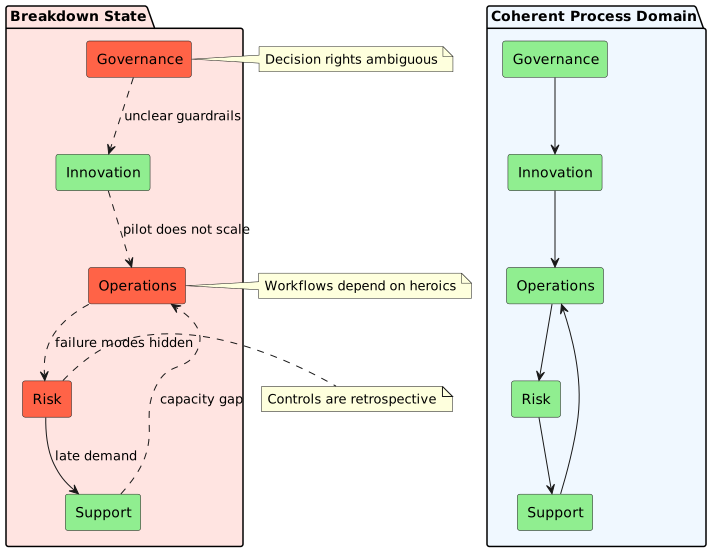
3.1. Governance Without Execution
The first breakdown pattern is governance without execution. This occurs when policies, steering committees, standards, and approval boards exist, but they are disconnected from the workflows where value is created.
Governance without execution produces ritualized control. Decisions are reviewed, but the process does not improve. Standards are published, but the workarounds remain. Committees meet, but delivery teams still lack clear decision rights. The organization appears governed while execution remains informal.
This failure is common when governance is designed as a reporting structure rather than a process layer. A transformation program may have dashboards, status meetings, and executive checkpoints, but if those mechanisms do not change how decisions flow through the organization, they do not create execution capability.
3.2. Innovation Without Scaling
The second breakdown pattern is innovation without scaling. The organization produces prototypes, pilots, proofs of concept, and local experiments, but those experiments never become standard work.
This failure often hides behind success. The pilot works. The demo impresses leadership. The team proves that the technology or method is viable. But when the organization tries to replicate the result, the hidden process dependencies appear: informal coordination, special funding, manual data cleanup, exceptional vendor support, borrowed expertise, or bypassed governance.
Innovation that cannot be scaled is not transformation. It is learning. Learning is valuable, but it only becomes transformation when the Process Domain absorbs it into governance, operations, risk, and support.
3.3. Operations Without Feedback
The third breakdown pattern is operations without feedback. Work gets done, but the organization cannot see how it gets done, why it fails, where it slows, or which constraints are accumulating.
Operations without feedback produce local optimization and systemic fragility. Teams improve what they can see. Managers measure what is easy to count. Technology automates the visible steps while the hidden handoffs, exceptions, delays, and rework remain unexamined.
Process architecture requires feedback loops. Performance monitoring is not only a reporting function. It is the evidence base for governance, risk management, support investment, and continuous improvement [5].
3.4. Risk as a Late-Stage Review
The fourth breakdown pattern is risk as a late-stage review. Risk is assessed after design decisions have already been made, vendors selected, workflows deployed, and operating assumptions embedded.
When risk enters late, it can only block, approve, or document exceptions. It cannot shape the process architecture. This produces an antagonistic relationship between delivery and control: delivery teams see risk as friction, while risk teams see delivery as noncompliance.
In the Process Domain, risk must be designed into the workflow. Controls, validations, escalation paths, resilience mechanisms, and continuity practices should be part of the process model from the beginning.
3.5. Support as an Afterthought
The fifth breakdown pattern is support as an afterthought. Transformation teams design a future operating model and then discover that HR, IT, procurement, finance, facilities, or vendor management cannot sustain it.
Support constraints are often treated as implementation details. In reality, they are architectural constraints. A process that requires a skill the organization cannot hire, a platform IT cannot support, a procurement pathway that takes six months, or a facility model that cannot accommodate the workflow is not executable at scale.
Support must be part of process design because support determines whether a process can survive normal operating conditions.
4. Value Streams as Architectural Objects
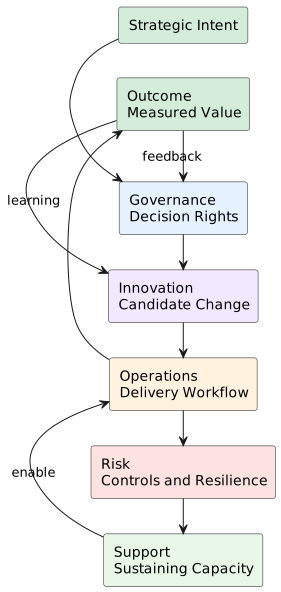
The Process Domain becomes most practical when the architect treats value streams as architectural objects. A value stream is not just a process map. It is an end-to-end model of how value moves from demand to outcome across people, process, policy, and technology.
Traditional process improvement often focuses on local efficiency: reducing cycle time in a step, automating a task, removing a handoff, or simplifying an approval. Those improvements matter, but they are not sufficient for transformation. Digital transformation requires understanding how the full stream of work carries intent, decisions, data, risk, and accountability across the enterprise [6].
4.1. Designing for Flow
Flow is the movement of work, information, decisions, and accountability through the system. A process can be documented and still fail to flow. A workflow can be automated and still produce delay. A value stream can appear efficient at the task level while remaining incoherent across the enterprise.
Designing for flow requires the architect to ask:
-
Where does demand enter the system?
-
Who owns the decision at each boundary?
-
What information is required before work can move forward?
-
Which policies govern the transition?
-
Which technologies support or constrain the step?
-
Which risks are introduced or reduced?
-
Which support capabilities sustain the process under load?
These are architectural questions. They connect the Process Domain to every other O-DXA domain.
4.2. Designing for Repeatability
Repeatability is the difference between effort and capability. A team may succeed once through exceptional coordination, but an organization only has a capability when it can reproduce the outcome under normal conditions.
Repeatability requires explicit work definitions, role clarity, decision frameworks, supporting tools, risk controls, and feedback mechanisms. It also requires deliberate variation management. Not every process should be standardized completely. Some work requires local adaptation. The architectural question is where variation is acceptable and where it creates systemic risk.
4.3. Designing for Resilience
Resilience is the ability of the process system to continue delivering value under stress. Process resilience depends on redundancy, observability, escalation, support capacity, and risk-aware design.
Many transformation programs optimize for efficiency before they understand resilience. They remove redundancy, centralize decisions, automate exceptions, and compress support capacity. The process becomes faster in stable conditions and more brittle under stress.
The Process Domain requires balancing efficiency with resilience. A process that cannot absorb disruption is not mature. It is merely optimized for a narrow operating assumption.
5. Governance as an Execution Property
Governance is not paperwork around execution. It is an execution property. The way a process is governed determines the speed, quality, legality, transparency, and resilience of the work.
In immature process environments, governance is external to execution. Work happens, and governance reviews it. In mature process environments, governance is embedded in the process model. Decision rights are clear. Evidence requirements are known. Escalation thresholds are explicit. Controls are visible. Exceptions are tracked. Learning feeds back into policy and design.

5.1. Decision Rights
Decision rights are the most underdesigned part of process governance. Organizations often define approval steps without defining what authority is being exercised, what evidence is required, what trade-offs are permitted, and what happens when the decision crosses a threshold.
Clear decision rights accelerate execution because teams know where authority resides. They also improve accountability because decisions can be traced to named roles, evidence, and governance rules.
5.2. Evidence Requirements
Governance requires evidence. A process cannot be governed if the organization cannot observe what is happening, what changed, what risk was accepted, what value was delivered, and what exception was granted.
Evidence requirements should be designed into the workflow. If evidence collection depends on manual after-the-fact reconstruction, governance will be slow, incomplete, and contested.
5.3. Exception Management
Exceptions are not failures by definition. They are signals. A healthy Process Domain distinguishes between justified exceptions, design gaps, policy mismatches, and operational workarounds.
Exception management is one of the strongest feedback mechanisms in process architecture. If the same exception recurs, the process is teaching the organization that the current design does not fit operating reality.
6. FORGE Approaches to Process-Driven Transformation
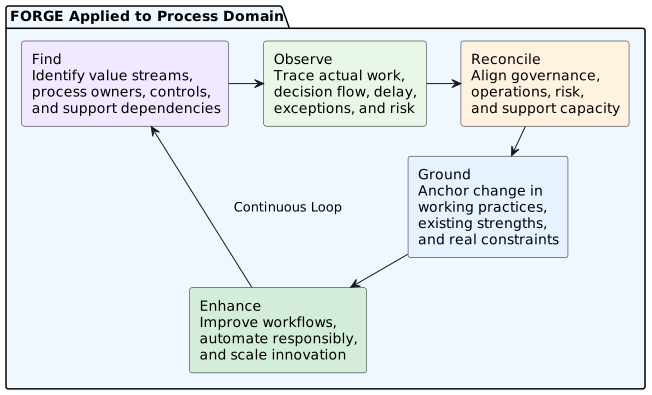
The FORGE methodology provides the practitioner with a repeatable engagement loop for diagnosing and improving the Process Domain. It prevents process work from collapsing into either abstract operating-model design or narrow workflow optimization.
6.1. Find: Identify the Real Process System
The Find stage identifies the process system as it actually exists. This includes formal workflows, informal workarounds, decision points, control points, exception paths, system dependencies, support functions, and value-stream boundaries.
The architect is not merely collecting process maps. The architect is identifying the structural mechanisms by which intent becomes action. The Find stage should reveal the real process owners, the real handoffs, the real decision rights, and the real constraints.
6.2. Observe: Trace Work Across Boundaries
The Observe stage traces work across organizational, technical, policy, and support boundaries. This is where the architect sees whether the documented process matches operating reality.
Observation should examine:
-
Delay and queue formation.
-
Rework and exception patterns.
-
Decision bottlenecks.
-
Data handoffs and system fragmentation.
-
Control failures and risk exposure.
-
Support constraints and capacity gaps.
The point is not to blame teams for variation. The point is to understand why the process behaves the way it does.
6.3. Reconcile: Align the Process Layers
The Reconcile stage restores coherence across the five Process Domain layers. Governance must align with operations. Innovation must align with scaling pathways. Risk must align with workflow design. Support must align with delivery demand.
Reconciliation is where the architect turns observation into design choices. Some policies may need simplification. Some workflows may need redesign. Some support functions may need investment. Some innovations may need to be stopped because they cannot scale. Some risks may need to be accepted explicitly rather than hidden as operational workarounds.
6.4. Ground: Build on What Already Works
The Ground stage prevents process transformation from becoming theoretical. Every organization already has working practices, trusted routines, informal coordination mechanisms, and support capabilities that can be strengthened.
Grounding means using those strengths deliberately. Instead of imposing a process model detached from reality, the architect anchors change in practices that already carry trust and operational value.
6.5. Enhance: Improve and Institutionalize
The Enhance stage converts design into sustained capability. Enhancement may include workflow redesign, automation, metrics, policy changes, support investment, risk controls, training, and governance updates.
Enhancement is not the end of process transformation. It is the start of the next cycle. Once a process is changed, the organization must find, observe, reconcile, ground, and enhance again as conditions change.
7. The Repeatable Execution Organization
The Process Domain is the execution architecture of transformation. It explains why strategy does not scale by itself, why pilots remain isolated, why governance can become ceremonial, why operations drift, and why support constraints often determine the real boundary of change.
By decomposing execution into five layers—Governance, Innovation Management, Operational and Delivery, Risk Management, and Support—and applying FORGE as a continuous practice, practitioners gain a method for turning transformation intent into repeatable organizational capability.
7.1. Final Takeaways for the Practitioner
-
Process is not bureaucracy. Process is the architecture of repeatable execution. Bureaucracy is what happens when process loses connection to value.
-
Pilots do not scale automatically. Innovation must be absorbed into governance, operations, risk, and support before it becomes transformation.
-
Governance must be embedded in the workflow. Decision rights, evidence requirements, controls, and exception paths should be part of process design.
-
Value streams are architectural objects. They carry intent, work, data, decisions, risk, accountability, and support demand across the enterprise.
-
Support is load-bearing. HR, IT, procurement, facilities, finance, and vendor management determine whether process designs can survive normal conditions.
-
FORGE is the engagement loop. Use Find, Observe, Reconcile, Ground, and Enhance to maintain coherence across the Process Domain as work, technology, and constraints evolve.
7.2. Looking Forward: The Digital Domain
The Process Domain establishes how the organization works—how intent becomes governed decisions, repeatable workflows, managed risks, and supported delivery. The next paper in this series turns to the systems that increasingly carry and constrain that work: The Digital Domain: Platforms, Software, and Data as Architecture will examine how digital systems become architectural assets, and how technology must be designed as part of the transformation operating model rather than treated as an implementation layer.
Transformation scales when process makes execution repeatable. Without that discipline, strategy remains aspiration, innovation remains isolated, and technology remains disconnected from value.
References
[1] P. Forth, P. Romano, and others, “Flipping the Odds of Digital Transformation Success,” McKinsey & Company, 2022, [Online]. Available: https://www.mckinsey.com/capabilities/bcg-x/our-insights/flipping-the-odds-of-digital-transformation-success.
[2] D. W. Pulsipher, “Governing Enterprise Architecture Realization (GEAR): Logical and Physical Representation,” Intel Corporation, 2023. [Online]. Available: https://cdrdv2-public.intel.com/790385/GEAR%20Logical%20and%20Physicalv2.pdf.
[3] Embracing Digital Transformation, “Digital Transformation: The O-DXA Framework.” 2024, [Online]. Available: https://embracingdigital.org/en/digital-transformation/index.html.
[4] D. Sull, C. Sull, and J. Yoder, “Why Strategy Execution Unravels and What to Do About It,” Harvard Business Review, 2015, [Online]. Available: https://hbr.org/2015/03/why-strategy-execution-unravels-and-what-to-do-about-it.