
The Organizational Domain: Aligning Structure, Roles, and Accountability
Every digital transformation initiative ultimately succeeds or fails on the strength of its people, structures, and culture. Technology can be procured, processes can be redesigned, and strategies can be rewritten — but if the human and structural dimensions of the organization are misaligned, transformation will not hold. Within the Open Digital Transformation Architecture (O-DXA) framework, the Organizational Domain is the structural model for those human dimensions. It is composed of seven interdependent layers — Stakeholders, Personas, Communication Channels, Roles & Responsibilities, Skills & Competencies, Structure, and Culture & Values — each controlling a distinct dimension of how an organization functions, decides, and transforms. This whitepaper establishes the Organizational Domain as the foundational layer of people-centric transformation, demonstrates how silos and misalignment emerge when those layers fall out of coherence, and shows how accountability and the FORGE (Find, Observe, Reconcile, Ground, Enhance) methodology provide the practitioner with the tools to restore and sustain alignment across the Transformation Dimensions (people, process, policy, and technology).
1. The Human Architecture Problem
The most common failure mode in digital transformation is not technical. It is structural. Organizations invest heavily in platforms, tools, and methodologies, yet the transformation stalls — not because the technology failed, but because the people, roles, and structures surrounding it were never aligned to support it [1].
This is the core insight of the Organizational Domain: that organizations behave exactly as they are structured. If the structure is fragmented, the transformation will be fragmented. If accountability is diffuse, execution will be diffuse. If culture is misaligned with the stated mission, every initiative will face invisible resistance at every layer [2].
In the GEAR: Transformation Operating System (TOS) [3], the Organizational Domain is one of five structural domains in the O-DXA (Open Digital Transformation Architecture) model [4]. Where the Strategic Domain governs the "Why" and the "What" of transformation, the Organizational Domain governs the "Who" — the human and structural architecture that either enables or constrains every decision, every communication, and every change initiative.
To transform an organization, we must first understand how it is built. That understanding begins with the seven layers of the Organizational Domain.
2. The Organizational Domain: Seven Layers of Human Architecture
The Organizational Domain defines the human and structural dimensions of the system that contribute to its overall efficiency, adaptability, and resilience. It is not a single monolithic concept but a layered model — seven interdependent sub-layers, each governing a specific aspect of human and structural coordination.
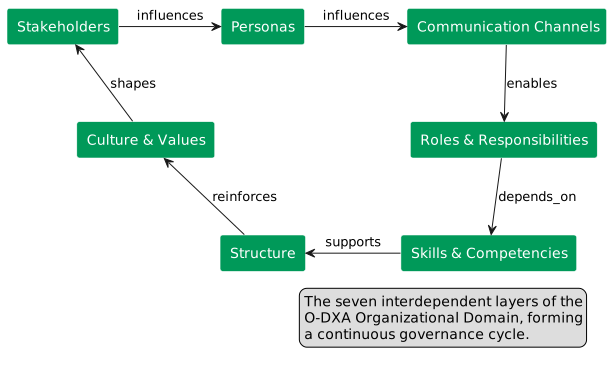
The seven layers form a directed cycle — not a hierarchy. Each layer has a defined purpose and a directional relationship to adjacent layers. A change in any one layer propagates through the others. This is what makes the Organizational Domain both powerful and fragile: coherence across all seven layers is the precondition for transformation to take hold.
2.1. Stakeholders Layer
The Stakeholders Layer identifies and engages all individuals and groups that influence organizational direction, governance, and success. Stakeholders are not passive observers — they are active forces shaping the organization’s priorities, constraints, and culture.
Key stakeholder groups include:
-
Internal Stakeholders: Executive leadership, department heads, employees, and implementation teams.
-
External Stakeholders: Partners, advisors, contractors, and the communities the organization serves.
-
Regulatory Bodies: Institutions enforcing compliance and legal mandates.
The Stakeholders Layer is the entry point of the Organizational Domain. It influences the Personas Layer — stakeholder needs and priorities define the human archetypes that the organization must design around. Without a clear stakeholder map, every downstream layer is built on assumption.
2.2. Personas Layer
The Personas Layer translates stakeholder groups into human-centric archetypes — realistic profiles representing the goals, workflows, challenges, and needs of the people the organization serves and employs. Personas are not demographic categories; they are structural tools for ensuring that organizational design, communication, and process decisions are grounded in real human context [5].
A well-constructed persona captures:
-
The workflows and daily challenges of a representative user or role type.
-
The decisions that persona must make and the information they need to make them.
-
The friction points that impede their effectiveness within the current structure.
The Personas Layer influences the Communication Channels Layer — the way people work and communicate must be designed around who they actually are, not who the organization assumes them to be.
2.3. Communication Channels Layer
The Communication Channels Layer establishes the transparent and efficient pathways for internal and external information exchange that foster collaboration and alignment. It is the nervous system of the Organizational Domain — when it functions well, information flows to where decisions are made; when it fails, the organization fragments.
Effective communication architecture must address:
-
The balance between real-time and asynchronous channels.
-
Feedback processes that ensure continuous improvement and course correction.
-
Information accessibility for all stakeholders, regardless of role or location.
The Communication Channels Layer enables the Roles & Responsibilities Layer. Roles can only be executed effectively when the information required to fulfill them flows reliably and without distortion. Siloed or broken communication channels are among the most common structural causes of transformation failure [6].
2.4. Roles & Responsibilities Layer
The Roles & Responsibilities Layer defines the clearly articulated roles and accountabilities that support organizational objectives and operational effectiveness. It is the layer that answers the question every transformation initiative eventually confronts: who is responsible for what, and who has the authority to decide?
Role clarity is not merely an HR concern — it is an architectural one. When roles are ambiguous, accountability diffuses. When responsibilities overlap without clear ownership, execution stalls. When the Roles & Responsibilities Layer is well-designed, it creates the structural conditions for transformation to be owned, tracked, and delivered.
This layer depends on the Skills & Competencies Layer. A role is only as effective as the capabilities of the person filling it. Defining a role without ensuring the skills exist to fulfill it is one of the most common sources of accountability gaps in transformation programs [7].
2.5. Skills & Competencies Layer
The Skills & Competencies Layer develops and maintains the workforce capabilities required to meet evolving organizational demands. In a period of rapid technological change, this layer is under constant pressure — the skills required today are not the skills that will be required in three years, and organizations that fail to cultivate and adapt their competency base will find their structural roles increasingly unfulfillable.
This layer must address:
-
The identification of current and future skill requirements aligned to strategic goals.
-
The mechanisms for identifying and closing skill gaps — through hiring, training, or structural redesign.
-
The alignment of individual competencies with the roles and responsibilities they are expected to fulfill.
The Skills & Competencies Layer supports the Structure Layer. The organizational structures an enterprise can sustain are directly constrained by the capabilities of its people. Ambitious structural designs that outpace the available competency base will collapse under execution pressure [8].
2.6. Structure Layer
The Structure Layer designs the organizational frameworks that enable effective coordination, agility, and performance. Structure is the most visible layer of the Organizational Domain — it is what appears on org charts, in reporting lines, and in the governance models that define how decisions are made and escalated.
But structure is more than hierarchy. It encompasses:
-
The formal and informal reporting relationships that govern authority and accountability.
-
The cross-functional teams, matrix arrangements, and collaborative structures that enable agility.
-
The governance models that determine how decisions are made, reviewed, and enforced.
The Structure Layer reinforces the Culture & Values Layer. The structures an organization builds do not merely reflect its culture — they actively shape it. A structure that rewards siloed performance will produce a siloed culture, regardless of what the mission statement says [9].
2.7. Culture & Values Layer
The Culture & Values Layer cultivates the shared beliefs and principles that guide collaboration, engagement, and mission achievement. Culture is often treated as the softest layer of organizational design — the hardest to measure and the easiest to defer. In practice, it is the most durable and the most resistant to change.
Culture is not a communications campaign. It is the accumulated behavioral residue of every structural decision, every accountability mechanism, and every communication pattern the organization has established over time [9, 10]. It is the layer that shapes the Stakeholders Layer — influencing how stakeholders engage, what they prioritize, and whether they trust the organization’s transformation intent.
This is why the Organizational Domain is a cycle, not a hierarchy. Culture shapes stakeholders, who define personas, who drive communication design, who enable roles, who require skills, who determine structure, which reinforces culture. Every layer is both cause and effect.
2.8. The Layer Relationship Model
The seven layers do not operate independently. They form a coherent system of mutual influence and dependency. Understanding these relationships is the prerequisite for any serious organizational transformation effort.
| From | Relationship | To | Architectural Significance |
|---|---|---|---|
Stakeholders Layer |
influences |
Personas Layer |
Stakeholder needs define the human archetypes the organization designs around. |
Personas Layer |
influences |
Communication Channels Layer |
Human archetypes drive communication strategy, tools, and cadence. |
Communication Channels Layer |
enables |
Roles & Responsibilities Layer |
Information flow is the precondition for role execution and accountability. |
Roles & Responsibilities Layer |
depends_on |
Skills & Competencies Layer |
Roles require specific capabilities to be fulfilled effectively. |
Skills & Competencies Layer |
supports |
Structure Layer |
Available competencies constrain and enable structural design choices. |
Structure Layer |
reinforces |
Culture & Values Layer |
Structural decisions accumulate into cultural norms and behavioral defaults. |
Culture & Values Layer |
shapes |
Stakeholders Layer |
Culture determines how stakeholders engage, trust, and govern. |
The ability to transform is contingent upon recognizing how each layer constrains or enables change. Organizations that attempt transformation by addressing only one or two layers — typically Structure and Culture — without attending to the full cycle will find their efforts absorbed and neutralized by the layers they ignored.
3. How Silos and Misalignment Form
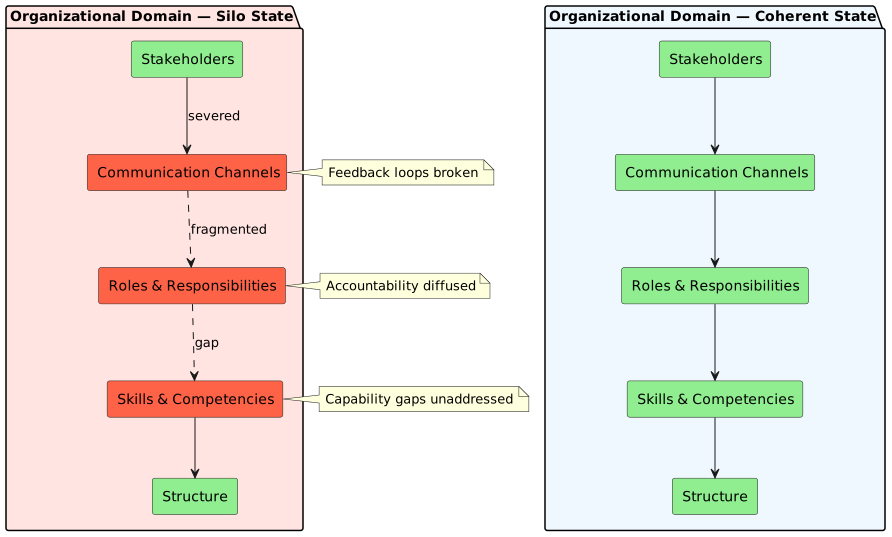
Silos are not an accident. They are a structural outcome — the predictable result of an Organizational Domain whose layers have fallen out of coherence. Understanding how silos form requires moving beyond the conventional narrative of "departmental politics" and examining the specific layer-level failures that produce them [11].
3.1. Communication Channels as Silo Generators
The most common structural origin of silos is a failure in the Communication Channels Layer. When communication pathways are designed around departmental boundaries rather than information flow requirements, they sever the feedback loops that keep the Stakeholders and Culture & Values layers in sync.
The result is not merely that teams "don’t talk to each other." It is that the information required to fulfill roles never reaches the people responsible for fulfilling them. Decisions are made on incomplete data. Accountability becomes impossible to enforce because the evidence required to assess performance is trapped behind communication barriers.
3.2. Roles Without Skills: The Accountability Gap
The second most common source of misalignment is the gap between the Roles & Responsibilities Layer and the Skills & Competencies Layer. Organizations frequently define ambitious transformation roles — Chief Digital Officers, Transformation Leads, Platform Owners — without ensuring that the skills required to fulfill those roles exist in the people assigned to them [8].
This creates accountability gaps that compound over time. The role exists on paper. The responsibility is assigned. But the capability to execute is absent. When the transformation initiative stalls, the structural cause — a skills gap — is invisible to leadership, who see only the accountability failure.
3.3. Structure Without Culture: The Reorganization Trap
The most expensive and least effective transformation intervention is the structural reorganization that ignores the Culture & Values Layer. Organizations that restructure reporting lines, create new cross-functional teams, and redesign governance models — without attending to the cultural norms that the old structure reinforced — find that the new structure is colonized by the old culture within months.
Structure reinforces culture. But culture also resists structure. When a new structure is imposed on an unchanged culture, the culture wins. The new org chart becomes a formality. The old behavioral patterns reassert themselves through informal networks, unwritten rules, and the accumulated weight of institutional habit [10, 9].
3.4. The Compounding Effect of Layer Misalignment
Silos do not form in a single layer. They form when multiple layers fall out of coherence simultaneously, and the misalignment compounds across the cycle. A broken Communication Channels layer fragments role execution. Fragmented role execution exposes skills gaps. Unaddressed skills gaps constrain structural design. Constrained structure reinforces siloed culture. Siloed culture shapes stakeholder disengagement. Disengaged stakeholders produce misaligned personas. And misaligned personas drive communication strategies that deepen the original fragmentation.
Poor alignment between layers — not just between departments — is the root structural cause of transformation friction. Transformation success requires strategies that address misalignment at the layer level, not just at the team or process level [12].
4. Accountability as an Architectural Concern
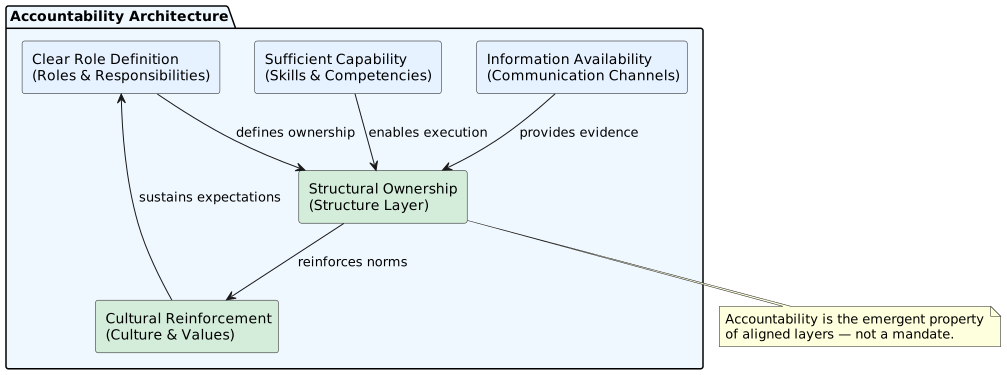
Accountability is not a management practice. It is an architectural property — a structural characteristic of the Organizational Domain that must be deliberately designed, not assumed [7].
In most transformation programs, accountability is treated as a behavioral expectation: leaders are told to "own" their initiatives, teams are asked to "take responsibility" for outcomes, and individuals are held accountable for results that the structure itself made impossible to achieve. This is accountability as performance. It produces blame, not execution.
Architectural accountability is different. It is the deliberate design of the Roles & Responsibilities Layer, the Skills & Competencies Layer, and the Communication Channels Layer to create the structural conditions under which ownership is unambiguous, capability is sufficient, and information is available.
4.1. Designing for Accountability
Accountability in organizational structure enhances execution fidelity. When the Roles & Responsibilities Layer is designed with precision — clear ownership, defined scope, explicit decision rights — the organization creates the structural conditions for transformation to be tracked and delivered.
But role clarity alone is insufficient. Defined roles and expectations facilitate smoother transformation processes only when the Skills & Competencies Layer ensures that the people filling those roles have the capability to fulfill them. A role without capability is a liability, not an asset.
The Communication Channels Layer completes the accountability architecture. Accountability requires evidence — the ability to observe whether a role is being fulfilled, to surface problems early, and to course-correct before failures compound. Without reliable information flow, accountability becomes retrospective: we discover failures only after they have propagated through the system.
4.2. Collective and Individual Accountability
Transformational success hinges on both individual and collective accountability mechanisms. Individual accountability ensures that specific decisions and outcomes have named owners. Collective accountability ensures that the system as a whole — the full cycle of seven layers — is maintained in coherent alignment.
The architect’s role in accountability design is to ensure that neither form of accountability is sacrificed for the other. Organizations that over-index on individual accountability produce cultures of blame and risk-aversion. Organizations that over-index on collective accountability produce diffuse ownership and execution paralysis. The Organizational Domain provides the structural model for balancing both: individual accountability is designed into the Roles & Responsibilities Layer; collective accountability is designed into the Structure and Culture & Values layers.
5. FORGE Approaches to Organizational Alignment
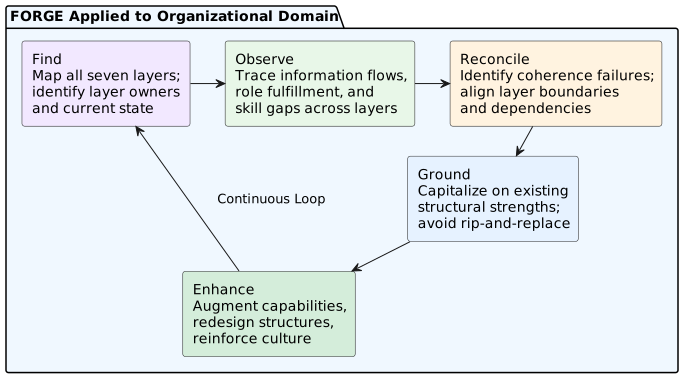
The FORGE methodology — Find, Observe, Reconcile, Ground, Enhance — provides the practitioner with a repeatable engagement loop for diagnosing and restoring coherence across the Organizational Domain layers [13]. Where the previous sections have established what the layers are and how they fail, FORGE provides the how of intervention.
5.1. Find: Mapping the Organizational Domain
The first stage of FORGE applied to the Organizational Domain is to map all seven layers in their current state. This is not an org chart exercise. It is a structural audit — identifying who the actual stakeholders are (not just the named ones), what personas the organization is actually designing around, how communication actually flows (not how it is supposed to flow), and where roles, skills, structure, and culture are coherent or in conflict.
The FORGE methodology provides actionable insights for architects to design effectively [4]. The Find stage produces the raw material for everything that follows: a clear, evidence-based picture of the Organizational Domain as it actually exists.
5.2. Observe: Tracing Layer Dependencies
The Observe stage moves from mapping to analysis. The architect traces the directional relationships between layers — following the influence of Stakeholders through to Personas, the enablement of Communication Channels through to Roles, the dependency of Roles on Skills — to identify where the flow is interrupted.
This is where the "Hidden Tax" of organizational misalignment becomes visible [6]. The cost of a broken Communication Channels layer is not just poor communication — it is the compounding cost of role execution failures, skills gaps that go unaddressed, structural rigidity that cannot adapt, and cultural drift that erodes mission alignment. The Observe stage makes that cost legible.
5.3. Reconcile: Restoring Layer Coherence
The Reconcile stage is the architect’s primary intervention point. Having mapped the current state and traced the dependency failures, the architect now works to restore coherence across the layers — reconciling the gap between the Roles & Responsibilities Layer and the Skills & Competencies Layer, realigning Communication Channels with actual information flow requirements, and ensuring that structural design choices are consistent with cultural reality.
Successful transformation relies on continuous feedback loops guided by FORGE principles [13]. Reconciliation is not a one-time event. It is a continuous practice of identifying where layers have drifted out of alignment and restoring the coherence that transformation requires.
5.4. Ground: Building on Structural Strengths
The Ground stage ensures that organizational transformation is efficient and realistic. Before redesigning structures, redefining roles, or launching culture change programs, the architect identifies the existing strengths within the Organizational Domain — the communication channels that already work, the roles that are already well-defined, the cultural values that already support the transformation mission.
Integrating FORGE into organizational practices strengthens resilience against unforeseen challenges [3]. Grounding transformation in existing strengths avoids the "Rip and Replace" fallacy — the assumption that the current organization must be dismantled before the new one can be built. In most cases, the existing Organizational Domain contains more structural capital than leadership recognizes.
5.5. Enhance: Augmenting the Organizational Domain
The Enhance stage is where architectural intent becomes operational reality. Having found, observed, reconciled, and grounded the transformation, the architect now augments the Organizational Domain — redesigning the layers that require it, introducing new capabilities where gaps exist, and reinforcing the cultural and structural conditions that will sustain the transformation over time.
The FORGE methodology provides a systematic approach to align organizational design with strategic transformation objectives [4]. Enhancement is not the end of the cycle — it is the beginning of the next Find. Organizational alignment is not a destination; it is a continuous architectural practice.
6. The Sustainable Organization
The Organizational Domain is the human architecture of transformation. Without it, every strategy is an aspiration, every process is a procedure without ownership, and every technology investment is a capability without the people to realize it.
By decomposing the organization into its seven constituent layers — Stakeholders, Personas, Communication Channels, Roles & Responsibilities, Skills & Competencies, Structure, and Culture & Values — and applying the rigors of the FORGE methodology within the GEAR framework, practitioners gain the structural tools to diagnose misalignment, design accountability, and build organizations that can sustain transformation over time.
6.1. Final Takeaways for the Practitioner
-
Organizations behave as they are structured. The seven layers of the Organizational Domain make that structure legible and actionable. Start there.
-
Silos are a structural symptom, not a cultural failure. Trace the layer coherence failures — broken communication channels, roles without skills, structures that reinforce the wrong culture — and address them at the layer level.
-
Accountability must be designed, not mandated. Build it into the Roles & Responsibilities, Skills & Competencies, and Communication Channels layers before expecting it to appear in behavior.
-
FORGE is the engagement loop. Use Find, Observe, Reconcile, Ground, and Enhance as a continuous practice — not a one-time project — to maintain coherence across the Organizational Domain.
-
The cycle is the point. Culture shapes stakeholders, who define personas, who drive communication, who enable roles, who require skills, who determine structure, which reinforces culture. Every intervention in one layer propagates through all the others. Design accordingly.
6.2. Looking Forward: The Process Domain
The Organizational Domain establishes who the organization is — its people, its structures, its culture, and its accountability architecture. The next paper in this series turns to how the organization works: The Process Domain: Designing for Flow and Execution will examine how the O-DXA Process Domain translates organizational intent into operational reality, and how FORGE applies to the design and governance of the processes that connect people to outcomes.
The journey from aspiration to execution runs through people first. It always has.
References
[1] P. Forth, P. Romano, and others, “Flipping the Odds of Digital Transformation Success,” McKinsey & Company, 2022, [Online]. Available: https://www.mckinsey.com/capabilities/bcg-x/our-insights/flipping-the-odds-of-digital-transformation-success.
[2] K. Ahlbäck, C. Fahrbach, M. Murarka, and O. Salo, “How to Rewire a Company,” McKinsey Quarterly, 2023, [Online]. Available: https://www.mckinsey.com/capabilities/people-and-organizational-performance/our-insights/how-to-rewire-a-company.
[3] D. W. Pulsipher, “Governing Enterprise Architecture Realization (GEAR): Logical and Physical Representation,” Intel Corporation, 2023. [Online]. Available: https://cdrdv2-public.intel.com/790385/GEAR%20Logical%20and%20Physicalv2.pdf.
[4] Embracing Digital Transformation, “Digital Transformation: The O-DXA Framework.” 2024, [Online]. Available: https://embracingdigital.org/en/digital-transformation/index.html.
[5] J. Pruitt and J. Grudin, “Personas: Practice and Theory,” Proceedings of the 2003 Conference on Designing for User Experiences, 2003, [Online]. Available: https://dl.acm.org/doi/10.1145/997078.997089.
[6] Baker Tilly, “The Hidden Tax of Organizational Misalignment,” Baker Tilly US, LLP, 2024. [Online]. Available: https://www.bakertilly.com/insights/the-hidden-tax-of-organizational-misalignment.
[7] Deloitte Insights, “Organizational Accountability in the Age of Digital Transformation,” Deloitte Insights, 2023, [Online]. Available: https://www2.deloitte.com/us/en/insights/topics/talent.html.
[8] PwC, “Global Workforce Hopes and Fears Survey 2023,” PricewaterhouseCoopers, 2023. [Online]. Available: https://www.pwc.com/gx/en/issues/workforce/hopes-and-fears.html.
[11] P. Lencioni, Silos, Politics and Turf Wars: A Leadership Fable About Destroying the Barriers That Turn Colleagues Into Competitors. Jossey-Bass, 2006.
[12] Gartner, “Change Management and the Future of Work,” Gartner Research, 2024. [Online]. Available: https://www.gartner.com/en/human-resources/topics/change-management.
[13] D. W. Pulsipher, A. Scott, D. Richard, and R. Lisa, “GEAR: Process Architecture,” Intel Corporation, 2024. [Online]. Available: https://cdrdv2-public.intel.com/828453/GEAR%20Process%20Highlevel.pdf.