
The Strategy Domain: Translating Mission into Architectural Intent
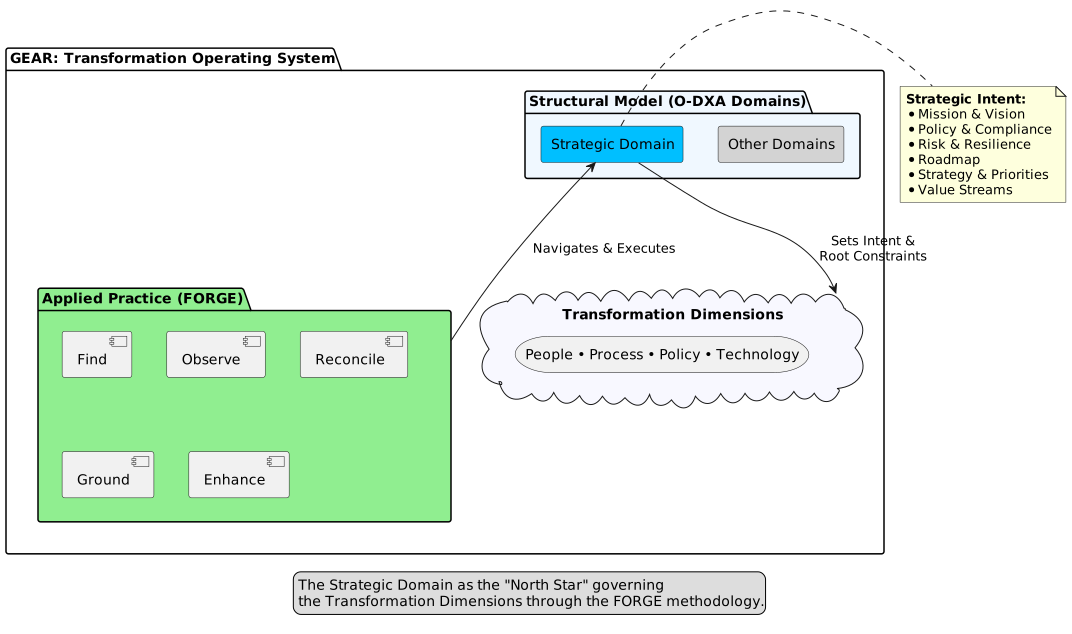
Digital transformation is frequently treated as a series of technological implementations or a collection of disconnected "vision" statements. However, real-world failure analysis reveals that transformation succeeds only when treated as a systems architecture problem. Within the Open Digital Transformation Architecture (O-DXA) framework, the Strategic Domain serves as the critical bridge between leadership aspirations and executable outcomes. This whitepaper establishes the Strategic Domain as the governing layer for translating a mission into architectural intent by shifting the perspective of strategy from high-level plans to a set of architectural directions and constraints. By applying the FORGE (Find, Observe, Reconcile, Ground, Enhance) methodology within the GEAR: Transformation Operating System (TOS), organizations can navigate the Transformation Dimensions (people, process, policy, and technology) to realize sustainable change.
1. Introduction: The Disconnect
The primary question facing modern enterprises is not what to change, but why their strategic changes fail to manifest in operation. Why does strategy fail to translate into execution?
The answer lies in the missing link of architectural intent. Most organizational strategies are composed of aspirations: "We want to be AI-first," or "We must modernize our constituent engagement." While these are valid goals, they lack the structural constraints and dependencies required for execution. Without architectural intent, strategy becomes disconnected aspiration.
In this whitepaper, we move beyond "Strategy as vision" and toward "Strategy as architecture." We will demonstrate how the O-DXA Strategic Domain—as part of the GEAR: Transformation Operating System (TOS)—provides the necessary guardrails and structural definitions to ensure that every investment, every capability, and every line of code aligns with the organization’s core mission on the Transformation Dimensions.
2. The Strategic Domain: Scope and Governance
The Strategic Domain focuses on aligning an organization’s direction, priorities, capabilities, and risk posture with its core mission and vision. It is the layer of the Transformation Operating System that governs how leadership aspirations, community needs, and long-term goals are translated into actionable strategies.
Within the O-DXA metamodel, the Strategic Domain is not a monolith but a collection of interconnected layers that ensure the enterprise is purpose-driven and outcome-focused.
2.1. What the Strategic Domain Really Governs
The Strategic Domain is the "Mission Control" of the GEAR Navigation Dashboard. It provides the map layers that guide the journey from aspiration to infrastructure.
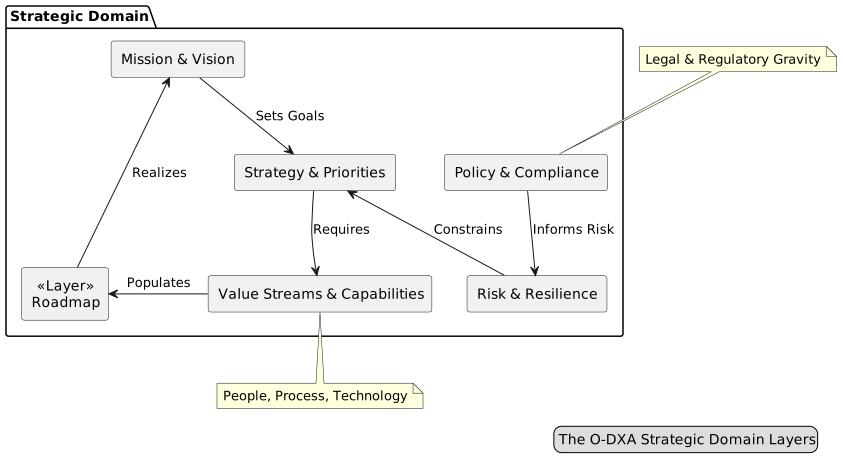
The Strategic Domain governs the "Why" and the "What" of the transformation before the "How" is ever determined. It encompasses six primary layers:
-
Mission & Vision Layer: Defines the aspirational long-term goals and core purpose.
-
Policy & Compliance Layer: Establishes the legal, regulatory, and policy frameworks that guide operations.
-
Risk & Resilience Layer: Addresses the ability to anticipate and recover from risks while maintaining continuity.
-
Roadmap Layer: Defines the sequence of milestones and dependencies supporting the achievement of objectives.
-
Strategy & Priorities Layer: Identifies medium to long-term outcomes and key focus areas.
-
Value Streams & Capabilities Layer: Outlines the value flows and enabling capabilities necessary to deliver the mission.
2.2. The Stakeholder Ecosystem
Strategic architecture is not created in a vacuum. It is shaped by a diverse ecosystem of stakeholders navigating the Transformation Dimensions: * Organizational leadership and executives: Setting the direction and mission. * Policy makers and legislators: Defining the regulatory constraints and legal bedrock. * Community members and constituents: Defining the relevance and desired outcomes. * Employees and internal teams: The practitioners who execute the intent on the ground.
By governing these layers and stakeholders, the Strategic Domain ensures that digital transformation is treated as a coherent system rather than a fragmented set of projects [1].
3. The Anatomy of Strategic Failure
Digital transformation projects do not typically fail because of poor coding or inadequate servers; they fail long before the first line of code is written. In the context of O-DXA, strategic failure is often a failure of translation [2].
3.1. How Strategy Fails Before Execution Begins
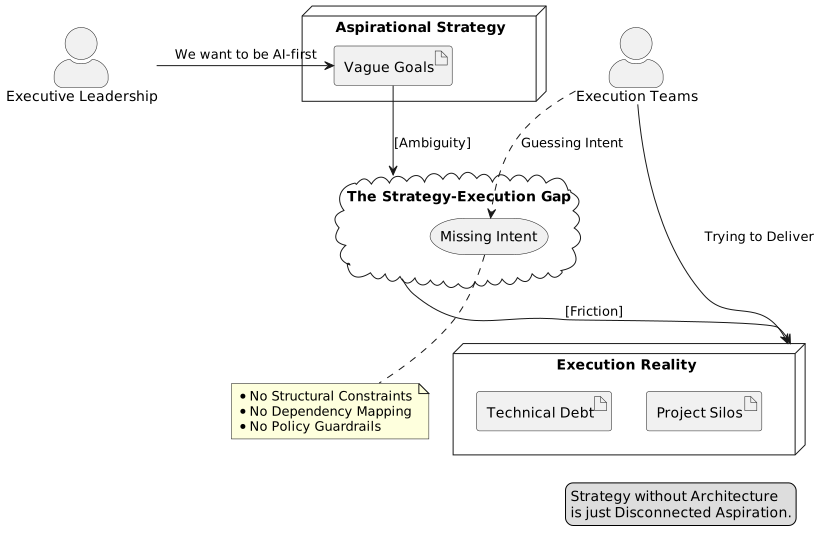
Strategic failure manifests in several distinct patterns that architects must learn to recognize:
-
The Aspiration-Execution Gap: Leadership provides high-level goals (e.g., "enhance agility") without defining the architectural constraints or required capability shifts. This leaves execution teams to "guess" the intended architecture [3].
-
Disconnected Vision: The mission statement exists in a vacuum, unlinked to the actual value streams or capabilities of the organization [4].
-
Ghost Roadmaps: Timelines and milestones that are not underpinned by technical dependencies or risk assessments [5]. These roadmaps are "ghosts" because they look solid but lack substance.
-
Policy Blindness: Strategies that ignore the regulatory and compliance "gravity" of the organization, leading to late-stage realization that the strategy is legally or operationally unworkable [6].
Without a structured domain to govern these elements, strategy remains a set of disconnected aspirations, doomed to friction and eventual abandonment.
4. Architectural Intent: The Missing Link
If strategy is the "What" and execution is the "How," then Architectural Intent is the "Why" expressed as a set of structural decisions. It is the missing link that ensures the mission is translated into something executable.
4.1. Shifting from Plans to Constraints
The traditional view of strategy is a plan—a sequence of actions. GEAR shifts this to Architectural Intent, which is a set of directions and constraints. In our GPS metaphor, this is the difference between a static paper map and an active routing engine that accounts for real-time terrain.
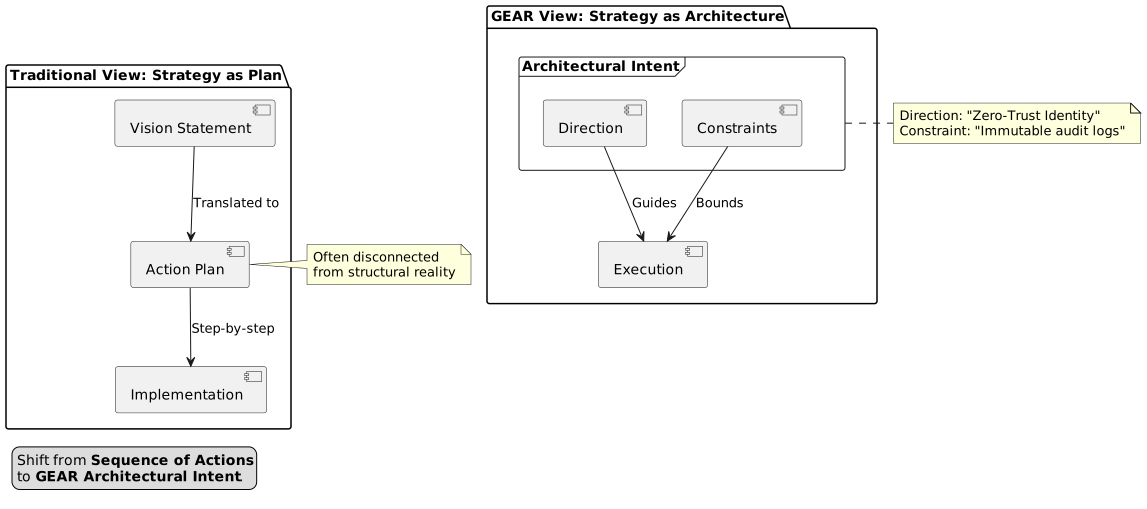
The traditional view of strategy is a plan—a sequence of actions. GEAR shifts this to Architectural Intent, which is a set of directions and constraints.
-
From "Vision Statements": Vague goals that everyone agrees with but no one knows how to build.
-
To "Architectural Direction": Specific, non-negotiable structural requirements that must be met to achieve the mission.
For example, a vision statement might say, "We will protect constituent data." Within the GEAR Transformation Operating System, the architectural intent defines the Policy and Cybersecurity Pillar constraints on the Transformation Dimensions: "All constituent data must be managed through a centralized, zero-trust identity plane with immutable audit logs" [6].
4.2. Strategy as Architectural Direction
By treating strategy as architectural direction within the TOS, the organization gains: * Coherence: Every project is measured against the same strategic intent [1]. * Agility: Because the constraints are clear, teams can innovate within those boundaries without constant re-alignment with leadership [7]. * Sustainability: Intent survives changes in individual leadership because it is baked into the organization’s architecture [3].
In the following sections, we will use the O-DXA Strategic Domain layers to show how this intent is practically structured using the GEAR components.
5. Layered Analysis: From Mission to Value
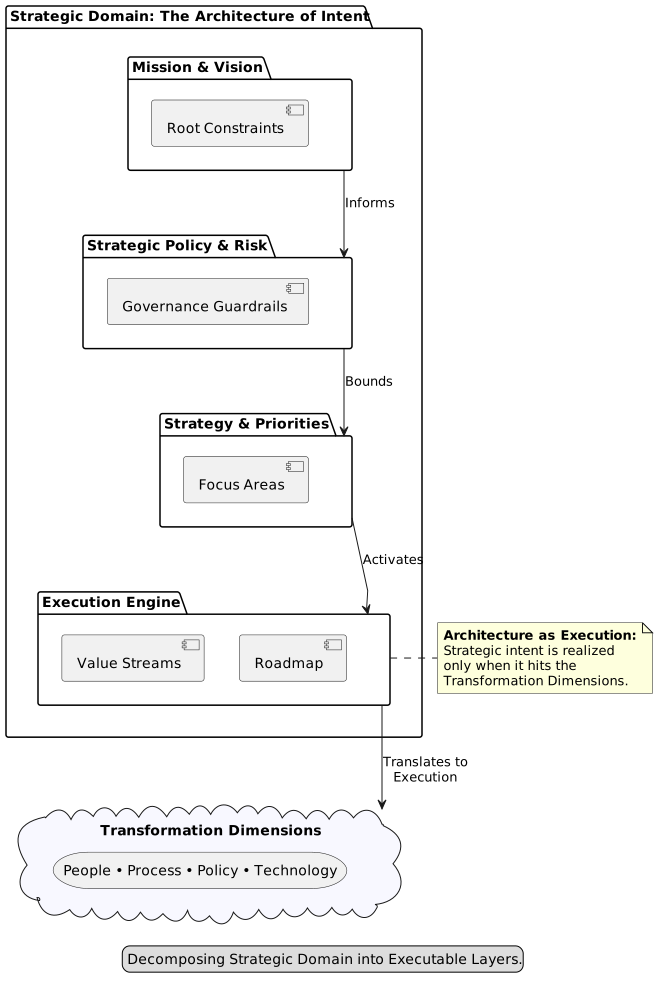
To translate a mission into architectural intent using the TOS, we must decompose the Strategic Domain into its constituent layers. This decomposition ensures that every aspect of the organization—from its legal mandate to its daily value flows—is architecturally aligned on the Transformation Dimensions.
5.1. Mission & Vision: The Foundation of Intent
The Mission & Vision Layer defines the organization’s aspirational long-term goals and core purpose. In GEAR, this is not a static document but a dynamic alignment of several components within the People and Policy dimensions:
-
Legislative Authority: The legal mandate and authority guiding the organization. This provides the "gravity" and boundaries of what is possible.
-
Community and Constituent Input: Ensuring that the mission remains relevant and responsive to the people it serves.
-
Leadership Aspirations: Capturing the transformational ambitions of the executive team.
-
Narrative of Action: Explaining how the mission adapts over time to societal and technological shifts.
Architectural Shift: Instead of treating the mission as a marketing statement, architects must treat it as the Root Constraint. Every subsequent layer must be a realization of this root constraint.
5.2. Strategy & Priorities: Defining the Focus
The Strategy & Priorities Layer identifies the medium to long-term outcomes required to achieve the mission. It is here that broad aspirations are narrowed into specific focus areas.
-
Strategic Objectives: High-level goals that provide direction for the next 3-5 years.
-
Organizational Priorities: Determining which objectives take precedence during resource allocation.
Architectural Shift: Strategy is not a "to-do list"; it is a set of Priority Decisions. If a project does not directly support a Strategic Objective, it lacks architectural intent and should be reassessed.
5.3. Value Streams & Capabilities: The Engine of Delivery
Finally, the Value Streams & Capabilities Layer outlines the value flows and enabling capabilities necessary to deliver on the strategy. This is where the Process and Technology dimensions become critical.
-
Value Streams: The end-to-end collection of activities that create value for the constituent (e.g., "From Application to Benefit Delivery").
-
Capabilities: The specific organizational abilities (People, Process, Technology) required to execute the value stream.
Architectural Shift: We shift from "Technology-first" (buying a tool) to "Capability-first" (defining the required ability to support the strategy).
5.4. Roadmap Layer: The Sequence of Transformation
While many organizations treat a roadmap as a simple timeline of project launches, the Roadmap Layer in GEAR is a structured visualization of the sequence of milestones, dependencies, and timelines required to realize the strategic objectives.
-
Transformation Milestones: Significant markers of progress that represent the realization of a specific capability or policy shift.
-
Dependency Mapping: Identifying the critical path between policy changes, risk mitigations, and technical implementations.
-
Timeline Alignment: Ensuring that the speed of execution matches the organization’s capacity for change and the urgency of the mission.
Architectural Shift: A roadmap is not a schedule; it is a Dependency Graph. Instead of asking "When will it be done?", architects use the Roadmap Layer to ask "What must be true before this can be realized?" This shift prevents the common failure of launching technology before the governing policy or necessary capability is in place.
6. Guardrails: Policy, Risk, and Compliance
Even the most inspired strategy will fail if it runs afoul of regulatory requirements or is crippled by unmanaged risks. In GEAR, the Policy and Risk layers provide the necessary guardrails for transformation.
6.1. Policy & Compliance: The Architecture of Rules
The Policy & Compliance Layer establishes the legal and regulatory frameworks that guide operations. In a digital transformation context, this often involves: * Data Governance Policies: Defining how data is shared and protected (aligned with the Data Management Perspective). * Security Policies: Establishing the zero-trust mandates (aligned with the Cybersecurity Perspective).
Architectural Shift: Policy is not a hurdle; it is a Design Constraint. By integrating policy into the architecture early, we ensure that compliance is "built-in" rather than "bolted-on."
6.2. Risk & Resilience: Building for Continuity
The Risk & Resilience Layer addresses the organization’s ability to anticipate, mitigate, and recover from disruptions. Strategic intent must include a "Resilience Budget"—the recognition that transformation introduces new risks that must be architected for from the start, particularly in the realm of the Artificial Intelligence Perspective [8, 9].
Architectural Shift: Resilience is not an insurance policy; it is a System Property. We move from reactive risk management to proactive architectural resilience, ensuring the mission survives even in the face of significant disruption [10].
By integrating these guardrails into the Strategic Domain, we ensure that the architectural intent is not only executable but sustainable and compliant.
7. GEAR: The Transformation Operating System in Practice
The most common barrier to sustainable transformation is the communication gap between the enterprise architect and the executive leadership team. While leadership speaks in terms of mission and risk, architects often speak in terms of stacks and protocols. The GEAR Transformation Operating System (The Four Aspects: Structural Domains, Applied Practice, Execution Pillars, and Transformation Dimensions) provides the cohesive bridge for engaging executive strategy across all five O-DXA domains (Strategy, Business, Data, Application, and Technology).
7.1. Practical Methods for Strategic Engagement: The FORGE Model
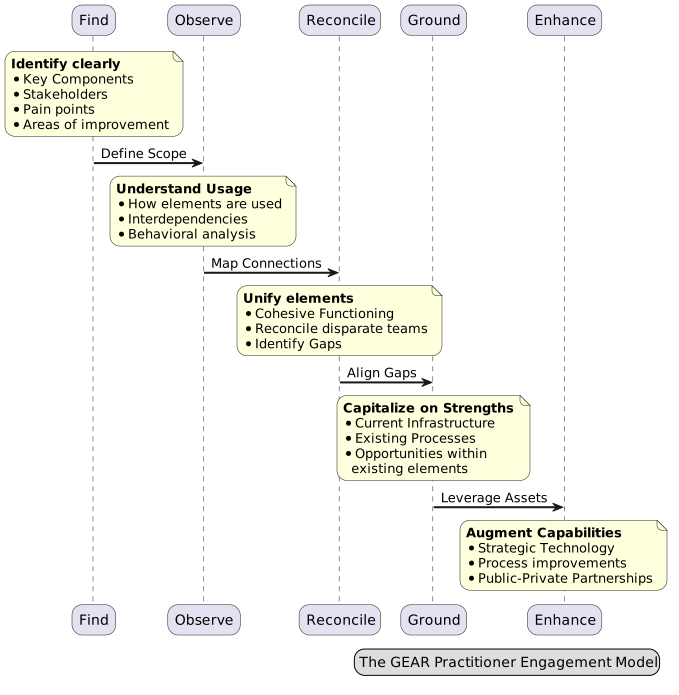
The GEAR Strategic Engagement follows a five-stage model designed to move from discovery to enhanced capability. This model—Find, Observe, Reconcile, Ground, and Enhance (FORGE)—is a universal approach that ensures coherence across every domain of the transformation. It is driven by the architect, who serves as the "explosion" point where strategic intent is detonated into technical and operational reality.
7.2. Applying FORGE to the Strategic Domain
While FORGE is a universal practice across GEAR, its application within the Strategic Domain is unique because it deals with the "Root Constraints" of the enterprise. Here is how an architect applies FORGE to translate a mission into executable intent:
7.2.1. 1. Find: Mapping the Strategic Landscape
The architect begins by clearly identifying the Mission Statement, Legislative Authority, and Leadership Aspirations. In the Strategic Domain, "Find" isn’t just about assets; it’s about identifying the Stakeholders (citizens, legislators, executives) and their often-conflicting Pain Points. * Key Output: A clear inventory of the "Why" and the specific areas where the current strategy is failing to deliver value.
7.2.2. 2. Observe: Understanding Strategic Interdependencies
In this stage, the architect observes how the different layers of the Strategic Domain interact within the Transformation Dimensions. How does Policy influence Risk? How do Value Streams currently realize (or fail to realize) Strategic Objectives? We analyze behavioral patterns—how the organization actually makes priority decisions versus how it says it makes them. * Key Output: A dependency graph showing how mission-level constraints flow down into operational realities.
7.2.3. 3. Reconcile: Closing the Strategy-Execution Gap
The architect identifies where the Roadmap is disconnected from Policy or where Capabilities are missing to support a Strategic Priority. This is where we "Unify" disparate elements—for example, reconciling the Cybersecurity Pillar’s requirements with the Mission’s need for open data access. * Key Output: A set of reconciled architectural directions and constraints that eliminate "Aspiration Silos."
7.2.4. 4. Ground: Rooting Strategy in Reality
Before jumping to new technology, the architect "Grounds" the strategy by capitalizing on Current Infrastructure and Existing Processes. We look for "Strengths within existing elements"—perhaps an existing Data Management capability that can be repurposed to support a new AI-first strategy. * Key Output: A transformation plan that is efficient and realistic, avoiding the "Rip and Replace" fallacy.
7.2.5. 5. Enhance: The Architect’s Explosion
This is the final stage where the mission is "Enhanced" through strategic technology, process improvements, and Private-Public Partnerships. The architect takes the reconciled directions and explodes them into the Value Streams & Capabilities Layer. This is where "Digital Transformation" becomes tangible. * Key Output: Augmented organizational capabilities that are architecturally aligned, sustainable, and purpose-driven.
To move from "Strategy as Vision" to "Strategy as Execution," architects apply the FORGE method across the entire GEAR framework:
-
Find: Clearly map the key components and stakeholders involved in the transformation. The architect finds the "Pain Points" and areas of improvement that the mission aims to address.
-
Observe: Understand how the existing elements are used and, crucially, the interdependencies between them. This is where the architect builds the mental and digital model of the current state.
-
Reconcile: Unify disparate elements and teams for cohesive functioning. The architect’s role here is to reconcile silos and identify the "Architectural Gaps" that prevent unified operations [4].
-
Ground: Capitalize on current infrastructure and organizational processes. By grounding the transformation in existing strengths and opportunities within existing elements, the architect ensures efficiency [3].
-
Enhance: Augment capabilities with strategic technology, process improvements, and external Private-Public Partnerships. This is the "explosion" of the architectural role where strategic intent is realized through technical and operational enhancement [5].
7.3. The Architect’s Explosion: From Intent to Infrastructure
The "Architect" phase of traditional engagement is not just a step; in the GEAR model, it is the process of taking the Observe and Reconcile data and exploding it into the Ground and Enhance actions [5]. The architect is the catalyst who ensures that "Enhanced Capabilities" are not just new tools, but structural improvements that align perfectly with the Mission & Vision layer.
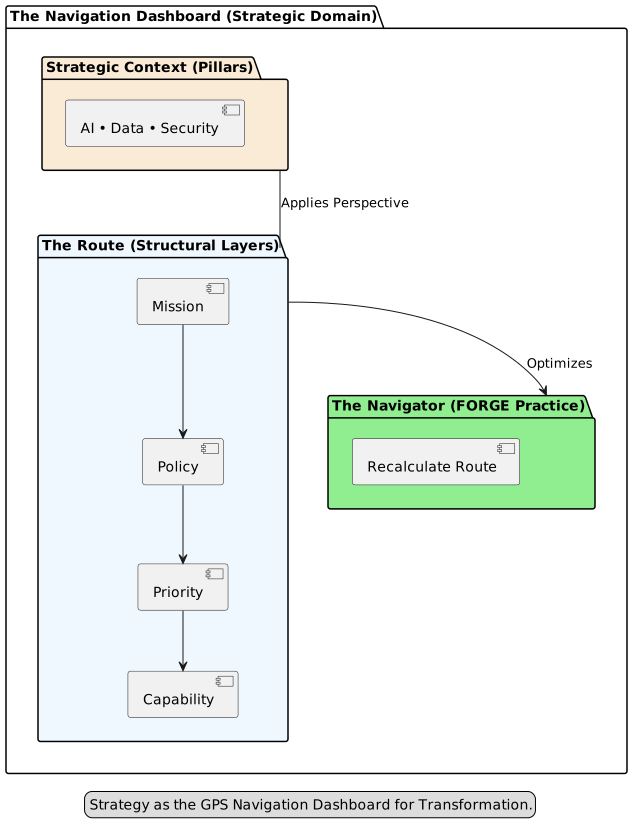
Sustainability in transformation is achieved when the strategy is not a "one-off" event but a continuous architectural practice [3]. By engaging the C-suite through the GEAR framework, architects become strategic partners, ensuring that the organization’s "North Star" is always reflected in its operational reality across Strategy, Business, Data, Application, and Technology domains.
8. The Sustainable Transformation
The Strategic Domain is the heartbeat of digital transformation. Without it, the organization is merely a collection of projects searching for a purpose. By decomposing the mission into its constituent architectural layers and applying the rigors of the GEAR framework, we transform vague aspirations into executable intent [1].
8.1. Final Takeaways for the Practitioner
-
Strategy is not a plan; it is a set of constraints. Focus on defining what must be true to achieve the mission.
-
Architecture is the bridge. Use the GEAR framework—O-DXA Domains, Six Pillars, and Four Dimensions—to ensure that every executive decision has a structural home.
-
Engagement requires a cohesive method. Use the FORGE (Find, Observe, Reconcile, Ground, Enhance) model to facilitate continuous alignment across all domains and dimensions.
By adopting an architecture-first approach to strategy within the GEAR framework, leaders and architects can ensure that their digital transformation is not only successful today but sustainable for the future.
References
[1] Embracing Digital Transformation, “Digital Transformation: The O-DXA Framework.” 2024, [Online]. Available: https://embracingdigital.org/en/digital-transformation/index.html.
[2] P. Forth, P. Romano, and others, “Flipping the Odds of Digital Transformation Success,” McKinsey & Company, 2022, [Online]. Available: https://www.mckinsey.com/capabilities/bcg-x/our-insights/flipping-the-odds-of-digital-transformation-success.
[3] J. W. Ross, P. Weill, and D. Robertson, Enterprise Architecture as Strategy: Creating a Foundation for Business Execution. Harvard Business Review Press, 2006.
[4] D. W. Pulsipher, “Governing Enterprise Architecture Realization (GEAR): Logical and Physical Representation,” Intel Corporation, 2023. [Online]. Available: https://cdrdv2-public.intel.com/790385/GEAR%20Logical%20and%20Physicalv2.pdf.
[5] D. W. Pulsipher, A. Scott, D. Richard, and R. Lisa, “GEAR: Process Architecture,” Intel Corporation, 2024. [Online]. Available: https://cdrdv2-public.intel.com/828453/GEAR%20Process%20Highlevel.pdf.
[6] D. W. Pulsipher and A. Scott, “Security Aspect of Governing Enterprise Architecture Realization (GEAR) Logical View,” Intel Corporation, 2024. [Online]. Available: https://cdrdv2-public.intel.com/854309/GEAR%20Security%20Aspect%20White%20Paper.pdf.
[8] C. R. Institute, “Harnessing the Value of Generative AI: 2nd edition,” Capgemini, 2024. [Online]. Available: https://www.capgemini.com/insights/research-library/generative-ai-in-organizations-2024/.
[9] G. Lanthier and others, “The Front-runners’ Guide to Scaling AI,” Accenture Strategy, 2023, [Online]. Available: https://www.accenture.com/us-en/insights/data-ai/front-runners-guide-scaling-ai.
[10] D. W. Pulsipher, “Digital Twins Help Connect the Digital and Real Worlds,” Intel Corporation, 2023. [Online]. Available: https://www.intel.com/content/www/us/en/developer/tools/scenescape/overview.html.