
Why Digital Twin Initiatives Fail
- 1. Executive Summary
- 2. The Persistent Illusion of the Digital Twin
- 3. The Technology-First Trap
- 4. Digital Twin Through the GEAR Framework
- 5. Case Insight: Reframing a Municipal Digital Twin
- 6. Data Management as the Structural Foundation
- 7. Why Digital Twins Stall
- 8. Reframing Digital Twin as Executable Architecture
- 9. Take Aways
Digital twin initiatives frequently fail not because the technology is immature, but because organizations lead with visualization platforms instead of enterprise architecture. A true digital twin is an operational capability that integrates strategic intent, organizational authority, end-to-end processes, digital systems, physical assets, and a governed, multi-source data supply chain. This paper demonstrates why technology-first approaches stall and how architecture-first execution—through the GEAR framework and FORGE methodology—produces measurable, sustainable value.
1. Executive Summary
Across industries—particularly in large municipalities and infrastructure-heavy enterprises—digital twin initiatives often begin with remarkable demonstrations. Executives are shown immersive 3D environments, real-time telemetry overlays, predictive simulations, and highly polished user interfaces. The experience is compelling. The promise is transformative.
Yet after the initial excitement fades, many of these initiatives stall.
The platform exists. The visualization works. The data feeds appear live. But operational decisions remain unchanged. Processes continue as before. Governance confusion emerges. Funding becomes difficult to justify.
The failure is rarely technical.
It is architectural.
A digital twin is not a rendering engine. It is not a dashboard. It is not a simulation sandbox. It is an operationally integrated architectural capability that connects strategic objectives to physical assets through governed data and executable processes.
When organizations lead with technology instead of enterprise architecture, they build impressive overlays without operational integration. The result is predictable: visual sophistication without institutional transformation.
This paper reframes digital twin as an enterprise architecture discipline grounded in the GEAR framework—Strategy, Organization, Process, Digital, and Physical domains—and operationalized through the FORGE methodology. It argues that data management is not a supporting capability of digital twin; it is its foundation.
2. The Persistent Illusion of the Digital Twin
The modern digital twin narrative has been heavily influenced by advances in visualization and simulation technology. High-performance rendering platforms and immersive interfaces have made it possible to replicate entire cities, facilities, or systems in extraordinary detail. These capabilities create a powerful illusion of operational maturity.
But visualization fidelity does not equal architectural integration.
A model of a city, however detailed, does not automatically integrate with permitting workflows. A live traffic overlay does not alter signal optimization authority. A flood simulation does not change emergency response coordination unless it is embedded into decision rights and operational processes.
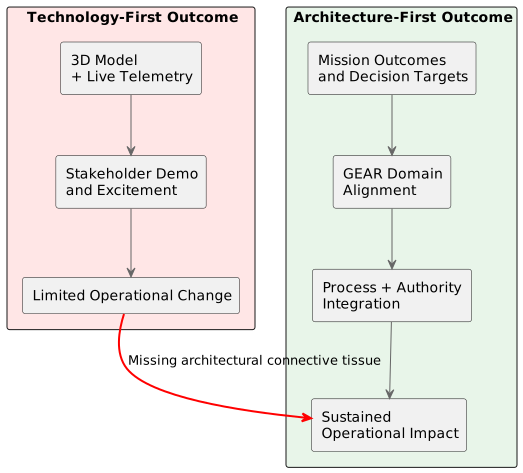
What frequently exists after a technology-first deployment is a representational layer—an impressive digital mirror of the physical world—without the connective tissue that allows it to influence action.
A true digital twin is not defined by how accurately it renders reality. It is defined by whether it changes how decisions are made.
3. The Technology-First Trap
Technology-first strategies are seductive for understandable reasons. They offer visible progress. They align with funding structures. They generate public excitement. Vendors present mature, polished solutions that appear ready for immediate deployment.
In many cases, organizations begin their digital twin journey in the Digital domain of the enterprise, assuming that technology integration alone will drive transformation. However, this approach creates architectural imbalance. Without reconciling strategic objectives, organizational authority, process orchestration, and physical asset constraints, digital twin efforts remain detached from operational reality.
The result is a recurring pattern: the platform exists, but no single department owns it. Data feeds operate, but their provenance is unclear. Dashboards display insights, but decision rights remain ambiguous. Over time, enthusiasm wanes and the twin becomes a static showcase rather than a living system.
This pattern is not unique to a specific vendor or industry. It is the natural outcome of bypassing enterprise architecture.
4. Digital Twin Through the GEAR Framework
A sustainable digital twin must integrate across all enterprise domains.
At the Strategic level, clarity is required regarding purpose. What mission outcome is being improved? Which decisions are expected to change? Without strategic alignment, the twin becomes an experiment rather than an operational capability.
Within the Organizational domain, authority and governance must be defined. Who owns the twin? Who acts on its insights? How are conflicts resolved across departments? A twin that produces insight without authority produces frustration.
In the Process domain, the focus shifts to workflow integration. Which operational processes are being enhanced? How does information flow differently because the twin exists? If processes do not change, value does not materialize.
The Digital domain includes systems of record, APIs, data integration patterns, and application architecture. Here, the twin must orchestrate—not replace—existing systems. It becomes a coordination layer rather than a monolithic system.
Finally, the Physical domain anchors the twin in operational reality. Assets, sensors, environmental conditions, and constraints must be represented accurately and meaningfully.
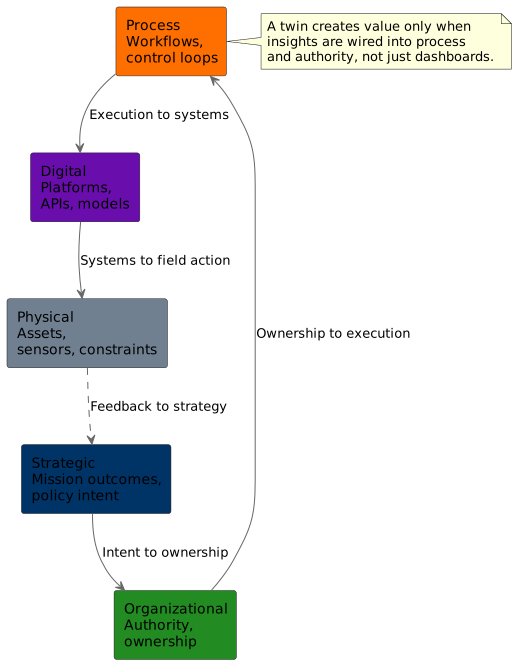
Only when these domains are architecturally aligned does a digital twin move from demonstration to execution.
5. Case Insight: Reframing a Municipal Digital Twin
In a recent municipal engagement, a city had previously invested in a high-visibility digital twin initiative centered on advanced visualization technology. The intended use cases were legitimate and high value: traffic management, flood response, and building development planning.
However, after deployment, the initiative struggled to produce measurable operational impact.
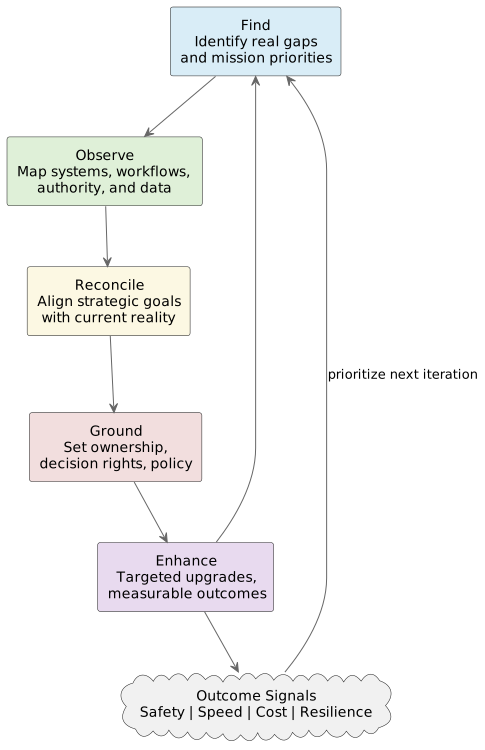
Through the FORGE methodology—Find, Observe, Reconcile, Ground, Enhance—the architectural landscape was reassessed. Existing digital systems were mapped. Operational workflows were analyzed. Decision authority was clarified. Data sources were evaluated for quality and ownership.
The findings were instructive. In many cases, the systems required to support the target use cases already existed. Traffic systems, GIS platforms, permitting databases, and emergency management tools were operational. The gap was not the absence of technology; it was the absence of architectural alignment.
By reframing the initiative through enterprise architecture rather than visualization capability, the organization discovered that targeted enhancements—rather than wholesale reinvention—were sufficient to achieve mission outcomes.
The failure had not been technological immaturity. It had been architectural framing.
6. Data Management as the Structural Foundation
Digital twin initiatives ultimately rise or fall on data architecture.
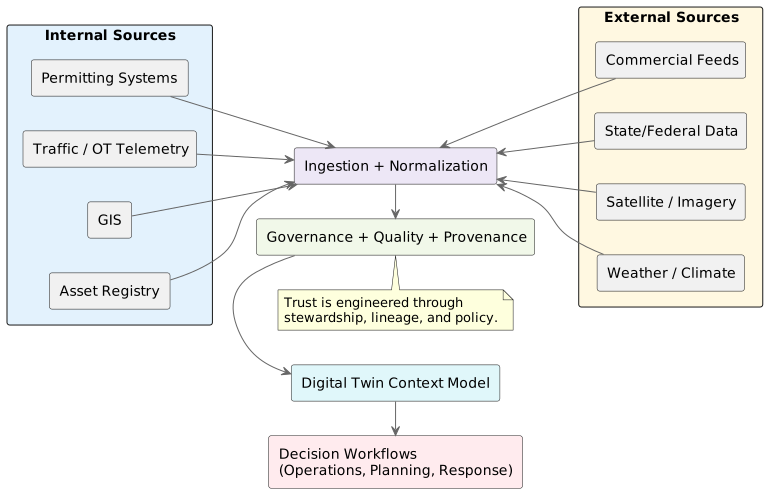
A digital twin is a continuous synchronization mechanism between physical reality and digital representation. That synchronization depends on trusted, authoritative, governed data streams.
Critical questions must be answered before platform selection:
Where does the data originate? Who owns it? How frequently is it updated? What is the acceptable latency? How is quality validated? How are conflicting sources reconciled?
Many initiatives focus exclusively on internally owned data—asset inventories, GIS records, traffic telemetry, or permitting databases. However, meaningful operational insight often depends on augmented external data: weather feeds, satellite imagery, state or federal datasets, commercial mobility analytics, or private-sector IoT streams.
Incorporating external data introduces complexity: licensing constraints, cybersecurity exposure, trust boundaries, and governance challenges. Without a coherent data supply chain architecture, the twin becomes a fragile aggregation of feeds rather than a resilient decision-support system.
Data management is not a secondary pillar of digital twin capability. It is the structural foundation that determines fidelity, reliability, and trust.
7. Why Digital Twins Stall
When examined across industries, digital twin initiatives stall for remarkably consistent reasons. Decision authority is undefined. Governance structures are ambiguous. Data stewardship is fragmented. Funding models prioritize pilot visibility over operational sustainability. Sensor deployments outpace process integration.
Beneath each of these symptoms lies a common cause: the absence of an enterprise architecture baseline.
Without a clear architectural map, organizations attempt to construct digital twins on unstable foundations. Over time, complexity accumulates, confidence erodes, and momentum slows.
8. Reframing Digital Twin as Executable Architecture
Digital twin initiatives should not begin with the question, “Which platform should we deploy?”
They should begin with a different set of questions:
What mission outcome are we trying to enhance? Which decisions require improved visibility or predictive insight? What processes must change? What authoritative data already exists? Where are the genuine architectural gaps?
Using the FORGE methodology, organizations can identify what exists, observe how it operates, reconcile aspiration with reality, establish governance, and enhance selectively.
Architecture first. Technology second.
9. Take Aways
A digital twin is not a product. It is not a rendering engine. It is not a dashboard.
It is a governance construct, a process integration model, a data supply chain discipline, and a decision-support capability grounded in enterprise architecture.
When organizations approach digital twin as a technology acquisition exercise, they produce impressive demonstrations with limited institutional impact.
When they approach it as an architectural discipline—aligned across Strategy, Organization, Process, Digital, and Physical domains—they create sustainable, measurable transformation.
Digital twins fail not because organizations lack technology.
They fail because they lack architecture.