
The FORGE Methodology: From Intent to Infrastructure (The GEAR Practice)
Digital transformation often stalls because organizations lack a repeatable, practitioner-led method for moving from high-level models to operational reality. While the Open Digital Transformation Architecture (O-DXA) provides the structural model for the enterprise, the FORGE (Find, Observe, Reconcile, Ground, Enhance) methodology provides the active practice. Together, they form GEAR: The Transformation Operating System (TOS)—a comprehensive framework for bridging the gap between mission intent and infrastructure. GEAR integrates The Four Aspects: the Structural Domains (the horizontal map), the Applied Practice (the FORGE methodology), the Execution Pillars (specialized capability views), and the Transformation Dimensions (the operating terrain). This whitepaper details each stage of the FORGE methodology within the GEAR framework, establishing it as the definitive practice for the digital transformation architect.
1. Introduction: The Practice of Transformation
The primary challenge in digital transformation is not a lack of technology, but a lack of execution discipline. Organizations often mistake the adoption of modern tools—cloud, AI, and agile methods—for transformation itself. As established in the foundational analysis of transformation failure [1, 2], technology modernization efforts that are not accompanied by alignment across the Transformation Dimensions (the operating terrain of people, process, policy, and technology) produce only transient or purely local outcomes.
This is the "Pilot Paradox" [3, 4]: high local innovation success that results in zero systemic impact due to fragmentation. To overcome this, we must shift our fundamental view of the architect’s role. For too long, "Enterprise Architecture" has been relegated to a library of static diagrams and PDF documents—a passive exercise in "Architecture as Documentation."
To deliver sustainable change, we must move toward Architecture as Execution.
In this model, architecture functions as an active governing system. It is not a set of pictures; it is a set of structural decisions that constrain and guide the enterprise toward its mission. This requires a methodology that is as rigorous as the models it serves. This methodology is FORGE.
FORGE is the engine of the GEAR practice. While the Open Digital Transformation Architecture (O-DXA) tells us where the domains of transformation are, and the Execution Pillars provide the specialized capability views, FORGE tells us how to engage them on the Transformation Dimensions (the operating terrain). By systematically applying the stages of Find, Observe, Reconcile, Ground, and Enhance, architects move from being passive observers to becoming the catalysts of organizational evolution.
2. GEAR: The Transformation Operating System
To understand FORGE, one must first understand its place within the broader GEAR (Governing Enterprise Architecture Realization) framework. GEAR exists to solve the "Hidden Tax" of transformation: the cumulative cost of fragmentation manifesting as delay, rework, risk, and operational complexity [5].
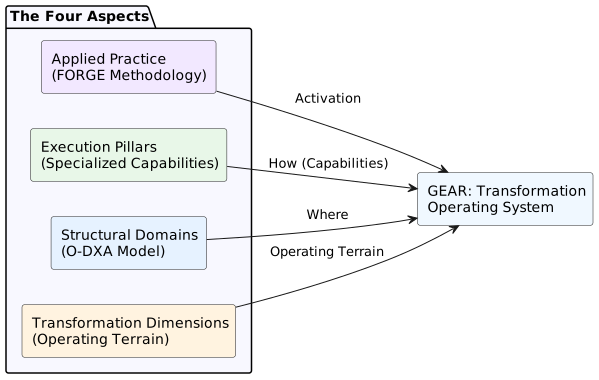
GEAR is more than just a process; it is a Transformation Operating System (TOS)—a multi-dimensional system of execution that integrates The Four Aspects:
-
The Structural Domains (The O-DXA Model): Five areas of architectural responsibility (Strategy, Organizational, Process, Digital, Physical) that define where coordination must hold.
-
The Execution Pillars (Specialized Capabilities): Cross-cutting technical views (AI, Data Management, Cybersecurity, Edge, Advanced Comms, Ubiquitous Computing) that provide specialized patterns and shift with market needs.
-
The Transformation Dimensions (The Operating Terrain): The four vectors (People, Process, Policy, Technology) that define the operating environment. Every change must keep this terrain in coherent alignment.
-
The Applied Practice (The FORGE Methodology): The repeatable steps (Find, Observe, Reconcile, Ground, Enhance) that architects use to activate the system across domains and pillars.
2.1. Beyond the Documentation Trap
A significant barrier to transformation is the current perception of Enterprise Architecture (EA). For many organizations, EA has become synonymous with documentation—a massive library of static diagrams and artifacts that capture the "As-Is" state with meticulous detail but fail to provide a clear, executable direction for the future.
Frameworks like TOGAF (The Open Group Architecture Framework) provide an exceptionally expressive language and a robust methodology for capturing how an enterprise functions and how its parts interact [6]. However, in practice, these efforts often stall at the documentation phase. The models are created, the repositories are filled, but the organization continues to operate in silos, disconnected from the architectural intent.
GEAR, O-DXA, and FORGE are not intended to replace these established frameworks. Instead, they augment and sit on top of them. While TOGAF provides the grammar and the encyclopedia of the enterprise, GEAR provides the execution engine that realizes real digital transformation. We use the expressive power of existing frameworks to understand the current state, but we apply the FORGE methodology to drive that state toward a specific, mission-aligned future.
2.2. The GEAR Framework: Model + Practice
GEAR provides the unified framework for this coordination by combining a structural model with an applied practice, designed to integrate seamlessly with existing EA efforts:
-
O-DXA (Open Digital Transformation Architecture): The structural model that defines the five domains (Strategy, Organizational, Process, Digital, Physical) and the Execution Pillars (AI, Data, Security, etc.) [7]. It provides the "common map" required for cross-domain coordination, acting as the high-level steering layer above detailed technical architectures.
-
FORGE (Find, Observe, Reconcile, Ground, Enhance): The practice methodology used to engage and transform those domains. It is the "way of working" that ensures O-DXA models—and the detailed EA artifacts they reference—are translated into operational reality on the Transformation Dimensions.
-
GEAR (Governing Enterprise Architecture Realization): The Transformation Operating System (TOS) that applies O-DXA through the FORGE methodology to solve the unique challenges of enterprise transformation.
At its core, O-DXA is about categorizing and cataloging the elements of your organization across all domains. It gives practitioners a common taxonomy when moving through FORGE, so what is "found" can be consistently named, grouped, and compared. When elements are identified during FORGE, they are categorized by O-DXA domain, ensuring the analysis stays structurally coherent.
Those same domains also reveal gaps. They expose where analysis is incomplete and where the organization itself has real structural voids that must be addressed before transformation can hold.
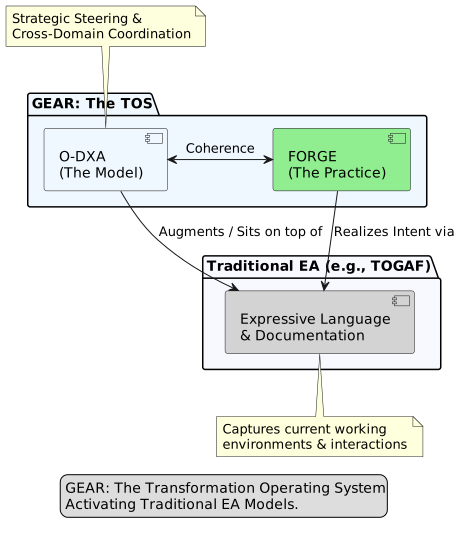
By formalizing this relationship, we ensure that architecture is never a passive exercise [8]. Every model produced in O-DXA is a direct result of a FORGE engagement stage, and every FORGE stage is bounded by the Structural Domain constraints. This prevents the "Strategy-Execution Gap" by ensuring that architectural intent is the primary driver of technical and organizational change.
3. The FORGE Methodology: Stage-by-Stage
The FORGE methodology is designed to be universal—applicable whether you are architecting a new AI capability in the Digital Domain or a new governance structure in the Organizational Domain. Each stage is a critical link in the chain of transformation.
3.1. Find: Mapping the Landscape
The first stage of any engagement is to clearly identify the components, stakeholders, and pain points of the current environment. "Find" is about surfacing the "Known Unknowns" and establishing the baseline of reality.
-
Key Components: Identifying the assets, systems, data, and infrastructures that currently exist.
-
Stakeholders: Mapping the power structures, both formal (org charts) and informal (influencers).
-
Pain Points: Documenting the friction that currently prevents the mission from being achieved.
-
Areas of Improvement: Identifying the immediate opportunities for high-impact change.
The Architect’s Role: To look beyond the surface level and find the "Shadow IT," the informal processes, and the hidden influencers who control the actual flow of work.
Example: Finding the Data Silo In a large enterprise or agency, an architect might "Find" that while the primary mission is to provide constituent benefits, the data required to verify eligibility is spread across three different departments, each using a different legacy system. The "Pain Point" is the 60-day delay in processing applications caused by these disconnected silos.
3.2. Observe: Understanding Interdependencies
Once the components are found, the architect must observe how they interact. This is the stage of behavioral analysis. We are not just looking at what a system is, but how it is used and how it relates to other systems.
-
Usage Patterns: Analyzing how users actually interact with the systems (versus how they were designed to be used).
-
Interdependencies: Mapping the technical and organizational links between elements.
-
Feedback Loops: Identifying how information flows back from the field to influence decision-making.
The Architect’s Role: To build the "Nervous System" map of the enterprise, identifying where silos create friction and where information is lost at the boundaries.
Example: Observing the Ripple Effect Using the previous example, the architect "Observes" that when Department A updates a record, Department B is not notified, leading to a high rate of errors. They map the interdependency between the legacy database and the customer service portal, revealing that a failure in the legacy system immediately triggers a surge in call center volume.
3.3. Reconcile: Closing the Strategy-Execution Gap
Reconciliation is the pivot point of the methodology. It is where the architect identifies the disconnects between strategy and execution, or between disparate technical stacks. As established in the O-DXA Strategy Domain [7], strategy often fails because it is presented as a "vision" without the corresponding architectural directions and constraints.
Reconcile is about closing this gap by unifying the enterprise for cohesive functioning on the Transformation Dimensions.
-
Unify Elements: Bringing disparate teams and systems into alignment through shared structural decisions.
-
Reconcile Teams: Closing the "Vision Gap" [1] and "Accountability Gap" [2] between executive intent and operational reality.
-
Identify Gaps: Pinpointing the missing architectural "connective tissue" that prevents unified operations.
The Architect’s Role: To act as the "Unifier," bringing disparate teams together to agree on a shared set of architectural directions and constraints [9]. The architect shifts the conversation from "plans" to "structural requirements."
Example: Reconciling the Policy Gap The architect identifies that the "Strategy" (fast benefit delivery) is blocked by a "Policy" (manual verification). They "Reconcile" these by proposing an architectural constraint: "All verification must be automated through a shared API layer." This unifies the disparate teams around a single technical goal, moving from a disconnected aspiration to a bound execution reality.
3.4. Ground: Rooting in Reality
Before enhancing the environment, the architect must "Ground" the future state in the strengths of the current state. This prevents the common failure mode of "Rip and Replace," which often destroys existing value and institutional knowledge.
-
Capitalize on Infrastructure: Leveraging existing platforms, data, and tools.
-
Process Anchoring: Building on top of workflows that already work well.
-
Identify Opportunities Within: Finding the hidden potential in existing elements (e.g., an underutilized cloud environment).
The Architect’s Role: To ensure that the transformation is efficient by capitalizing on existing investments and organizational culture [8].
Example: Grounding the AI Pilot Instead of building a new AI platform from scratch, the architect "Grounds" the initiative by "Capitalizing" on the existing data lake. They identify that the current infrastructure already has the storage and compute capacity needed to host the model, significantly reducing cost and time-to-market.
3.5. Enhance: The Architect’s Explosion
The final stage is where the transformation becomes tangible. This is the "Explosion" where strategic intent is detonated into new capabilities, augmented by technology and process improvements. It is the transition from understanding to action—the moment where "Architecture as Execution" is realized.
-
Augment Capabilities: Using strategic technology (AI, Edge, Cloud) to enhance human performance and organizational capacity.
-
Process Improvements: Eliminating "swivel-chair" handoffs [10] through automated, cross-domain workflows.
-
Public-Private Partnerships: Leveraging external expertise and infrastructure to accelerate transformation outcomes.
The Architect’s Role: To lead the execution, ensuring that the new capabilities are sustainable, governed, and perfectly aligned with the mission. The architect is the catalyst who ensures the "Digital Core" is robust and adaptable.
Example: The Automated Benefit Engine The architect leads the "Enhance" phase by implementing an AI-driven verification engine that connects the reconciled API layer to the grounded data lake. This "Augments" the agency’s capability, reducing the processing time from 60 days to 60 seconds. This is not just a technology deployment; it is the execution of a new architectural reality.
4. Applying FORGE Across the Domains: Detailed Perspectives
The power of FORGE lies in its repeatability. It provides a consistent "way of working" regardless of the architectural layer.
4.1. The Strategic Domain: Finding the "Why"
In the Strategic Domain, the architect uses FORGE to reconcile executive aspirations with legislative reality.
-
Find: The legislative mandates and leadership goals.
-
Observe: How budget cycles currently constrain strategy.
-
Reconcile: Creating a roadmap that aligns funding with technical dependencies.
-
Ground: Anchoring the strategy in the organization’s core mission.
-
Enhance: Augmenting the strategy with real-time performance telemetry.
4.2. The Organizational Domain: Designing for Accountability
Transformation fails when no one owns it.
-
Find: The informal power brokers and cultural blockers.
-
Observe: How decisions are actually made in the halls versus the boardroom.
-
Reconcile: Aligning roles and decision rights with the new digital architecture.
-
Ground: Leveraging the existing tribal knowledge of the workforce.
-
Enhance: Creating new, cross-functional "Tribes" or "Squads" to drive innovation.
4.3. The Process Domain: Eliminating the Hidden Tax
The Process Domain is where the "Hidden Tax" of fragmentation is most visible.
-
Find: The "swivel-chair" integrations and manual handoffs.
-
Observe: The cycle time of mission-critical workflows.
-
Reconcile: Unifying the disparate steps into a single, automated value stream.
-
Ground: Building on top of existing, compliant processes.
-
Enhance: Implementing "Process Intelligence" to proactively identify bottlenecks.
4.4. The Digital Domain: Refactoring for Agility
In the Digital Domain, FORGE is used to manage technical debt and scale platforms.
-
Find: Legacy systems, shadow IT, and data silos.
-
Observe: Data gravity and latency across the hybrid cloud.
-
Reconcile: Creating a shared data fabric and common identity plane.
-
Ground: Leveraging existing cloud-native services.
-
Enhance: Augmenting with GenAI and automated DevOps pipelines.
4.5. The Physical Domain: Grounding at the Edge
The Physical Domain is where digital transformation meets the "Real World."
-
Find: Edge assets, sensors, and operational technology (OT).
-
Observe: Environmental constraints (power, cooling, connectivity).
-
Reconcile: Unifying the OT and IT architectures.
-
Ground: Anchoring digital twins in high-fidelity physical data.
-
Enhance: Implementing autonomous edge intelligence.
5. The Architect’s Explosion: From Observation to Action
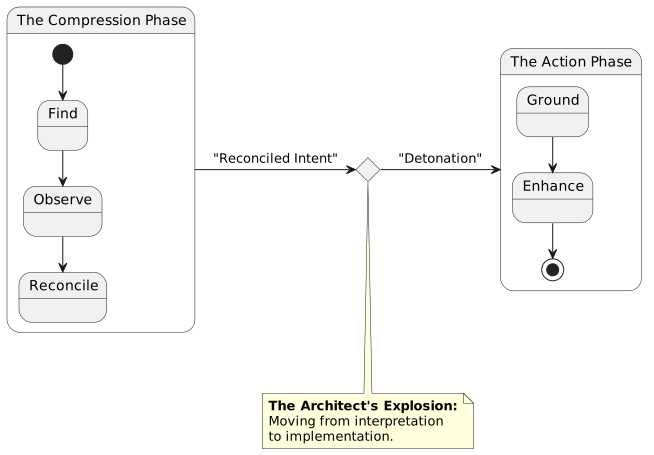
The transition from the Reconcile stage to the Ground and Enhance stages is what we call the "Architect’s Explosion."
During the first three stages (Find, Observe, Reconcile), the architect is in a state of compression—ingesting data, mapping complexity, and resolving conflicts. This is a cognitive-heavy phase where the architect serves as the "Enterprise Interpreter."
Once reconciliation is achieved, the architect "explodes" that potential energy into the enterprise. This explosion is the detonation of strategic intent. It is the moment where the architect moves from telling the organization what is wrong to showing them what is possible. It is the shift from "Theory" to "Infrastructure."
6. Case Study: The Unified Emergency Response System
To illustrate the full power of FORGE, let us examine a hypothetical yet realistic scenario: a regional government seeking to unify its emergency response systems across police, fire, and medical services.
6.1. The Challenge
Each service operates its own dispatch system, data standards, and radio frequencies. During a major incident, the lack of interoperability leads to delayed response times and a fragmented situational awareness.
6.2. Applying FORGE
6.2.1. Find
The architect begins by mapping the landscape. They Find 14 different dispatch software versions, three different radio vendors, and a myriad of informal "workarounds" where dispatchers use personal cell phones to coordinate between services. They identify the key stakeholders—service chiefs, city council members, and field responders—and document the primary pain point: "Information Lag."
6.2.2. Observe
The architect Observes the interdependencies. They notice that a medical call often requires a police escort, but the police dispatch is only notified after the medical team arrives on the scene. They map the flow of information and find that data is being manually re-entered three times across different systems.
6.2.3. Reconcile
This is the pivot. The architect Reconciles the disparate technical requirements. They bring the IT leads from all three services together and identify an "Architectural Gap": the lack of a shared geospatial data layer. They reconcile the conflicting vendor interests by proposing a vendor-neutral API gateway that unifies the data streams.
6.2.4. Ground
Instead of a "Rip and Replace" of all 14 dispatch systems, the architect Grounds the solution. They identify that the most modern system (used by the Fire service) can be used as the "Grounding Infrastructure." They capitalize on the existing fiber-optic network that already connects the precincts, avoiding the cost of new connectivity.
6.2.5. Enhance
The Explosion occurs. The architect Enhances the capability by implementing a unified Common Operating Picture (COP) that pulls data from the reconciled API gateway and displays it on ruggedized tablets in every emergency vehicle. They augment the system with an AI-driven routing engine that predicts traffic delays.
6.3. The Outcome
The "Emergency Response" value stream is transformed. Response times drop by 25%, and situational awareness is unified. The transformation is sustainable because it was grounded in existing strengths and reconciled across organizational silos.
7. Conclusion: Activating the Transformation Operating System
The failure of digital transformation is rarely a failure of technology; it is a failure of coordination and execution discipline. As established throughout this series, the "Hidden Tax" of fragmentation and the "Pilot Paradox" of isolated innovation are symptoms of an enterprise that lacks a shared architectural map and a repeatable practice for engagement.
The FORGE methodology, as the applied practice of GEAR: The Transformation Operating System (TOS), transforms the digital transformation architect from a passive observer into an active driver of organizational success. By moving through the stages of Find, Observe, Reconcile, Ground, and Enhance, architects bridge the gap between abstract models and tangible infrastructure.
This shift from "Architecture as Documentation" to "Architecture as Execution" is the fundamental requirement for sustainable transformation. It ensures that every technological investment—from AI platforms to edge sensors—is architecturally aligned, grounded in institutional strengths, and reconciled against the organization’s core mission on the Transformation Dimensions.
7.1. Final Takeaways for the Practitioner
To move from intent to infrastructure, the practitioner must embrace three core shifts:
-
GEAR is the Transformation Operating System: Adopt the O-DXA model and the FORGE methodology as your unified system for coordination. Use it to provide the "connective tissue" that brings people, process, policy, and technology into durable alignment on the Transformation Dimensions.
-
FORGE is the Method: Treat transformation as a repeatable engagement loop rather than a one-time project. Use the "Compression" stages (Find, Observe, Reconcile) to build the necessary architectural intent before "Exploding" into action (Ground, Enhance).
-
Architecture is the Execution: Move beyond static diagrams. Your primary output as an architect is not a document, but a set of structural decisions and constraints that guide the enterprise toward its North Star.
-
Pillars are for Execution: View specialized capabilities (AI, Security, Data) as Execution Pillars that must be integrated across all domains to achieve systemic outcomes.
7.2. Looking Forward: The Strategy Domain
While the FORGE methodology provides the "How" of architectural practice, the next paper in this series will explore the "Why" in greater detail. In The Strategy Domain: Translating Mission into Architectural Intent, we will apply the FORGE method specifically to the governance of strategic aspirations, demonstrating how architects can transform vague executive visions into binding architectural directions.
The journey from failure to execution begins with a single choice: to stop documenting the enterprise as it is, and to start forging it into what it must become.
References
[1] P. Forth, P. Romano, and others, “Flipping the Odds of Digital Transformation Success,” McKinsey & Company, 2022, [Online]. Available: https://www.mckinsey.com/capabilities/bcg-x/our-insights/flipping-the-odds-of-digital-transformation-success.
[2] D. W. Pulsipher, “Governing Enterprise Architecture Realization (GEAR): Logical and Physical Representation,” Intel Corporation, 2023. [Online]. Available: https://cdrdv2-public.intel.com/790385/GEAR%20Logical%20and%20Physicalv2.pdf.
[3] C. R. Institute, “Harnessing the Value of Generative AI: 2nd edition,” Capgemini, 2024. [Online]. Available: https://www.capgemini.com/insights/research-library/generative-ai-in-organizations-2024/.
[4] G. Lanthier and others, “The Front-runners’ Guide to Scaling AI,” Accenture Strategy, 2023, [Online]. Available: https://www.accenture.com/us-en/insights/data-ai/front-runners-guide-scaling-ai.
[5] B. Tilly, “From Siloed to Seamless: Building a Connected Digital Ecosystem.” 2024, [Online]. Available: https://www.bakertilly.com/insights/from-siloed-to-seamless-building-a-connected-digital-ecosystem.
[7] Embracing Digital Transformation, “Digital Transformation: The O-DXA Framework.” 2024, [Online]. Available: https://embracingdigital.org/en/digital-transformation/index.html.
[8] J. W. Ross, P. Weill, and D. Robertson, Enterprise Architecture as Strategy: Creating a Foundation for Business Execution. Harvard Business Review Press, 2006.
[9] D. W. Pulsipher, A. Scott, D. Richard, and R. Lisa, “GEAR: Process Architecture,” Intel Corporation, 2024. [Online]. Available: https://cdrdv2-public.intel.com/828453/GEAR%20Process%20Highlevel.pdf.
[10] Struto, “Swivel Chair Integration: Why Switching Between Apps is Killing Your Team’s Productivity.” 2024, [Online]. Available: https://www.struto.io/blog/swivel-chair-integration-why-switching-between-apps-is-killing-your-teams-productivity.