
Why Digital Transformation Fails and Why O-DXA Exists
Digital transformation initiatives continue to struggle despite unprecedented investment in cloud, data, AI, and cybersecurity. This white paper examines the root causes of these failures and explains why a shared architectural approach—embodied in the Open Digital Transformation Architecture (O-DXA)—is now essential.
Key Claims
This paper advances five core claims, which are examined and supported in the sections that follow.
-
Digital transformation failures are primarily structural and architectural in nature, rather than the result of insufficient technology or tooling. They arise from how organizations are structured and governed, not from a lack of modern tools.
-
Technology modernization efforts that are not accompanied by alignment across the Transformation Dimensions (people, process, policy, and technology) produce transient or purely local outcomes. Modern platforms amplify existing structural misalignments instead of resolving them.
-
Existing digital transformation frameworks lack mechanisms to sustain coherence between strategy, execution, and governance over time. They often improve planning and adoption but do not enforce long-term alignment.
-
Architecture must function as an active governing system rather than static documentation. It must constrain and guide decisions across the Transformation Dimensions if transformation outcomes are to persist.
-
O-DXA exists to address these systemic gaps by integrating strategy, execution, and governance into a unified architectural model. That model provides the coordination needed to bring people, process, policy, and technology into durable alignment across the enterprise.
Terminology and Definitions
This section defines key terms as they are used throughout this paper. These definitions are provided to ensure consistent interpretation and to avoid semantic drift across sections.
- Digital Transformation
-
A sustained organizational change that integrates strategy, structure, process, and technology to deliver long-term outcomes.
- Architecture
-
The governing structure that aligns intent, design, and execution across an enterprise.
- Execution
-
The operational realization of strategy through people, processes, and systems.
- Governance
-
The mechanisms by which decisions are made, enforced, and evolved across organizational boundaries.
- O-DXA
-
The Open Digital Transformation Architecture, a structural framework for aligning transformation intent with execution.
- Transformation Dimensions
-
When this paper refers to alignment, it is specifically concerned with how four vectors fit together on a shared surface: people (roles, skills, behaviours), process (ways of working and workflows), policy (rules, incentives, decision rights), and technology (platforms, data, and tools). Digital transformation fails when these four vectors evolve independently rather than under a shared architectural model.
- GEAR (Governing Enterprise Architecture Realization)
-
The Transformation Operating System (TOS) that integrates the O-DXA model, the FORGE practice, execution pillars, and the Transformation Dimensions.
- Fragmentation
-
The condition of misalignment between strategy, organization, and technical domains [1].
- Hidden Tax
-
The cumulative cost of fragmentation, manifesting as delay, rework, risk, and operational complexity.
- Islands of Excellence
-
Isolated successful initiatives or departments that lack the architectural "connective tissue" to scale enterprise-wide.
- Pilot Paradox
-
The phenomenon where high local innovation success (pilots) results in zero systemic impact due to fragmentation.
- Architectural Gap
-
(Also Fracture Point) The specific point of failure where a lack of shared standards or taxonomy prevents scaling.
1. Introduction
This paper examines why digital transformation initiatives consistently fail to deliver sustained organizational outcomes, despite significant advances in digital technologies and delivery practices. It argues that these failures are systemic rather than technical and that resolving them requires an integrated architectural model, not another isolated implementation framework.
2. The Myth of Technology-Led Transformation
This section establishes the foundational problem addressed by the paper and explains why it persists across organizations, industries, and technology generations. It frames the issue as systemic rather than episodic and sets the stage for deeper analysis in subsequent sections.
Organizations often mistake the adoption of modern technologies—cloud, AI, agile methods, and Zero Trust—for transformation itself. These technologies enable change, but they do not create it without corresponding shifts in how people work, how processes flow, and how policies govern decisions. When people, process, policy, and technology move on different trajectories, technology-led efforts produce short-lived or localized improvements rather than sustained transformation.
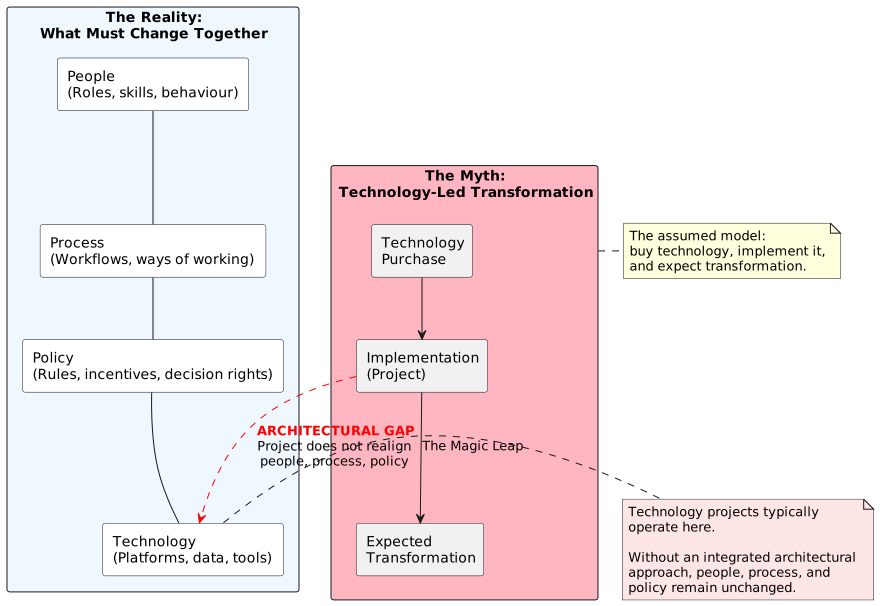
Organizations often mistake the adoption of modern technologies—cloud, AI, agile methods, and Zero Trust—for transformation itself. These technologies enable change, but they do not create it without corresponding shifts in governance, process, and organizational capability.
-
The Tooling Trap: Adopting modern technology (Cloud, AI, Agile) is often mistaken for achieving organizational transformation.
-
Local vs. Systemic Success: Initiatives frequently succeed within a single department but fail to create enterprise-wide momentum.
-
Capability Gap: True transformation is a change in capability and culture, not just a change in the tech stack.
Organizations continue to pursue transformation through technology adoption because technology is tangible, fundable, and measurable. However, this approach consistently underestimates the organizational, architectural, and cultural change required to translate tools into outcomes.
Despite unprecedented investment in cloud, AI, cybersecurity, and agile delivery, many organizations struggle to translate technology adoption into sustained outcomes. More technology does not automatically result in transformation.
These patterns show up repeatedly across today’s most popular “modernization” moves. Each can accelerate local progress, but none can create enterprise coherence by itself. The sections below unpack four common examples.
2.1. Cloud Is Not Transformation
Many organizations treat cloud migration as the finish line of digital transformation. In practice, moving legacy technical debt from an on-premise data center to a cloud provider—often described as "lift and shift"—primarily changes the billing model without improving agility [2]. Without re-architecting applications and refactoring processes to exploit elasticity, automation, and operational telemetry, the cloud simply becomes a more expensive place to do things the old way.
The persistence of this myth stems from the visibility of migration milestones, which create the illusion of progress while leaving underlying execution models unchanged. What is missing is coordinated change across governance, process, and accountability—so cloud capabilities translate into enterprise outcomes.
2.2. AI Is Not Intelligence
The current surge in Generative AI has created a pilot paradox, where organizations deploy LLMs for isolated tasks—such as email drafting or code completion—yet see little improvement in overall decision quality [3]. These efforts often optimize individual productivity while leaving organizational intelligence fragmented and uncoordinated [4].
Artificial intelligence only becomes organizational intelligence when it is embedded into decision-making workflows, governed appropriately, and grounded in the organization’s unique data, context, and objectives [5]. Without cross-domain coordination, AI remains a collection of tools rather than a systemic capability.
2.3. Agile Is Not Adaptability
Implementing Scrum ceremonies, stand-ups, or Jira boards does not inherently make an organization adaptable. In many environments, Agile devolves into "Water-Agile-Fall," where development teams operate in two-week sprints while budgeting, governance, and strategy remain rigid and annualized. The result is faster delivery of misaligned outcomes.
True adaptability requires the ability to pivot strategy based on operational feedback, market signals, or mission data—not merely the ability to write tickets more efficiently [6].
2.4. Zero Trust Is Not Maturity
Zero Trust is frequently marketed as a product that can be purchased rather than an architectural philosophy that must be adopted [7]. While tools such as Zero Trust Network Access (ZTNA) are important enablers, they represent only one component of a broader trust architecture.
Real security maturity emerges from continuous verification of identity, device, workload, and data across a fragmented enterprise landscape [8]. Zero Trust is not a destination reached through installation; it is a state of perpetual governance and architectural alignment.
The figure below contrasts a fast local optimization loop with the missing coordination needed to scale that success across the enterprise.
Technology initiatives frequently succeed within individual teams or departments, yet fail to generate enterprise-wide momentum without shared architectural coordination.
3. Fragmentation: The Hidden Tax on Transformation
Fragmentation is the silent killer of digital ROI. It occurs when parts of an enterprise operate as independent silos, creating a "hidden tax" [10] of inefficiency, data duplication, and security gaps [2]. When we treat transformation as a series of disconnected technology purchases, we do not solve fragmentation; we simply digitize it.
Put differently: fragmentation is the condition; the “hidden tax” is what it costs in delay, rework, and risk. That cost accumulates at the boundaries between teams, systems, and decision-making loops.
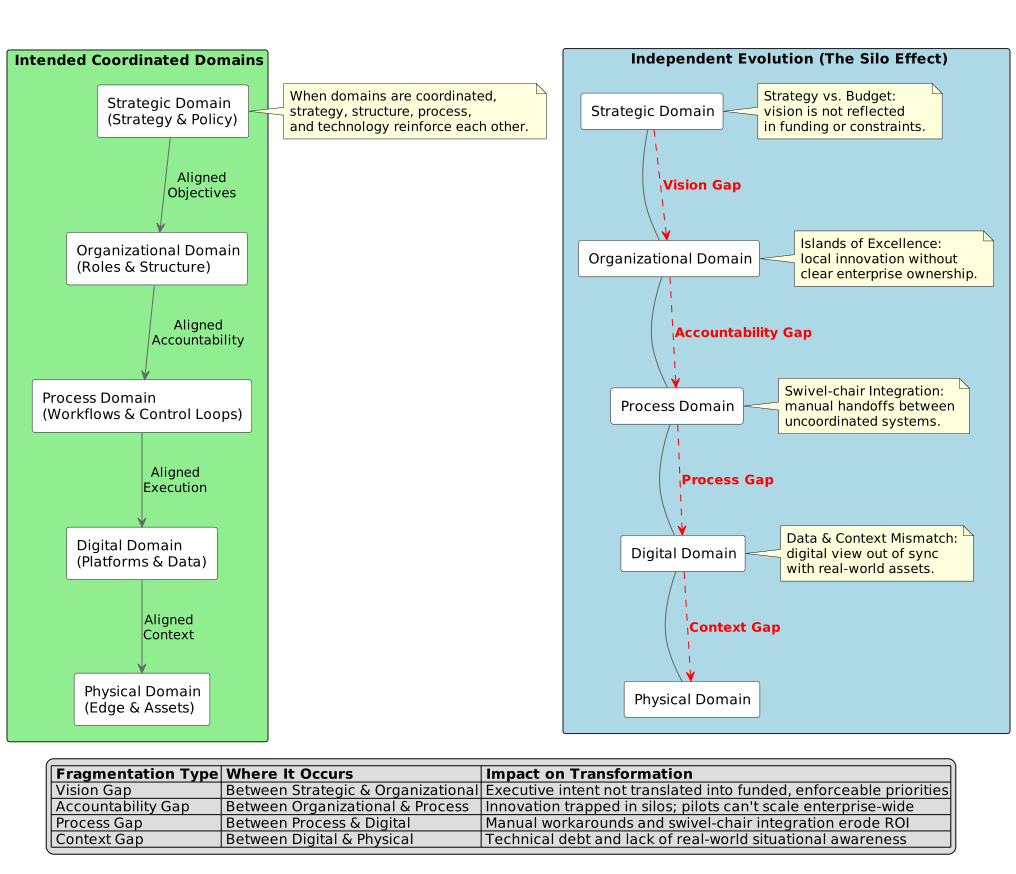
To achieve systemic change, we must address the five primary domains of fragmentation defined by the O-DXA standard [1].
3.1. Strategic Domain Fragmentation
Strategic fragmentation is the gap between executive vision and tactical execution. When leadership defines a "Digital First" strategy but budgeting remains tied to legacy project-based funding, the organization cannot pivot [11]. Within the Strategic Domain, this ensures that high-level goals never translate into actionable architectural requirements, leaving teams to guess at priorities.
3.2. Organizational Domain Fragmentation
Even with a clear strategy, departments often move at different speeds. This creates "Islands of Excellence" [12] where a data science team might be ready for production-scale AI, but the legal and compliance teams within the Organizational Domain lack the framework to support it [4]. The result is a "Pilot Paradox" where innovation is trapped within departmental boundaries.
3.3. Process Domain Fragmentation
Fragmentation in the Process Domain occurs when workflows "break" at the boundaries between teams. Without a unified process architecture, a single mission-critical request may cross multiple systems of record, requiring "swivel-chair" integration—where humans manually transfer data between disconnected applications [13]. This friction eliminates the speed gains promised by modern automation [14].
3.4. Digital Domain Fragmentation
This is the most visible form of fragmentation: the proliferation of disconnected software stacks. Within the Digital Domain, disparate cloud providers and incompatible data formats make it impossible to achieve a "single pane of glass" view of the enterprise [2]. Security becomes a bolted-on afterthought rather than an integrated design principle [8].
3.5. Physical Domain Fragmentation
In the era of Edge computing and IoT, the gap between the digital world and physical assets is widening. Without a way to synchronize digital twins within the Physical Domain to their digital counterparts, real-world data remains trapped and unactionable [5]. This prevents organizations from closing the loop between digital insights and real-world operations.
| Fragmentation is not a leadership failure—it is a structural one. To solve this, we require both a structural model and an applied practice. While the Governing Enterprise Architecture Realization (GEAR) framework provides the prescriptive blueprints required to unify these domains, it is through the FORGE (Find, Observe, Reconcile, Ground, Enhance) methodology that this architecture is actually executed. In the next paper in this series, we will examine the FORGE practice in detail. |
4. The Limits of Existing Transformation Frameworks
Most digital transformation frameworks focus on adoption, planning, or delivery practices, but under-specify the mechanisms required to sustain coherence over time. They improve how projects are initiated and managed, yet leave the deeper questions of architectural governance unresolved.
Frameworks that emphasize process introduce valuable discipline, but often treat governance and policy as external constraints rather than first-class design elements. Others focus on organizational change and leadership while assuming that technology and architecture will "follow." In both cases, strategy, execution, and governance can drift apart as conditions change.
Without explicit architectural mechanisms that bind people, process, policy, and technology into a coherent decision system, frameworks tend to devolve into localized practices or checklists. This explains why organizations can be fully "compliant" with a framework and still experience the same recurring patterns of fragmentation and pilot-only success.
5. Architecture as a the Missing Layer
Architecture is the mechanism for restoring coordination at those boundaries. It turns “local optimization” into shared decision rules, so teams can move fast without breaking coherence.
Architecture is not documentation. It is how organizations make coherent decisions at scale.
Too often, "Enterprise Architecture" is viewed as a library of static diagrams. True architecture is a dynamic coordination discipline providing the "connective tissue" that bridges the five domains. It ensures that a decision made in the Strategic Domain has a predictable and beneficial impact on the Physical Domain [9].
5.1. Architecture Beyond Documentation
If architecture is relegated to PDF documents, it becomes another form of digital fragmentation. In the O-DXA standard, architecture acts as a common taxonomy that defines the "rules of the road," allowing autonomous teams to move fast without breaking systemic coherence [6].
5.2. Architecture as Decision Alignment
Architecture provides the context required to evaluate trade-offs across domains. For example, when an engineering team chooses a new database in the Digital Domain, architecture ensures that the choice aligns with the organization’s Zero Trust security posture and its long-term goals in the Strategic Domain [8]. Without this alignment, organizations default to "swivel-chair" decision-making, where local speed creates global debt [13].
5.3. Architecture at Scale
Scaling a pilot project is a coordination problem [3]. By applying the O-DXA Domains, organizations can move away from "Islands of Excellence" and toward a "Digital Core" where every new capability—from the Digital Domain to the Physical Domain—plugs into a pre-existing, governed infrastructure [2].
O-DXA operationalizes this coordination discipline by breaking the enterprise into five explicit areas of architectural responsibility. These domains provide a shared map for decisions that must stay aligned as change scales.
6. The Five Domains of Digital Transformation (O-DXA)
The Open Digital Transformation Architecture (O-DXA) framework is not a collection of new technologies or management techniques; rather, it is a multi-dimensional lens for capturing the current state of an enterprise and the hidden interactions between its parts. By mapping an organization’s existing capabilities to five interdependent domains, O-DXA allows architects to visualize the flow of value and identify the precise "fracture points" where transformation stalls [2]. It serves as a diagnostic map that exposes how a decision in one domain ripples through the others, creating either systemic agility or architectural debt.
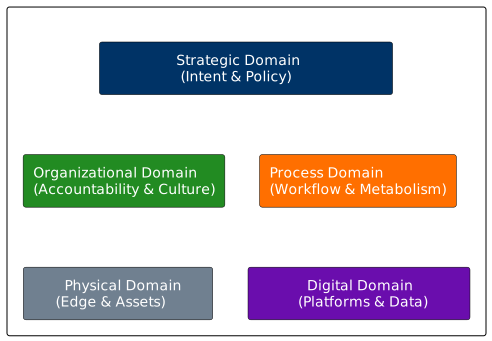
In practical terms, the O-DXA Domains answer five coordination questions:
-
Strategic Domain: Why are we doing this (intent, policy, outcomes)?
-
Organizational Domain: Who owns decisions and accountability?
-
Process Domain: How does work flow and how do feedback loops operate?
-
Digital Domain: What platforms, data, and integration patterns enable execution?
-
Physical Domain: Where does execution meet real-world constraints (assets, edge, OT)?
6.1. Strategic Domain
The Strategic Domain captures the existing intent, mission alignment, and policy framework of the enterprise. It is the observational layer where an organization’s "Why" is documented and measured against actual outcomes. Rather than defining a new strategy, O-DXA uses this domain to evaluate whether current policy and investment priorities are systemically aligned with mission success [9].
The scope of this domain involves mapping the interactions between executive leadership, board-level governance, and capital planning. It identifies how "Success Criteria" are currently defined and communicated. By capturing the state of the Strategic Domain, organizations can identify the "Vision Gap"—instances where strategic mandates are being ignored or misinterpreted by technical teams at the execution layer [11].
The primary benefit of capturing the Strategic Domain is the revelation of hidden "Decision Rights." It makes visible the informal guardrails that currently dictate how procurement and engineering teams operate. When this state is clearly documented, leadership can see where strategic ambiguity is causing local teams to seek unnecessary permission for micro-decisions, thereby slowing the entire enterprise [1].
In practice, this domain is used to audit resource conflicts. For example, by capturing the current state of data sovereignty policies, an architect can predict how a proposed AI initiative in the Digital Domain will interact with existing compliance mandates, allowing for the proactive resolution of conflicts before they become blockers.
6.2. Organizational Domain
The Organizational Domain documents the current state of the human element, including existing reporting structures, cultural norms, and accountability models. It observes the "Operating System" of the enterprise, identifying how authority is actually distributed versus how it appears on an organizational chart [12].
The scope of this domain includes mapping current change management practices, talent distribution, and cross-functional governance. It is here that O-DXA identifies the "Islands of Excellence"—capturing where innovation is happening in isolation and identifying the cultural or structural barriers that prevent those successes from scaling [11].
Capturing the Organizational Domain makes the current level of systemic agility visible. It identifies where rigid hierarchies are currently stifling the capability-based interactions required for digital speed. This observational data allows architects to show leadership exactly how current accountability gaps are contributing to the "Pilot Paradox" [9].
In daily operations, this domain is used to trace the path of a successful pilot. By capturing how a departmental AI success currently interacts with HR, Legal, and Operations, O-DXA makes it clear why that pilot cannot scale, providing the data needed to adjust the organizational "connective tissue."
6.3. Process Domain
The Process Domain captures the current state of execution, including existing workflows, funding cycles, and control loops. It documents the "Metabolism" of the organization—the actual speed at which value is currently delivered and feedback is ingested [14].
The scope of this domain covers the observation of the mission delivery lifecycle, from initial procurement requests to operational monitoring. It is the layer where O-DXA identifies the "swivel-chair" integrations currently in place—manual handoffs and data re-entry points that act as a "Hidden Tax" on the organization’s productivity [13].
The primary benefit of documenting the Process Domain is the creation of a baseline for predictable performance. By capturing the current "Control Loops" (or lack thereof), architects can demonstrate the actual ROI of digital investments. This visibility reveals where funding cycles are currently misaligned with the speed of technical execution [1].
This domain is used to visualize the friction in financial cycles. For example, by mapping the current state of annual budget approvals against the two-week sprint cycles of a development team, O-DXA highlights the structural mismatch that prevents true adaptability.
6.4. Digital Domain
The Digital Domain captures the current landscape of platforms, data, applications, and integration. It observes the "Nervous System" of the enterprise, documenting the actual flow of information across disparate software stacks and cloud environments [2].
The scope of this domain involves inventorying current infrastructure, data management platforms, and cybersecurity frameworks. It identifies the "Single Pane of Glass" gaps where information is currently siloed or inaccessible. Capturing this domain reveals the existing technical debt and security vulnerabilities that are currently preventing the enterprise from scaling [8].
The benefit of capturing the Digital Domain is the identification of interoperability barriers. By documenting the current state of data formats and API availability, O-DXA shows exactly why new applications cannot leverage existing datasets, exposing the duplication of effort that currently drains resources [1].
In practice, this domain is used to audit "Security as Design." For instance, by capturing the current state of 5G or Edge deployments, architects can evaluate how closely they align with Zero Trust principles, identifying where security is being "bolted on" as an afterthought [7].
6.5. Physical Domain
The Physical Domain captures the current state of infrastructure, Edge devices, Operational Technology (OT), and real-world environmental constraints. It provides the "Grounding" for the architecture, documenting how digital models currently interact with physical assets [5].
The scope of this domain extends to the mapping of power, cooling, and connectivity constraints at the furthest Edge. It identifies where physical data is currently being lost or where digital insights are failing to trigger physical actions. Without capturing this state, transformation remains a theoretical exercise disconnected from field operations [2].
The primary benefit of capturing the Physical Domain is situational awareness. By documenting how physical assets are (or are not) connected to the Digital Domain, architects can identify the gaps in "Digital Twin" fidelity. This reveals where predictive maintenance and remote operations are currently impossible due to physical-to-digital fragmentation [5].
The Physical Domain is used to identify "closed-loop" failures. For example, by capturing the current state of sensor arrays in a manufacturing plant, O-DXA can show why an AI insight in the Digital Domain is currently unable to adjust a physical process, highlighting the need for better architectural integration.
7. Why Domains Alone Are Not Enough
Mapping an organization into the five O-DXA domains is a critical diagnostic step, but it is not a complete solution. While the domains define where decisions must be coordinated and what current interactions look like, they do not define how execution occurs. This gap explains why many architectural efforts stall; they identify the "fracture points" but lack the specific instruments required to repair them.
Think of the domains as the coordination map: they show where alignment must hold. To actually execute across that map, enterprises need cross-cutting capabilities that provide the repeatable patterns, tooling, and standards for delivery.
If the Domains represent the horizontal layers of the enterprise, they require vertical capabilities to drive change across them. Without these specialized capabilities, the domains remain passive categories rather than active drivers of transformation. For example, identifying a gap in the Process Domain is useful, but without a mature Data Management pillar, there is no way to automate the workflows that bridge that gap.
The limitation of a "domains-only" approach is that it risks becoming another form of high-level documentation. True transformation requires the intersection of these architectural responsibilities with specific technical "views" or "pillars." These pillars—such as AI, Cybersecurity, and Edge Computing—provide the specialized expertise and tooling needed to execute a strategy across the entire stack [2].
This intersection is where O-DXA becomes prescriptive. By overlaying the Six Pillars of Digital Transformation [1] onto the five domains, an organization can move from capturing its current state to engineering its future state. The pillars act as the execution engine, providing the repeatable patterns and technical standards that unify the enterprise from the Strategic Domain all the way down to the Physical Domain.
8. Introducing the Six Execution Pillars as Evolving Perspectives
The Six Execution Pillars of Digital Transformation represent the core technical and operational perspectives required to execute strategy across all five O-DXA domains. Unlike traditional technology "stacks," these pillars are evolving perspectives; they shift with market needs and provide repeatable patterns that can be leveraged by any "Island of Excellence" to move into production-scale intelligence [2].
|
The Six Execution Pillars are not static initiatives. They are evolving technical perspectives. |

8.1. Artificial Intelligence
The Artificial Intelligence perspective provides the models, reasoning, and automation required to enhance organizational decision-making. To avoid the "Pilot Paradox," this perspective focuses on grounding AI in specific organizational context and ensuring that models in the Digital Domain can trigger reliable, autonomous actions in the Physical Domain [3, 5].
8.2. Data Management
The Data Management perspective acts as the foundation for the entire digital core. It defines how data is ingested, curated, governed, and tagged across a heterogeneous infrastructure. Its primary goal is to eliminate the "swivel-chair" integration found in the Process Domain by creating a distributed information management layer that spans from Edge to Cloud [14].
8.3. Cybersecurity
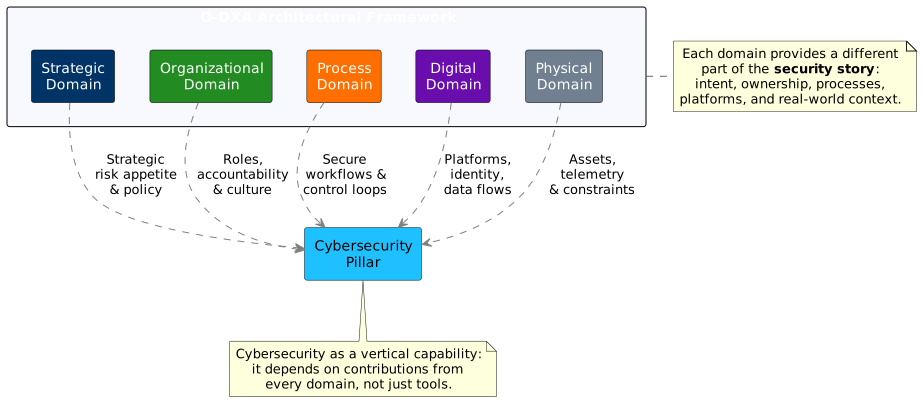
The Cybersecurity perspective implements the Zero Trust philosophy as a design principle rather than a bolted-on product. It ensures that identity, device, and workload verification are continuous and automated across all domains. This perspective provides the governance required to maintain confidentiality and integrity in highly fragmented, dynamic environments [8, 7].
8.4. Edge Computing
The Edge Computing perspective addresses the unique constraints of the Physical Domain, bringing compute and analytics closer to where data is generated. It provides the architectural patterns for deploying and managing services in environments with limited power, cooling, or connectivity, enabling real-time situational awareness [2].
8.5. Advanced Communications
The Advanced Communications perspective provides the "Nervous System" connectivity required for high-speed, low-latency data movement. Whether through 5G, Wi-Fi 6, or satellite links, this perspective ensures that the Digital Domain remains synchronized with the Physical Domain, allowing for the "closed-loop" operations required by modern industrial and mission-critical applications [7].
8.6. Ubiquitous Computing
The Ubiquitous Computing perspective ensures that the right compute resources (CPU, GPU, FPGA) are available at the right location at the right time. It abstracts the underlying hardware complexity, allowing developers to deploy applications across a hybrid-multi-cloud ecosystem without needing to understand the specific physical hardware at the Edge [15].
9. Why O-DXA and GEAR Exist
The existence of the Open Digital Transformation Architecture (O-DXA) and the GEAR: Transformation Operating System (TOS) is a response to the systemic failure of technology-led initiatives. As enterprises grow in complexity, the "Hidden Tax" of fragmentation becomes too heavy for traditional management structures to bear. O-DXA exists to provide the shared language and structural alignment required to transform a collection of disconnected "Islands of Excellence" into a coherent, high-performing enterprise [2, 12].
At its core, GEAR (O-DXA + FORGE) integrates strategy, execution, and governance into a unified Transformation Operating System. That system connects high-level intent to day-to-day decisions on the Transformation Dimensions of people, process, policy, and technology, so that transformation outcomes can persist rather than erode over time.
9.1. The Need for a Shared Reference Architecture
In most organizations, different departments (Finance, Engineering, Operations) use different reference models, different taxonomies, and different success metrics. This lack of a shared map is what creates "Fracture Points" [10]. O-DXA provides a vendor-neutral, cross-domain reference architecture that allows all actors—from the Boardroom to the Edge—to understand how their specific decisions impact the rest of the organization. It is the "common ground" required for multi-cloud and hybrid-workforce coordination [1].
9.2. What O-DXA Is (and Is Not)
It is critical to understand that O-DXA is not a new software product, a management methodology, or a replacement for existing standards like TOGAF. Instead, it is a diagnostic and alignment framework. While TOGAF provides the "how-to" of architectural practice [6], O-DXA provides the "what-is" of enterprise state. It is a map of interactions, not a library of blueprints. It does not dictate which technology to buy; it dictates the architectural responsibilities that any technology must fulfill to scale [9].
9.3. O-DXA as an Enabler of Coherence
The ultimate goal of O-DXA is coherence—the state where every part of the enterprise is working in harmony toward the same mission outcomes. By overlaying the Six Execution Pillars onto the five Domains, O-DXA allows an organization to see its transformation "in 3D." It enables leadership to trace a strategic objective in the Strategic Domain, through a funding model in the Process Domain, down to a specific secure deployment in the Digital and Physical Domains [8]. O-DXA is the mechanism that restores the link between digital ambition and real-world results.
10. Implications
Digital transformation cannot be managed as a loose collection of initiatives. It must be governed as an architectural system—a Transformation Operating System—whose purpose is to keep people, process, policy, and technology in alignment on the Transformation Dimensions to achieve mission outcomes.
From this analysis, several implications follow:
Strategic Implication (IMP-01): Digital transformation must be governed as an architectural system rather than a collection of disconnected projects. Strategy must explicitly account for the architectural structures—the GEAR Transformation Operating System—that sustain coherence over time.
Organizational Implication (IMP-02): Leadership structures and decision rights must align with transformation intent. Without clear ownership of cross-domain decisions, local optimizations on the Transformation Dimensions will continue to undermine enterprise outcomes.
Architectural Implication (IMP-03): Architecture must function as an active governing discipline, not static documentation. It should define and enforce the decision rules that shape how people, process, policy, and technology evolve together as a coherent system.
Policy Implication (IMP-04): Standards and frameworks should emphasize coherence, execution alignment, and governance. Policies must be designed to sustain alignment across the Transformation Dimensions rather than preserving siloed control.
10.1. Restoring Coherence through the Transformation Operating System
The failure of digital transformation is rarely a failure of technology; it is a failure of coordination. As we have seen, the "Hidden Tax" of fragmentation and the "Pilot Paradox" of isolated AI successes are symptoms of an enterprise that lacks a shared architectural map and an applied practice for execution.
The GEAR Transformation Operating System provides that map and practice. By capturing the current state of our Strategic, Organizational, Process, Digital, and Physical Domains, we can finally see the enterprise as a single, interdependent system. When we overlay the Six Execution Pillars onto this map and apply the FORGE methodology, we move from being reactive observers of technology to being proactive engineers of organizational outcomes [1].
Transformation is not a destination reached through a purchase order; it is a state of coherence reached through architecture.
10.2. Join the Journey toward Coherence
The move toward O-DXA is more than a technical upgrade; it is a commitment to systemic agility. We invite architects, leaders, and technologists to move beyond the silos of their specific domains and contribute to the development of a shared "Digital Core."
The path forward requires us to:
-
Audit the Gaps: Identify where "swivel-chair" integrations are currently draining your ROI [13].
-
Connect the Islands: Move beyond departmental pilots and demand that every new capability be architected for enterprise-wide scale using the FORGE methodology.
-
Adopt the Standard: Leverage the O-DXA framework and the GEAR practice to provide the "connective tissue" your organization needs to turn digital ambition into real-world results [1].
|
The goal is not to adopt a standard for the sake of compliance. It is to restore the link between strategy and execution, ensuring that every technological investment serves the mission. |
About the Author
Dr. Darren W. Pulsipher is the Chief Enterprise Architect for the Public Sector at Intel and Chair of The Open Group’s Open Digital Transformation Forum. His work focuses on architectural coherence across strategy, execution, and emerging technologies.
About This Series
This whitepaper is part of a foundational series examining the structural conditions required for sustained digital transformation. Subsequent papers and derivative articles explore domain-specific, organizational, and operational implications of the O-DXA framework.
References
[1] Embracing Digital Transformation, “Digital Transformation: The O-DXA Framework.” 2024, [Online]. Available: https://embracingdigital.org/en/digital-transformation/index.html.
[2] D. W. Pulsipher, “Governing Enterprise Architecture Realization (GEAR): Logical and Physical Representation,” Intel Corporation, 2023. [Online]. Available: https://cdrdv2-public.intel.com/790385/GEAR%20Logical%20and%20Physicalv2.pdf.
[3] G. Lanthier and others, “The Front-runners’ Guide to Scaling AI,” Accenture Strategy, 2023, [Online]. Available: https://www.accenture.com/us-en/insights/data-ai/front-runners-guide-scaling-ai.
[4] C. R. Institute, “Harnessing the Value of Generative AI: 2nd edition,” Capgemini, 2024. [Online]. Available: https://www.capgemini.com/insights/research-library/generative-ai-in-organizations-2024/.
[5] D. W. Pulsipher, “Digital Twins Help Connect the Digital and Real Worlds,” Intel Corporation, 2023. [Online]. Available: https://www.intel.com/content/www/us/en/developer/tools/scenescape/overview.html.
[7] D. W. Pulsipher and others, “Zero Trust in 5G: Integration and Advancement in solution architecture,” Embracing Digital Transformation, 2024, [Online]. Available: https://cdrdv2-public.intel.com/813586/episode181-en.pdf.
[8] D. W. Pulsipher and A. Scott, “Security Aspect of Governing Enterprise Architecture Realization (GEAR) Logical View,” Intel Corporation, 2024. [Online]. Available: https://cdrdv2-public.intel.com/854309/GEAR%20Security%20Aspect%20White%20Paper.pdf.
[9] J. W. Ross, P. Weill, and D. Robertson, Enterprise Architecture as Strategy: Creating a Foundation for Business Execution. Harvard Business Review Press, 2006.
[10] B. Tilly, “From Siloed to Seamless: Building a Connected Digital Ecosystem.” 2024, [Online]. Available: https://www.bakertilly.com/insights/from-siloed-to-seamless-building-a-connected-digital-ecosystem.
[11] P. Forth, P. Romano, and others, “Flipping the Odds of Digital Transformation Success,” McKinsey & Company, 2022, [Online]. Available: https://www.mckinsey.com/capabilities/bcg-x/our-insights/flipping-the-odds-of-digital-transformation-success.
[12] M. Krasuska and others, “Driving digital health transformation in hospitals: a formative study,” BMC Health Services Research, 2021, [Online]. Available: https://pmc.ncbi.nlm.nih.gov/articles/PMC8685936/.
[13] Struto, “Swivel Chair Integration: Why Switching Between Apps is Killing Your Team’s Productivity.” 2024, [Online]. Available: https://www.struto.io/blog/swivel-chair-integration-why-switching-between-apps-is-killing-your-teams-productivity.
[14] D. W. Pulsipher, A. Scott, D. Richard, and R. Lisa, “GEAR: Process Architecture,” Intel Corporation, 2024. [Online]. Available: https://cdrdv2-public.intel.com/828453/GEAR%20Process%20Highlevel.pdf.
[15] D. W. Pulsipher, “Sentient Agent Bundle Resource Architecture,” Intel Corporation, 2022. [Online]. Available: https://www.intel.com/content/dam/www/central-libraries/us/en/documents/2022-12/sentient-agent-resource-bundle-white-paper.pdf.