
What the Physical Domain Encompasses
Digital transformation often fails for a familiar reason: teams design the software and the process, but they underestimate the world those systems must run in. A service may look sound in a diagram and still behave very differently once it meets a real site, real devices, real infrastructure, and real environmental conditions.
That gap is the reason the Physical Domain matters. In the O-DXA model, it is not a background concern or an operational detail to sort out later. It is a core architectural domain. If digital transformation is really about changing how an organization works, then it necessarily extends into the physical environments where work actually happens.
This matters for more than engineers. Enterprise leaders, public-sector teams, and transformation practitioners all make decisions that assume something about location, access, continuity, resilience, and support. Those assumptions can be reasonable in a design workshop and wrong in practice. The point of the Physical Domain is to make those assumptions visible.
What the Physical Domain Includes
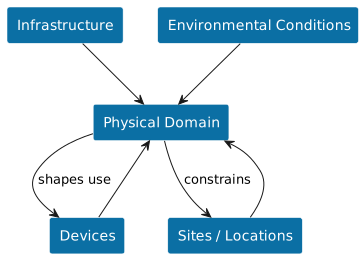
The simplest way to think about the Physical Domain is this: it includes the material conditions that shape how digital services are delivered and experienced. That means infrastructure, devices, sites and locations, communication channels, and environmental conditions.
The slide deck breaks that scope into a simple architecture view. The diagram below shows the domain as the point where infrastructure, devices, locations, and environmental conditions meet transformation work.
It does not mean you need a digital twin of everything. That would be the wrong lesson. Instead, it means understanding the physical elements that are important enough to affect transformation outcomes. A hospital, a warehouse, a branch office, a shipyard, a school, a data center, or a remote field location may each impose different conditions on the same digital service.
This is why the Physical Domain is broader than hardware alone. Devices matter, but so do the places those devices are used, the network paths that connect them, and the environment around them. A service may be technically available, yet still be hard to use if the physical setting interrupts access, reduces reliability, or limits continuity.
In other words, the Physical Domain is where digital_transformation meets material reality.
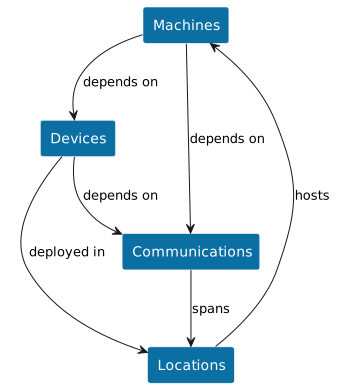
The lecture also frames the domain in layered terms. Machines, devices, communications, and locations are the top layers that make the domain operational in practice.
Why It Belongs in Architecture
One of the most important points in the lecture is also one of the most easily overlooked: infrastructure decisions are architectural decisions. Too often, teams talk about architecture as if it only covers software structure, data flow, or business process design. But infrastructure sets the operating envelope for all of those things.
If an organization wants a service to be available across multiple sites, or to function at the edge, or to support continuity in the face of disruption, then the physical setting becomes part of the architectural conversation. That does not mean every team needs to model the world in exhaustive detail. It does mean the organization should know enough about the physical domain to avoid blind spots.
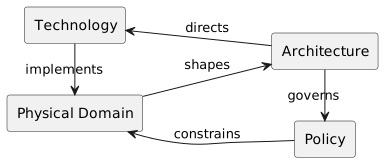
This is where governance and architecture meet. Governance asks what must be true for the service to be trusted, sustained, and managed well. Architecture asks how the system is shaped to meet those expectations. If the physical environment is ignored, both discussions become incomplete.
The lecture makes this point clearly: the Physical Domain is one of the core O-DXA domains. It must be treated as architecturally significant, not as an afterthought.
How Physical Reality Shapes Outcomes
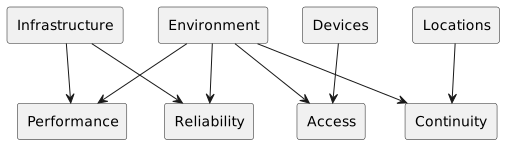
The most practical reason to care about the Physical Domain is that physical reality changes transformation outcomes. Infrastructure, devices, and site conditions all affect performance, reliability, access, and continuity.
The slides summarize that relationship directly. Physical conditions affect multiple outcomes at once, and the same service can behave differently depending on the environment around it.
A digital service does not behave in a vacuum. Software logic describes intended behavior, but the physical world determines whether that behavior can be realized under actual conditions. A system might work well in one location and struggle in another because of environmental differences, physical access constraints, or local continuity risks.
That is especially visible at the edge, where the gap between design assumptions and operating reality becomes easier to see. An edge deployment may face different conditions than a central facility. It may rely on different devices, different communication paths, and different environmental tolerances. What works in one setting cannot simply be assumed to work in another.
The lecture uses everyday examples to make this concrete. One location may need to plan for earthquakes. Another may need to plan for hurricanes or tornadoes. The specifics are not the point. The point is that real-world conditions shape business continuity and service resilience. If those conditions are not part of the architecture, the organization is planning with incomplete information.
That same logic applies to performance and reliability. Service-level expectations are not just a matter of software design. They are also shaped by where the service runs, what it depends on, and what physical stresses it must endure. This is why the Physical Domain belongs in the systems architecture of transformation, not in a separate bucket labeled “operations.”
Common Blind Spots
A common blind spot in transformation programs is assuming that “the cloud” removes the need to think about physical location. It does not. Even if an organization relies on abstracted services, it still needs to understand where systems reside, where data lives, and what physical context surrounds them.
Another blind spot is treating devices as trivial. Devices are often the bridge between digital capability and the place where work actually happens. If the devices are hard to access, hard to maintain, or poorly aligned with the physical setting, adoption suffers. The issue may look like a user problem, but the root cause is often architectural.
Sites and locations create similar blind spots. A solution may be designed centrally and then deployed across sites that have very different conditions. If those differences are not recognized, the organization may misread the problem later as an issue of execution, when in fact the architecture never accounted for the physical context.
The lecture also warns against a subtle mistake in the other direction: overcomplicating the physical model. Not every transformation needs a full simulation of every object, room, or device. What matters is broad awareness first, then deeper modeling where mission and capability require it. The goal is not to map everything. The goal is to model enough of the Physical Domain to understand how the system will behave in practice.
What Leaders Should Watch For
For leaders and practitioners, the lesson is simple but important. When a transformation seems to be underperforming, ask whether the team has made hidden assumptions about the physical environment.
A few questions can reveal a lot: - Where does the service actually run? - Which devices depend on it? - What site conditions could affect access or continuity? - Are environmental risks part of the planning? - Have infrastructure choices been treated as architectural choices?
If those questions are hard to answer, that is a sign the Physical Domain has not been modeled clearly enough. The result is often a gap between the intended transformation and the transformation that actually occurs in the field.
The bigger architectural takeaway is this: digital transformation is not complete when the software is designed or the process is mapped. It is complete only when the physical reality that shapes execution has been considered as part of the system itself.
When organizations treat the Physical Domain as first-class, they are more likely to design services that are resilient, accessible, and realistic. When they ignore it, they risk building elegant plans that fail outside the design center.
Go Deeper
-
Full lecture episode: https://embracingdigital.org/en/lectures/dta-25
-
Series blog summary: https://embracingdigital.org/en/blog/what-the-physical-domain-encompasses