
FORGE Practices for Digital Architecture
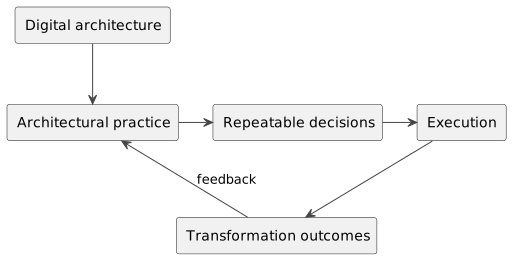
When digital transformation programs stall, the problem is often not a lack of ideas. It is a lack of architecture that can be used in practice. Many organizations can describe their systems well enough: they know they have applications, platforms, integrations, and data. But description is not the same as discipline. If architecture does not help people make repeatable decisions, manage trade-offs, and improve execution, it remains a document instead of a capability.
That is the central lesson of this lecture on the Digital Domain. Digital architecture must be practiced, not only described. In other words, the value of architecture is not in how neatly it is drawn or how carefully it is named. Its value is in whether it helps transformation programs move with more clarity, less rework, and better outcomes.
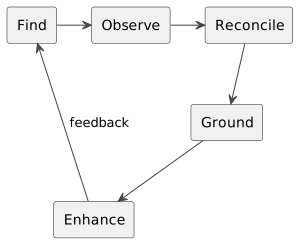
The lecture frames this discipline through FORGE: Find, Observe, Reconcile, Ground, and Enhance. FORGE is not presented as a new theory or a delivery method. It is a practical way to turn Digital Domain principles into repeatable architectural action.
Why digital architecture must be practiced
It is easy to treat architecture as if it were mostly explanatory. Teams create inventories, diagrams, and standards. They can point to boundaries between layers and name the technologies in use. That has value, but it is only the starting point.
A digital architecture becomes useful when it affects execution. That means it helps answer questions like: What depends on what? Where are the boundaries? What should this new decision rely on? What would create avoidable coupling? What can be improved without making future change harder?
This is especially important in the Digital Domain, where platform, software, and data choices quickly become operational reality. These are not abstract concerns. They shape how quickly an organization can respond to change, how reliably it can deliver services, and how much rework it will inherit later.
The lecture’s point is simple: architecture is a discipline of action. If it stays at the level of commentary, it does not yet do the work transformation needs.
FORGE as repeatable architectural action
FORGE gives architects a practical sequence for working with digital systems. The steps are descriptive at first, but they become judgmental and decision-oriented very quickly.
Find is where you establish what exists. That sounds basic, but it matters. You cannot make sound architectural decisions about an environment you have not clearly described.
Observe is where relationships become visible. This is where boundaries, dependencies, and interactions matter. A modern digital environment is rarely a single system. It is a connected set of applications, services, platforms, and data flows. Understanding those connections is essential.
Reconcile is where architectural judgment becomes explicit. Are the relationships bounded appropriately? Is one layer reaching beyond its proper responsibility? Is coupling too tight? Is cohesion strong enough to support change?
Ground is where you decide what future work can safely rely on. This matters because fragile foundations create future rework. If you build new capability on something unstable or temporary, you are likely to pay for it later.
Enhance is the forward-looking step. It is not just about preserving the current state. It is about improving what already exists so execution becomes more effective over time.
Taken together, those steps make architecture repeatable. They do not remove judgment; they structure it. That is important because digital transformation is full of situations that seem unique at the surface but are actually variations on the same architectural trade-offs.
Decisions across platform, software, and data
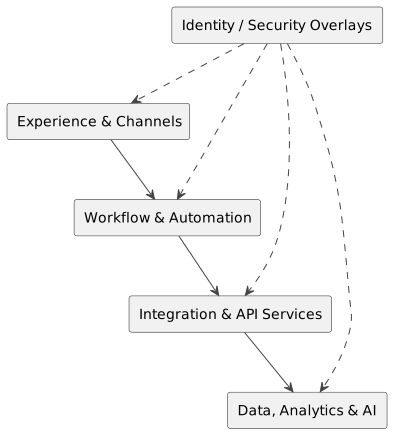
One of the clearest strengths of the lecture is the way it connects architecture to everyday choices. Platform decisions, software choices, and data governance are often treated as separate conversations. In practice, they are tightly related.
A platform decision affects what can run reliably and what future options remain open. A software choice affects how the organization integrates capability and how much friction it creates downstream. A data governance choice affects what information is trusted, where it lives, and who can use it.
FORGE helps because it forces those decisions into the same architectural frame. That is important in organizations that rely heavily on SaaS, cloud services, or layered service models. Even if the organization does not manage every underlying component directly, it still has architectural responsibility. It still needs to understand where data resides, what the dependencies are, and what assumptions it is making about the services it uses.
The lecture also makes a useful point about governance. Governance should not be treated as a separate bureaucracy that slows everything down. In a healthy architecture practice, governance supports alignment. It helps ensure that decisions are consistent with the architecture and with the outcomes the organization is trying to achieve. That is very different from using standards language as a form of control without real guidance.
What good practice changes
The true test of digital architecture is not whether it sounds rigorous. It is whether it improves execution.
When architecture is practiced well, teams can make better trade-offs. They can see when a new request duplicates an existing capability. They can recognize when a process change is a better answer than another tool. They can identify where a decision creates unnecessary coupling or future rigidity.
That matters because many execution problems come from isolated decision-making. A team adopts something new without understanding the surrounding stack. Another team moves data without considering downstream dependencies. A project adds integration points before the architectural foundation is ready. These are not small mistakes. They are the kinds of choices that create friction, rework, and slow adoption later on.
The lecture also emphasizes a practical benefit that leaders often care about: speed. It may sound counterintuitive, but disciplined architecture can make teams faster. When the organization has a clear view of what exists and how it fits together, it spends less time rediscovering the same facts and less time correcting avoidable errors.
In that sense, good architecture is not bureaucracy. It is a way to make change more reliable.
The Digital Domain exists to change outcomes
The whitepaper’s larger framing matters here. The Digital Domain is not just the place where technology lives. It is the part of transformation architecture that helps change outcomes.
That is why the lecture keeps returning to execution. Digital architecture is valuable when it helps a transformation program move from intent to outcome. It supports resilience, flexibility, agility, and better decision quality. It also helps organizations avoid the opposite: rigidity, hidden fragility, and unnecessary rework.
This is also why standards alone are insufficient. Standards can describe what should be true. Practice determines whether the architecture actually helps the organization do its work better. A well-described architecture that does not change execution is incomplete.
FORGE closes that gap by turning principles into a repeatable discipline. It gives architects a way to understand what they have, how it behaves, what it depends on, and what should be used as the basis for future change.
What leaders and practitioners should watch for
If you are leading or participating in digital transformation, a few signals are worth noticing.
First, ask whether architecture conversations are helping decisions or just documenting them. If the main result is more diagrams with no change in execution, the practice is not yet doing enough.
Second, watch for decisions made in isolation. When platform, software, and data are treated separately, the organization often pays later in integration cost, rework, or delayed delivery.
Third, pay attention to what the organization is grounding future work on. A convenient choice today can become a fragile foundation tomorrow.
Fourth, look for whether governance is enabling better alignment or merely adding friction. Good governance should support disciplined execution, not replace it.
The broader lesson is straightforward: architecture should make transformation easier to carry out well. If it is not doing that, it needs to be practiced differently.
Go Deeper
-
Full lecture episode: FORGE Practices for Digital Architecture https://www.embracingdigital.org/en/lectures/dta-24
-
Series blog summary: Digital Transformation Architect https://www.embracingidital.org/en/lectures