
Why Application-Centric Thinking Fails
- 1. Why application-centric thinking is appealing, but limited
- 2. Why isolated upgrades do not equal transformation
- 3. Why platforms, data, and outcomes must be considered together
- 4. How systemic architecture changes the evaluation of modernization
- 5. What this means for digital transformation leaders
- 6. Learn More
Application upgrades can look like progress, but digital transformation depends on the architecture that connects systems, data, and operating outcomes.
Most modernization efforts begin with a reasonable instinct: fix one application, show a visible result, then move on to the next. That approach feels practical because applications are tangible. They are easy to name, easy to fund, and easy to measure. But the lecture behind this article makes a sharper point: application-centric thinking is too narrow to deliver digital transformation.
Why? Because organizations do not experience outcomes through isolated systems. They experience them through the relationships among platforms, data, governance, execution, and the operating model around them. You can replace a legacy application and still leave the broader system unchanged. In that case, the software may be new, but the transformation is not.
That distinction matters because digital modernization is often mistaken for architectural change. The difference is not academic. Replacing software can improve one part of the environment, but if the deeper structure remains fragmented, the enterprise still faces the same limits: inconsistent data, brittle handoffs, unclear ownership, and uneven results across teams.
1. Why application-centric thinking is appealing, but limited
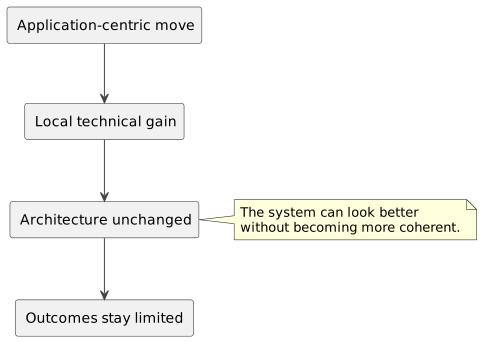
Application-centric thinking is attractive because it gives leaders something concrete to act on. A team can approve an upgrade, deliver a deployment, and point to progress. In the lecture, that kind of move is described as practical. It is also, by itself, insufficient.
The problem is that a single application usually sits inside a much larger digital domain. It depends on shared platforms, data flows, identity and security controls, and the broader process and organizational context. If those relationships do not change, the new application may function better locally while leaving the system around it intact.
A simple way to think about it is this: a better tool does not automatically make a better system. If the underlying architecture is still fragmented, the organization may just get a faster version of the same old problem. That is why the lecture stresses that application-centric thinking is insufficient for digital transformation. It focuses attention on one component while missing the structure that actually determines outcomes.
This is also why isolated modernization efforts often feel successful at first. They are visible. They are measurable. They can produce a quick win for one team. But if the broader architecture is not changing, that win stays local. The enterprise may see a newer interface, faster response times, or a smoother workflow in one area, while the overall transformation remains shallow.
2. Why isolated upgrades do not equal transformation
One of the lecture’s central warnings is that replacing or modernizing applications does not automatically improve transformation outcomes. A modern application can still sit on top of old assumptions, old data relationships, and old operating patterns. In that case, the organization has changed a component, not the architecture.
That distinction matters because outcomes depend on the whole system. If one team introduces a new application but the intake process remains fragmented, data ownership stays unclear, or reporting still depends on manual workarounds, the enterprise does not become more effective. It just becomes more complicated in a different way.
The lecture gives a useful example: a team replaces a legacy application, but the surrounding data and process structures are left unchanged. The launch may succeed locally. Yet reporting drifts, ownership stays unclear, and the broader enterprise outcome remains flat. The result is not dramatic failure. It is something more dangerous: a quiet, hidden limit on value.
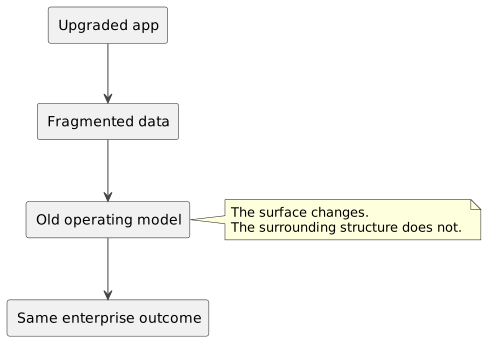
This is where many modernization efforts go wrong. Leaders may count the number of applications upgraded in a quarter and assume that the organization is progressing. But the better question is not how many systems changed. It is whether the architecture became more coherent. If the answer is no, then the organization may have increased complexity while reducing the chance of meaningful transformation.
Application-by-application decisions also tend to fragment decision-making across teams and technologies. Each group solves its own problem, but no one is accountable for the systemic effect. That is how digital silos form. The enterprise ends up with multiple local solutions that are hard to connect, hard to govern, and hard to change later.
3. Why platforms, data, and outcomes must be considered together
The lecture recenters the conversation on relationships. That is the architectural move. In the digital domain, platforms, data, and outcomes are not separate subjects. They are linked. A platform hosts and enables services. Data moves through it. Outcomes are produced by how well those pieces work together.
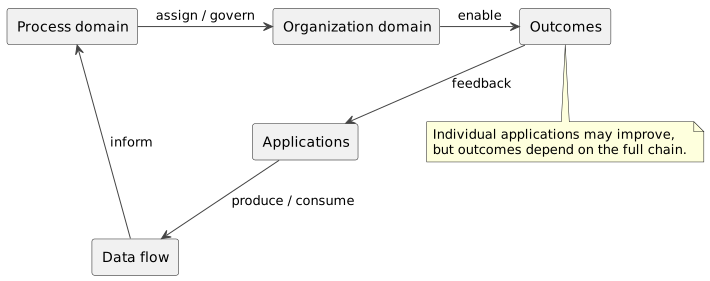
This is why the lecture spends so much time on data flow. A new application may be faster or more capable, but if it creates a new data silo, the organization inherits another layer of fragmentation. Old schemas and new schemas may not align. Data ownership may become unclear. Information may move through the system in ways that are hard to trace or govern.
That is a digital transformation problem, not just a software problem.
The same is true for identity, access, and security. An application does not exist outside the architecture. It must fit into authentication, authorization, access control, and cybersecurity practices already in place. It must also fit into the process domain, where work is actually done, and the organizational domain, where roles, responsibilities, and communication paths are defined.
The lecture’s point is not that every application change requires a complete redesign of everything. The point is that the relationships must be understood before judgment is made. Sometimes a new application is the right move. Sometimes it is not yet ready because the surrounding architecture cannot support it. Either way, the decision should be made systemically.
That is why the lecture describes digital transformation as a systems architecture problem. The issue is not whether one application is useful. The issue is whether the whole architecture is becoming more coherent, more governable, and more capable of producing the intended outcome.
4. How systemic architecture changes the evaluation of modernization
Once the unit of analysis shifts from the application to the system, the way modernization is judged changes as well. A modernization effort should not be evaluated only by adoption, deployment counts, or short-term performance gains. It should be evaluated by systemic effect.
Did the architecture become more coherent?
Did the relationships among platforms and data improve?
Did the operating model become easier to execute and govern?
Did the change reduce coupling, or did it create more hidden dependencies?
Those are architectural questions, and they are the right questions for digital transformation.
This is where governance and execution come in. Modernization has to fit the existing governance model and support structures. That does not mean slowing everything down. It means making sure that new applications are introduced in a way that the organization can sustain. A system that cannot be governed reliably is not a transformed system; it is a fragile one.
The lecture also notes that modern deployment patterns, including SaaS-based ones, can raise the stakes because data may move beyond older boundaries. That can be beneficial, but only if the architecture is understood. Otherwise, the organization can create new dependency chains without realizing it. The result may be a quick win on the surface and a long-term burden underneath.
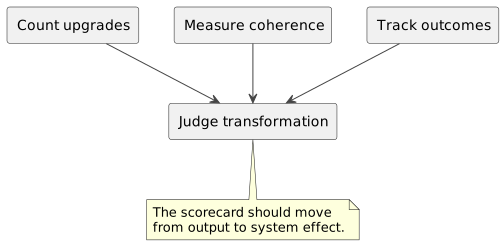
This is why the lecture resists the idea that modernization is simply a portfolio of separate projects. It is a portfolio, but it must work in lockstep around a consistent systems architecture. One group’s success cannot come at the expense of enterprise coherence. If it does, the organization may look modern while becoming harder to run.
5. What this means for digital transformation leaders
For leaders, the lesson is straightforward: do not confuse software replacement with architectural transformation. A new application may be valuable, but value depends on how it fits into the larger structure.
That means asking a different set of questions before declaring success. Is the change improving the coherence of the digital domain? Is the data architecture still sound? Are process and organizational impacts understood? Can the change be governed and executed at enterprise scale? Will the outcomes improve systemically, or only locally?
Those questions are especially important when organizations are under pressure to move quickly. Speed matters, but speed without architectural clarity often produces hidden complexity. The lecture’s message is not to slow modernization down for its own sake. It is to make sure that modernization is actually modernization, rather than a series of isolated upgrades.
For practitioners, the warning signs are worth watching. If every team optimizes its own application, if data ownership is unclear, if reporting depends on workarounds, or if new tools create more integration burden than they remove, then application-centric thinking may be in control. And if it is, the organization is probably not transforming the way it thinks it is.
The deeper lesson is that digital transformation is not measured by shiny new systems. It is measured by whether the enterprise becomes more coherent, more governable, and better able to produce outcomes across the whole architecture.
6. Learn More
-
Full lecture episode: https://embracingdigital.org/en/lectures/dta-22
-
Series blog summary: see the companion blog post for a more structured lecture-centric overview of this topic.