
Introducing the Layers of the Digital Domain
Modernization often starts with a familiar promise: new platforms, cleaner integrations, better data, faster delivery. But in many organizations, the work stalls anyway. The reason is not always a lack of effort or talent. More often, the Digital Domain is being treated as an execution space instead of an architectural one.
That distinction matters. If leaders carefully design the strategy, process, and organizational sides of change, but leave the digital side as an undifferentiated pile of systems and tasks, the overall transformation becomes fragile. Digital systems belong inside the architecture model, not outside it as mere IT execution. When that is forgotten, modernization tends to become fragmented, duplicate work appears, and responsibility becomes blurred.
This lecture introduces the Digital Domain as a layered architectural model. That is the core idea: the Digital Domain should not be described only by what teams build or operate. It should be understood through its structure, because structure explains how digital capability is composed, governed, and changed over time.
Why the Digital Domain Needs an Architectural Definition
Many people think of the Digital Domain as “where the technology lives.” That is understandable, because this is where software, integration, and data actually reside. But the lecture argues for a stricter view: the Digital Domain is part of the architecture model.
That means digital decisions are not just implementation details. They shape dependencies, coupling, responsibility, and long-term changeability. If the domain is treated only as a delivery problem, the organization may produce systems that function in the short term but do not hold together architecturally.
A useful way to think about this is to separate architecture from execution. Architecture defines and shapes the domain: what belongs where, how the parts relate, and what boundaries matter. Execution carries those decisions into working systems. Operational support keeps those systems running. All three are necessary, but they are not the same thing.
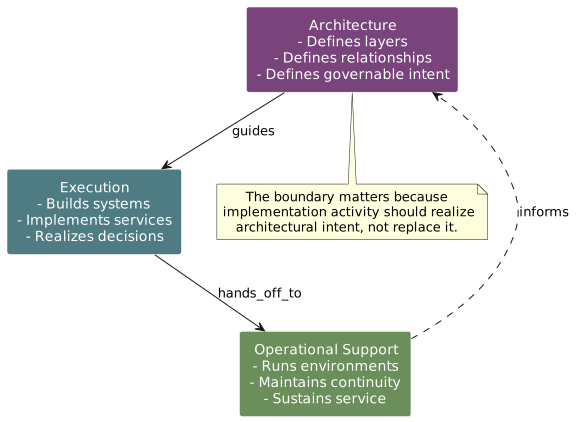
This is why the lecture insists on a clear boundary. The Digital Domain is not outside architecture. It is one of the architectural domains that must be designed with the same discipline as strategy, process, and organization. If it is ignored, the rest of the transformation effort can unravel.
The Digital Domain as a Layered Model
The lecture presents the Digital Domain through five layers, plus two cross-cutting aspect layers.

At the base is the Physical Specification Layer. This is the logical representation of the physical world inside the digital realm. It is not the physical world itself, but a digital specification of it: a representation that lets the layers above it understand, control, and manage physical assets.
Above that is the Software-Defined Infrastructure Layer. This is where software can control hardware and infrastructure resources. The lecture notes that this is broader than one narrow idea such as virtualization. It includes the logical control of underlying resources, including provisioning and partitioning, so that digital systems can operate in a managed way.
Next are two closely related layers: the Service Management Layer and the Distributed Information Management Layer. They work together and interact heavily with software-defined infrastructure. One manages how services are placed and coordinated; the other manages the movement, organization, and use of information. In practice, these two layers help connect data, services, and the infrastructure that supports them.
On top sits the Application Layer. This is the most visible part of the Digital Domain for many organizations, because it is where applications deliver value. But applications do not stand alone. They depend on the layers below them, and they are shaped by the relationships among those layers.
The lecture’s key point is not simply that these layers exist. It is that the layers clarify how digital capability is organized. They help distinguish one kind of decision from another. For example, an application concern should not be confused with an infrastructure concern, and a service management decision should not be treated as if it were an application design choice.
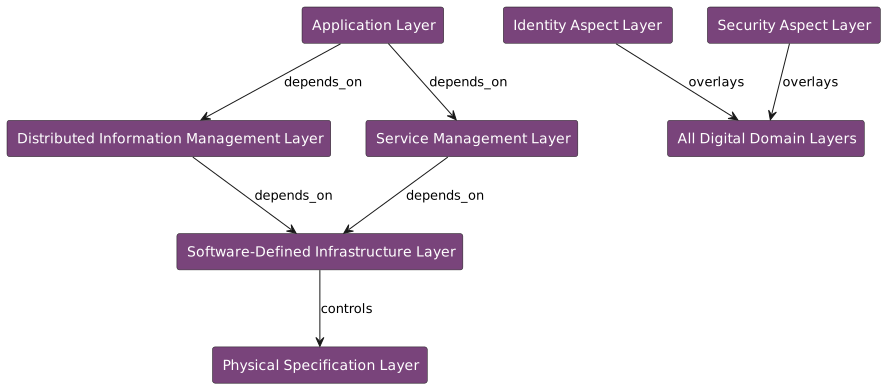
That clarity is valuable because it makes the domain governable. When organizations can see what belongs in each layer, they can ask better questions about dependencies, ownership, and fit.
Identity and Security Cut Across the Whole Domain
The lecture gives special attention to Identity and Security as cross-cutting aspect layers.
Identity is not just about users logging in. It also includes devices, data, applications, microservices, and services. In other words, identity is an architectural property that spans the Digital Domain. That is why the lecture treats it as a first-class concern rather than a narrow technical feature.
Security is also cross-cutting. It applies across the whole Digital Domain and interacts with all the other layers. The lecture does not collapse identity into security, however. It distinguishes them, because they are related but not identical. Identity answers “what is this thing?” and security concerns how the domain is protected and governed across its layers.
For leaders and practitioners, this matters because it changes how responsibility is assigned. If identity and security are seen as afterthoughts or as isolated team responsibilities, they are easy to under-design. If they are recognized as aspect layers, they become part of the architectural conversation from the start.
This is one of the lecture’s most practical lessons: some concerns do not belong to a single layer, but they still need a clear place in the model.
Why the Technology Dimension Matters
The Digital Domain does not exist in a vacuum. It is shaped by the Technology dimension.
That dimension constrains and enables what can be done in the Digital Domain. It does not replace architecture, but it affects the choices that architecture can make. This is why the lecture avoids treating modernization as a purely technical shopping exercise. New tools do not solve architectural confusion by themselves.
Instead, the Technology dimension should be understood as part of the broader architectural picture. It influences how layers are implemented, what relationships are possible, and what trade-offs need to be managed. When the Digital Domain is viewed this way, technology becomes a design factor rather than a substitute for design.
This is also where common confusion shows up in real organizations. Teams may accumulate multiple tools that perform similar jobs, or they may leave a tool in place without any clear role in the architecture. The lecture uses the idea of “shelfware” to describe technology that has been acquired but not meaningfully used. If a system cannot be mapped to a clear role in the Digital Domain, it is reasonable to ask whether it is actually contributing to execution.
That is not a complaint about tools. It is a reminder that architecture must be able to explain why a tool exists, where it fits, and what it supports.
Why Layer Clarity Improves Modernization
One of the lecture’s strongest claims is that modernization fails when the Digital Domain is treated as a delivery problem only.
That failure usually shows up in familiar ways. The organization may modernize one part of the environment while leaving the deeper structure unchanged. It may add new tools without changing the relationships among applications, information, services, and infrastructure. It may even improve delivery speed while leaving fragmentation intact. In those cases, the transformation looks active, but the structure remains shallow.
The lecture is clear that modernization is structural, not cosmetic. Structural modernization means understanding the boundaries between the layers and what each layer is responsible for. It also means distinguishing architectural decisions from implementation activity and operational support. That distinction is not academic. It is what makes modernization durable.
A simple example helps. Suppose a public organization wants to improve a digital service that spans multiple teams. If identity is handled differently in each part of the system, and if service placement depends on ad hoc infrastructure decisions, the service may still function—but it will be hard to govern, hard to change, and hard to trust. A layered model does not solve everything, but it makes the problem visible. It gives leaders and architects a shared way to talk about where the friction actually lives.
The same is true across sectors. When application, information, service, infrastructure, identity, and security concerns are all mixed together, modernization efforts tend to become vague. When they are separated into a layered model, responsibilities become clearer and trade-offs become easier to see.
That clarity also supports operational feedback. Operational support is not separate from architecture in the sense of being irrelevant. Logs, performance observations, and continuity concerns can inform future architectural adjustments. But that feedback only works well when the domain is clearly defined in the first place.
What Leaders Should Watch For
For executives, architects, and transformation practitioners, the practical question is this: are we treating the Digital Domain as architecture, or only as delivery?
A few warning signs are worth watching for.
First, if teams cannot explain where a capability belongs in the Digital Domain, the architecture is probably too vague.
Second, if identity and security are being handled as isolated tasks rather than cross-cutting concerns, the model is likely incomplete.
Third, if modernization work is producing new tools without changing the underlying structure, the effort may be more cosmetic than structural.
Fourth, if implementation activity is being confused with architectural design, the organization may be moving fast without actually becoming more coherent.
The lecture’s message is calm but firm: architecture first, then execution. When the Digital Domain is defined clearly, implementation becomes easier to direct and operational support becomes easier to sustain. When it is not, even strong efforts in other parts of the transformation can fail to hold.
For organizations trying to modernize in a disciplined way, the layer model offers something important: a way to see digital systems as architectural components rather than as disconnected IT tasks. That is the difference between building change that lasts and simply delivering more technology.
Go Deeper
-
Full lecture episode: https://embracingdigital.org/en/lectures
-
Series blog summary: https://embracingdigital.org/en/lectures/dta-21