
FORGE Practices for Process-Driven Transformation
When transformation stalls between intent and execution, process architecture is usually where the break happens.
Most organizations do not fail at digital transformation because they lack ideas. They fail because the ideas do not survive contact with day-to-day work. A new capability is announced, a pilot begins, the diagram looks promising, and then reality gets in the way: handoffs are unclear, approvals are inconsistent, ownership is fuzzy, and the work that matters most is still being done through habit rather than design.
That gap between intention and execution is the problem the FORGE practices are meant to address.
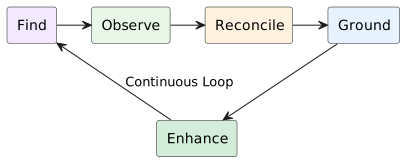
In this lecture, FORGE is presented as a practical sequence for process-driven transformation: Find, Observe, Reconcile, Ground, and Enhance. The focus is not on abstract theory or on a new “magic” method. It is on how organizations can make process architecture reflect operational reality, so that transformation becomes repeatable instead of episodic.
For leaders and practitioners, that distinction matters. A transformation program may look active on paper while the organization remains stuck in ceremonial governance, pilot purgatory, or hidden workarounds that never make it into the design. FORGE helps surface those conditions and turn them into something a team can actually improve.
Why process is where transformation breaks down
The whitepaper framing behind this lecture is simple: digital transformation succeeds when it is treated as a systems architecture problem, not just a technology initiative. The process domain is where intent becomes repeatable execution. If that domain is weak, transformation remains aspirational.
That is why this lecture starts with a basic but uncomfortable observation: what is documented and what is operational reality often diverge. A process can look complete in a model and still fail in practice because the real owners, decision-makers, controls, and communication paths were never captured. People then fall back on “the way we have always done it,” even when no one can explain why.
This is not a small documentation issue. It is an execution issue.
When process architecture does not reflect what is really happening, organizations lose visibility into how work actually moves. Hidden handoffs emerge. Orphaned processes continue without purpose. Controls exist in name only. Teams may believe they are governed, but the governance is ceremonial: present in policy documents, absent in practice.
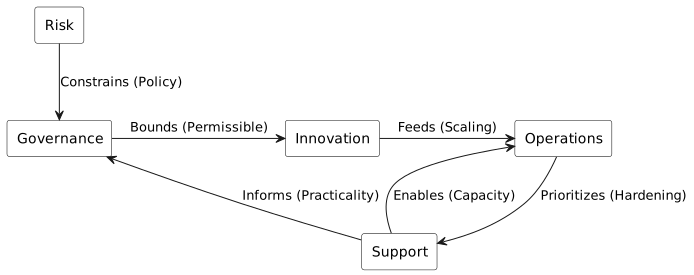
That is why the lecture treats process architecture as more than a diagramming exercise. It is the structure that connects strategy, governance, operations, support, and risk into something that can carry change.
FORGE as a disciplined way to see the work
FORGE stands for Find, Observe, Reconcile, Ground, and Enhance. The sequence is deliberately practical. It begins with what exists, not with what leaders wish were true.
Find means capturing operational reality. What systems are actually used? Who owns the work? Who makes decisions? What controls are in place? What informal or ad hoc processes have grown over time? The lecture emphasizes that important communication channels are often hidden inside the process domain and must be documented rather than assumed.
Observe means tracing a real piece of work from intent to outcome. Not a theoretical journey, but a real one. Where does strategic intent enter? What happens in governance? How does the work move through operations, risk, and support? Where do delays, rework, and ghost approvals appear? This is where organizations begin to see the actual structure of execution, not just the one they intended.
These two steps are often the hardest because they reveal what the organization would rather not see. But they are also the steps that make the rest of the work possible. Without them, transformation teams can spend months refining a design that never matches the way work is really done.
Agility is useful only when execution is disciplined
One of the lecture’s strongest points is that agility and discipline are not opposites. In transformation work, agility means the ability to adapt process design and execution as conditions change. But agility without discipline becomes improvisation, and improvisation does not scale.
That is why the lecture repeatedly returns to handoffs, decision rights, and governance. If an organization can change quickly but cannot preserve accountability, it will move fast in the wrong direction. If it can govern formally but cannot adjust process design when reality changes, it will become rigid and slow.
The Reconcile step addresses exactly this problem. Reconciliation is the work of resolving structural contradictions: a rule that no longer fits operational reality, a process that does not comply with governance, or a workflow that exists only because no one has challenged it. These mismatches produce drag. Left alone, they create orphaned work and unstable execution.
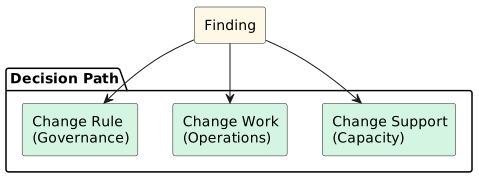
The value of FORGE is that it gives teams a way to improve process architecture without losing control of it. That is what makes the method relevant to process-driven transformation: it supports adaptability in process design and execution while keeping the organization anchored in how work must actually flow.
Feedback and iteration make improvement survivable
Transformation work often fails when it tries to solve everything in one pass. The lecture argues for the opposite: use FORGE as an engagement loop. Start high level, identify the key relationships, then go deeper on the next pass.
That is not a compromise. It is a safeguard.
Organizations change while you are analyzing them. If you go too deep too soon, you can end up with analysis paralysis. You learn a lot, but you never finish. The iterative FORGE loop avoids that trap by keeping each pass focused on what is most important at that moment.
This is where Ground and Enhance matter.
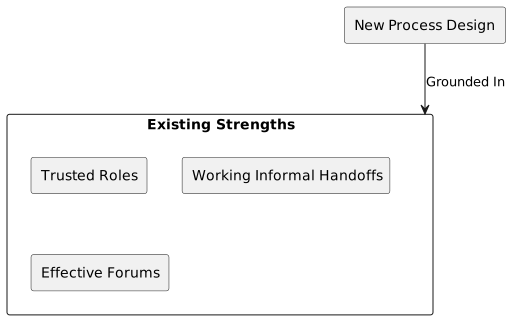
Grounding means identifying what is already stable and worth building on. The lecture stresses that you are not fixing everything on the first pass. You are finding the strengths that already exist — formal or informal — and documenting them so they can support change. That may include trusted roles, stable handoffs, or processes that are not perfect but are reliable enough to serve as a foundation.
Then comes Enhance. Enhancement is where the organization improves the process deliberately. It may clarify accountability, strengthen training, improve observability, remove friction, or rationalize a process that no longer adds value. The point is not to add complexity for its own sake. The point is to make execution more durable.
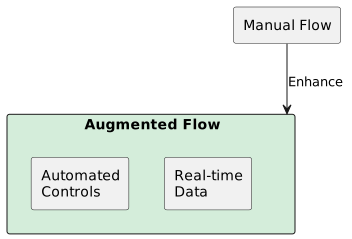
This is also where feedback becomes practical. If a process change requires new behavior, people need training. If accountability changes, decision rights must be clear. If a workflow is being automated or simplified, the organization must understand what outcome it is trying to preserve. Feedback is not just a post-project review; it is part of the process of making change survivable at scale.
What this means for leaders
The lecture’s broader implication is that transformation becomes durable only when it is embedded in culture and execution, not treated as a one-time redesign exercise. Embedding FORGE practices within organizational culture enhances execution efficiency because teams learn to surface reality, reconcile contradictions, and improve process in a repeatable way.
That does not mean every process must be heavily documented or endlessly optimized. It means leaders should know what to watch for:
-
Do documented processes match operational reality?
-
Are handoffs clear, or are they informal and fragile?
-
Is governance connected to actual work, or only to policy?
-
Are teams stuck in pilots that never become production capability?
-
When processes change, do people receive the training and authority they need?
Those questions are practical. They point to the health of the process domain, which is where digital transformation either takes root or stalls.
The lecture also aligns these practices with O-DXA in a limited but important way: the principles support sustained transformation. That alignment matters because process work does not sit apart from architecture. It is part of the architecture that makes transformation possible in the first place.
For practitioners, the takeaway is clear. If you want change that lasts, do not start by asking only what technology to buy or what strategy to announce. Start by asking how work actually flows, where it breaks, and whether the organization has a disciplined way to learn from those breaks. That is where process-driven transformation becomes real.
Go Deeper
-
Full lecture episode: Lecture 4: FORGE Practices for Process-Driven Transformation https://embracingdigital.org/en/lectures/DTA-20
-
Series blog summary: https://embracingdigital.org/en/lectures