
What the Process Domain Governs
Digital transformation is often likened to climbing a mountain: it requires vision, effort, and the right tools. But, just having a climbing plan or reliable equipment isn’t enough; one must also understand how to execute that plan effectively. Unfortunately, many organizations falter in their attempts to translate strategic intent into actionable steps. While investments in technology and talent are crucial, they alone do not guarantee repeatable success. In the realm of digital transformation, the Process Domain serves as an essential framework that defines how organizations can achieve sustainable change through coherent execution.
Navigating the Complexity of Digital Transformation
Digital transformation is not simply about implementing new technologies or systems; it’s about aligning these new tools with organizational strategies that deliver real results. Leaders usually describe their ambitious aims–to enhance digital services, increase operational efficiency, and improve adaptability–but a gap often exists between aspiration and execution. The reality is that many transformation efforts stall or fail to scale beyond pilot projects.
This moment of realization is vital: the challenges encountered often stem from unclear processes, inadequate governance structures, and misaligned execution strategies. The Process Domain exists to bridge this gap. It provides a structured approach that connects strategy with operational realities, ensuring that intentions translate into coherent actions.
The Five Layers of the Process Domain
At its core, the Process Domain consists of five interrelated layers that govern how work is executed within organizations:
-
Governance
-
Innovation Management
-
Operational and Delivery Processes
-
Risk Management
-
Support Processes

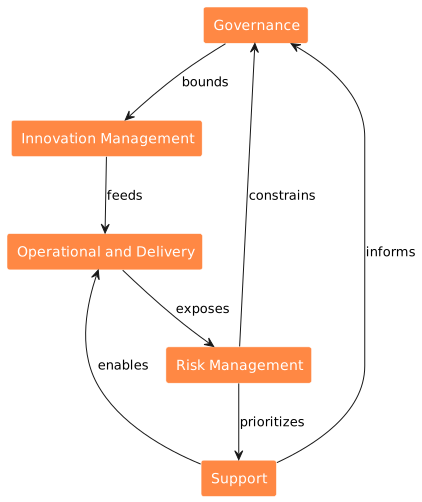
These layers are designed to work harmoniously to facilitate effective digital transformation. Governance provides the rules and oversight essential for robust execution. Innovation management ensures that new ideas are not only generated but also integrated into the operational workflow. The operational and delivery layer is where the value—actual services and products—is created. Risk management protects these efforts against potential pitfalls, while support processes underpin the entire system, ensuring that it operates smoothly.
Understanding this architecture is critical; when these layers function in a disjointed manner, organizations often face familiar issues: failed pilots that never scale, governance that becomes an afterthought, and operational processes that rely on individual heroics rather than structured protocols.
Unpacking Governance: The Framework for Effective Execution
The Governance Layer is foundational to the success of the Process Domain. It establishes the rules, policies, and decision-making frameworks that guide how processes behave within an organization. Strong governance essentially answers several critical questions:
-
What activities must be standardized across the organization?
-
Which processes can be delegated, and what must be approved at higher levels?
-
Who holds the authority to make decisions, and what evidence must they present to do so?
Effective governance prevents bottlenecks and confusion in process execution. By defining clear boundaries, it empowers teams to operate swiftly while maintaining accountability and alignment with strategic objectives. Furthermore, governance must work closely with innovation management; it sets the parameters within which experimentation and scaling can occur.
Integrating Innovation Management: From Ideas to Execution
The Innovation Management Layer acts as the conduit for turning creative ideas into repeatable practices. This layer involves identifying emerging technologies and innovative methods, developing them into pilots and prototypes, and ultimately, scaling successful initiatives into established company practices.
However, organizations often struggle at this juncture. While they may excel at developing new technologies or workflows, they frequently falter at embedding these solutions into daily operations. The Process Domain explicitly outlines how to make this shift, emphasizing the importance of scaling successful innovations into operational workflows that support sustained transformation.
Enhancing Operational and Delivery Processes: Making Value Visible
The Operational and Delivery Layer is where transformation truly becomes tangible. This layer encompasses the practical day-to-day activities that deliver value to customers and stakeholders. It’s here that strategic intentions materialize into real services, products, and outcomes.
Within this framework, organizations focus on optimizing workflows, reducing redundancy, and establishing performance metrics that will allow them to refine operations continuously. Clear governance structures and effective innovation practices are crucial to ensuring that operations run smoothly. When either component is weak, organizations may find themselves struggling with fragmented processes or incapable of scaling their initiatives.
Risk Management: Building Resilience into Processes
The Risk Management Layer provides the mechanisms for identifying, analyzing, and mitigating potential risks that could derail operations. It’s imperative that risk management is not viewed as an afterthought, applied only after workflows are established. Instead, it should be embedded within the process architecture from the start, allowing organizations to anticipate and mitigate issues proactively.
By positioning risk management as a design consideration, organizations can construct resilient processes that are better prepared for potential disruptions. This layer prioritizes support services and informs governance policies, ensuring that potential risks are always factored into decision-making.
Supporting Execution: The Unsung Hero of Transformation
Finally, the Support Layer includes all processes that enable and sustain operational functionality, such as IT services, human resources, and facilities management. Often viewed as peripheral to the transformation effort, support functions are critical for maintaining execution capacity; without them, even the best strategies falter.
Effective support ensures that operational processes wither under the stress of demand. By treating support capabilities as integral to the transformation architecture, leaders can guarantee that their operations can withstand challenges and continue delivering value to stakeholders.
The Interdependent System: Why Every Layer Matters
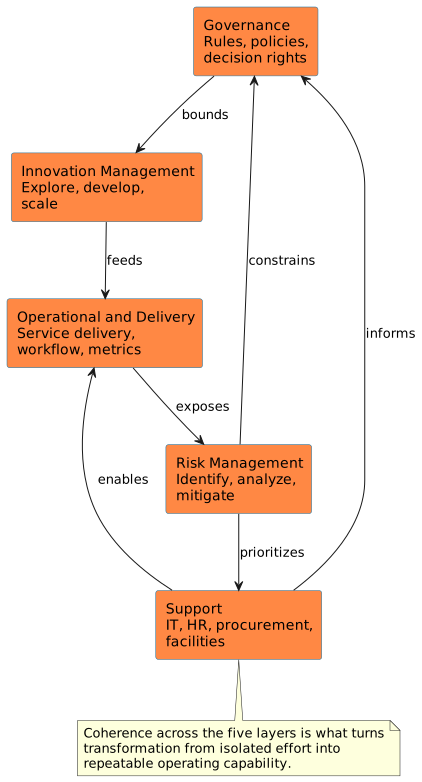
The five layers of the Process Domain are not simply discrete categories; they form a complex system of interaction and feedback. Each layer influences the other, creating a web of interdependencies:
-
Governance controls the direction of Innovation Management.
-
Innovation informs the daily operations rendered by the Operational and Delivery Layer.
-
Operations surface potential risks that can inform Risk Management practices.
-
Support functions enable Delivery while concurrently providing feedback that shapes Governance structures.
This model highlights a simple truth: misalignment or neglect at any level can create significant obstacles for digital transformation. An organization might seem well-structured on paper but without immersed governance, cohesive innovation, effective delivery, integrated risk management, and robust support, transformations can fall short.
Implications for Leadership in Digital Transformation
For leaders and practitioners, understanding and leveraging the Process Domain is vital. Addressing the layers and their interrelationships provides a clear roadmap for translating strategic ambitions into repeatable, measurable outcomes. Here are a few key takeaways:
-
Process is the Architecture of Execution: Recognize that effective processes must be designed as a coherent system.
-
Focus on Interdependencies: Ensure that the layers of the Process Domain are aligned to meet strategic goals without creating siloed functions.
-
Embed Risk and Support into Planning: Treat risk management and support as integral components of the transformation architecture.
-
Strive for Continuous Improvement: Establish feedback loops that allow for ongoing adaptation in governance, innovation, and operational processes.
As digital transformation accelerates across sectors, organizations must refine their approaches to execution. Implementing robust frameworks built around the Process Domain enables effective governance, sustainable innovation, and reliable operational delivery, thereby increasing the likelihood of successful transformation.
Learn More
-
Full lecture episode: https://embracingdigital.org/en/lectures/dta-17/index.html