
Accountability as an architectural concern
Accountability is often discussed as if it were a moral quality: people should take ownership, leaders should hold teams responsible, and better behavior should solve execution problems. That framing is attractive because it is simple, but it is usually wrong. In complex organizations, accountability is rarely missing because people do not care. It is missing because the organization has not been designed in a way that makes ownership visible, actionable, and durable.
When transformation efforts stall, the symptoms usually look familiar. Decisions are delayed. Risks are discovered too late. Work circulates across teams without closure. Escalations happen informally or not at all. Leaders become frustrated that nobody seems to own the outcome, while teams feel they are being blamed for failures they were never structurally equipped to prevent. These are not merely management issues. They are architectural issues.
To understand accountability properly, it helps to treat it as an emergent property of the Organizational Domain. Accountability becomes real when three conditions are present at the same time: relevant information can reach the people who must act, roles clearly define ownership and authority, and the formal structure reinforces those responsibilities through governance and escalation. If any one of those conditions is weak, accountability degrades into ambiguity or blame.
Why Accountability Breaks Down
Organizations often respond to accountability problems with behavioral interventions. They ask managers to be firmer, teams to be more proactive, or individuals to demonstrate stronger ownership. Those moves can create short-term pressure, but they do not address the structural causes of failure. If the information required to act does not arrive on time, if decision rights are diffuse, or if escalation paths are unclear, then demanding more ownership will only intensify frustration.
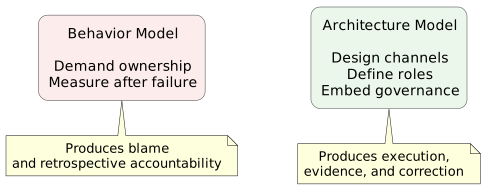
The distinction matters because retrospective accountability is not the same as operational accountability. Retrospective accountability appears after something goes wrong. It asks who is at fault. Operational accountability exists before failure. It makes it possible to see who owns a decision, what evidence should inform that decision, and where unresolved issues should go next. Transformation depends on the second kind.
This is why accountability should be treated as an architectural concern. Architecture defines the conditions under which work moves, information is interpreted, and decisions are enforced. If the architecture is weak, personal effort can compensate only temporarily. If the architecture is coherent, accountability becomes easier to sustain because the organization itself helps people act responsibly.
The Three-Layer Logic of Accountability
Accountability does not sit in one isolated part of the organization. It emerges across multiple connected layers. Three of those layers are especially important: Communication Channels, Roles and Responsibilities, and Structure. Together, they explain how accountability moves from abstraction to execution.
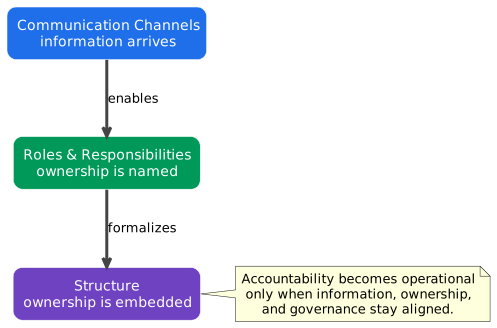
The sequence is important. Information must arrive before a role can act intelligently. A role must be defined before ownership can be assigned credibly. Ownership must be embedded into structure before it can survive conflict, competing priorities, and organizational scale. This is why accountability cannot be solved by rewriting job descriptions alone, and it cannot be solved by communication tools alone. The layers must work together.
Communication Channels Make Accountability Visible
Accountability begins with visibility. An individual or team cannot be accountable for something they cannot reliably see. The Communication Channels Layer determines how signals move through the organization: status updates, risk indicators, performance evidence, stakeholder feedback, operational demand, policy changes, and escalation requests. This layer is not limited to email or meetings. It includes every formal and informal path through which information travels.
When communication channels are well-designed, accountability becomes visible in practice. The right people receive the right signals in time to act. Evidence can be reviewed before outcomes deteriorate. Risks can be escalated while there is still time to intervene. Feedback loops remain intact, which means the organization can correct itself before failure becomes systemic.
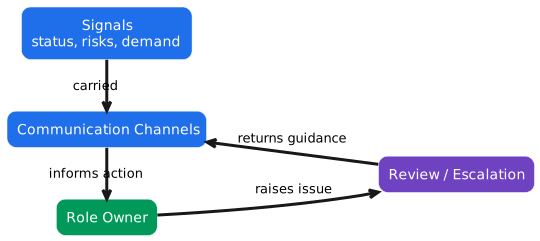
This is what many organizations miss. Information flow is not a convenience layer. It is a control layer. It determines whether accountability can operate in real time. A role owner without timely information is not truly accountable; they are exposed. Likewise, a governance forum without evidence cannot govern effectively. It can only react to narratives, opinions, and post hoc explanations.
The failure mode is equally predictable. If communication channels are fragmented around departments, filtered by hierarchy, or dependent on personal relationships, information arrives late or incompletely. That creates the appearance of individual underperformance when the deeper issue is architectural blockage.
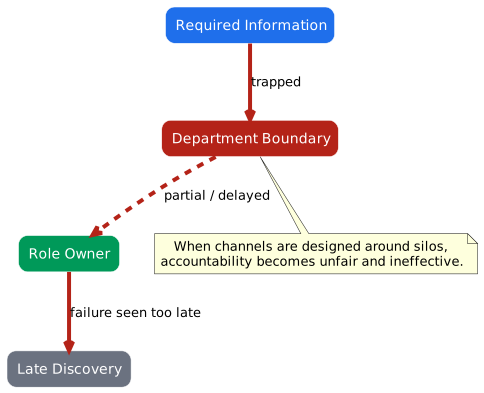
Once this happens, accountability becomes retrospective. The organization notices failure only after the operational window has closed. It then searches for someone to hold responsible, even though the architecture made informed action impossible. In that environment, accountability is experienced as blame because the system cannot distinguish between neglect and structural deprivation.
Roles and Responsibilities Make Accountability Assignable
Visibility alone does not create accountability. Information must be matched to a role that is expected to respond. The Roles and Responsibilities Layer answers the practical questions that execution depends on: who owns this outcome, who decides, who contributes, who reviews, and who escalates when progress stalls.
Where role design is weak, work spreads horizontally without closure. Multiple groups may influence an outcome, but none has clear authority to decide. Teams attend the same meetings, see the same dashboards, and discuss the same problems, yet little changes because the architecture has not established a single accountable owner. In these situations, activity is often mistaken for execution.
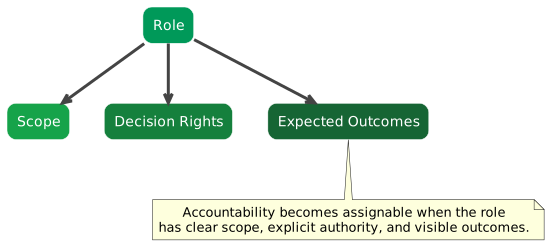
Strong role design has at least three characteristics. First, scope is clear. The organization can say what the role is expected to govern or deliver. Second, decision rights are explicit. The role owner does not need to renegotiate authority every time action is required. Third, expected outcomes are visible. Others can tell whether the role is functioning effectively because the outputs, decisions, and obligations are legible.
This is also where many accountability discussions become confused. Responsibility and authority are often separated. A role is told it owns the outcome but lacks the authority to make trade-offs, secure resources, or escalate conflicts. That is not accountability. It is liability without agency. Sustainable accountability requires a viable pairing of obligation and decision power.
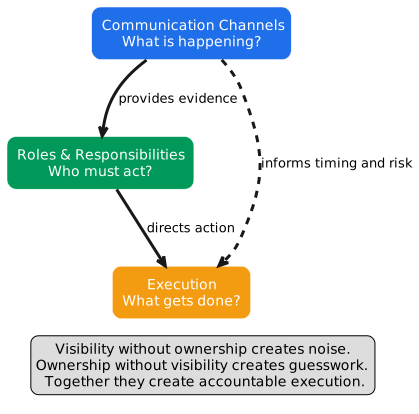
Communication and roles are therefore inseparable. Information tells the organization what is happening; roles determine who must act on that information. If communication exists without ownership, the organization creates noise. If ownership exists without communication, the organization creates guesswork.
One additional point matters here. A role can be well-defined on paper and still fail in practice if the person or team in that role lacks the necessary capabilities. That broader issue reaches into the Skills and Competencies Layer, but the accountability lesson is straightforward: naming an owner is not sufficient if the organization has not made execution feasible.
Structure Makes Accountability Durable
Even when information flows properly and ownership is clearly assigned, accountability remains fragile unless the structure reinforces it. The Structure Layer determines how authority, governance, reporting relationships, and escalation mechanisms are organized. It is where accountability becomes visible in the architecture rather than merely stated in policy.
This matters because transformation generates tension. Priorities compete. Dependencies collide. Risks cross team boundaries. Without structural reinforcement, ownership is easily overridden by hierarchy, ignored during conflict, or dissolved across committees. Formal structure is what allows accountability to persist when the organization is under pressure.
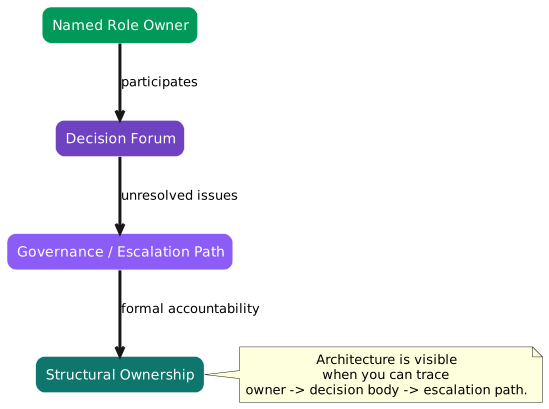
In practical terms, structure answers questions such as these: Where are decisions reviewed? Who resolves conflicts that cross functional boundaries? How are unresolved issues escalated? Which forum has the authority to redirect work, approve trade-offs, or intervene when a role cannot deliver independently? If the answers are vague, accountability will be vague as well.
The key point is not that every organization needs more hierarchy. In many cases, the opposite is true. The problem is not the amount of structure but the coherence of structure. A flatter organization can still embed strong accountability if decision forums, escalation paths, and role boundaries are clear. A highly hierarchical organization can still have weak accountability if authority is opaque and issues disappear between layers.
Structure also determines whether accountability can survive personnel changes. If accountability exists only through informal relationships or the force of a particular leader, it is not architecturally durable. Durable accountability is institutional, not personal. It remains legible even when people move, teams reorganize, or priorities shift.
Designing Accountability Into the Organization
If accountability is architectural, then it must be designed deliberately. The task is not to create more oversight for its own sake. The task is to align the conditions that make ownership possible and reviewable.
That starts with communication design. Organizations should identify what evidence each accountable role requires, how often it must arrive, and through which channels it must be reviewed. They should examine where information stalls, where signals are filtered, and where feedback loops are missing.
It continues with role design. Organizations should clarify which outcomes have a single accountable owner, what authority that owner holds, and what decisions require review or escalation. They should test whether roles are genuinely actionable or merely symbolic.
It culminates in structural design. Organizations should make governance paths explicit, define which forums resolve which classes of issues, and ensure escalation mechanisms are timely enough to matter. If structure only becomes visible after failure, it is too late.
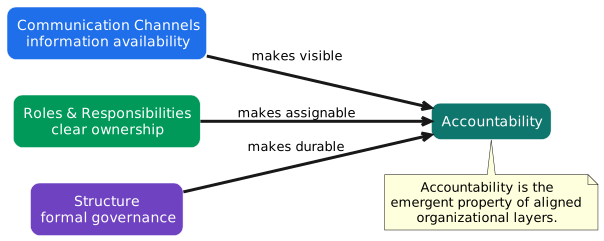
The design test is simple but demanding. Can the organization identify the evidence required for action, the role expected to act, the decision authority supporting that role, and the structural path for escalation when execution is blocked? If the answer is no at any point, then the accountability gap is not just cultural. It is architectural.
Why This Matters for Transformation
Digital transformation increases organizational interdependence. More work crosses functions, more decisions depend on shared information, and more outcomes rely on coordinated execution rather than isolated effort. Under those conditions, weak accountability becomes expensive very quickly. Delays multiply, risks compound, and strategic intent erodes as it moves through the organization.
Strong accountability, by contrast, improves more than governance. It improves execution quality. Teams know what they own. Leaders can distinguish signal from noise. Escalations happen through designed channels rather than political maneuvering. Review becomes evidence-based instead of anecdotal. Most importantly, the organization can correct itself while there is still time.
This is the deeper reason accountability should be treated as an architectural concern. It is not simply about holding people to account. It is about designing an organization in which ownership, evidence, and authority remain aligned under real operating conditions.
Listen and Go Deeper
For the original lecture that complements this article, listen to https://embracingdigital.org/en/lectures/dta-15/index.html