
The Explosion: Enhancing Capabilities through Architectural Intent
Digital transformation succeeds when strategy is converted into repeatable operating capability. For executives, the central question is whether transformation investments produce mission outcomes at acceptable risk and speed. For enterprise architects, the central question is whether architectural intent is being executed consistently across delivery and operations.
The Enhance phase of FORGE is where both concerns converge.
Why Enhance Is a Leadership Priority
Enhance is not a technical afterthought. It is the execution phase where investment intent, operating model decisions, and workforce adoption determine real enterprise value.
For leadership teams, Enhance functions as a portfolio control point where strategy is tested against operating reality. The key issue is whether strategic priorities are becoming real capabilities, whether delivery behavior remains aligned with governance and policy intent, and whether the enterprise is learning fast enough to adapt without destabilizing operations. When these controls are weak, transformation fragments into disconnected projects and escalating cost. When these controls are strong, organizations gain speed, resilience, and measurable mission performance.
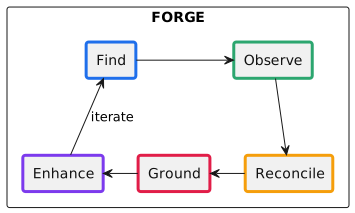
The leadership implication is straightforward: fund Enhance as an iterative capability program rather than a one-time release event, require traceability from each enhancement decision to mission outcomes, and keep architecture governance tightly coupled to investment governance.
Enterprise Architecture Imperative
Enterprise architecture must orchestrate integrated change. Technology-only optimization creates local gains and enterprise-level misalignment.
High-performing Enhance programs redesign process before replacing platforms where practical, treat workforce enablement as part of every increment, and update policy controls in parallel with delivery changes. Technical modernization is still essential, but it is most effective when tied to explicit operating constraints and measurable outcomes rather than technology refresh cycles alone.
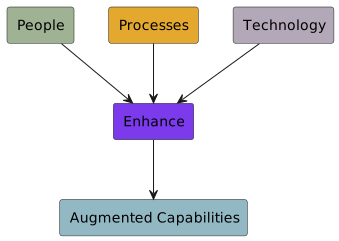
Architecturally, this means defining capability increments with explicit dependencies across people, process, policy, and technology, then assessing completion by operational adoption and performance impact, not only technical delivery status.
The Architect’s Explosion
The Architect’s Explosion is the handoff from strategic intent to operational execution. At this point, architecture quality is determined by delivery behavior, not document quality.
A successful handoff preserves intent in delivery sequencing, exposes operational constraints early enough to avoid downstream rework, and keeps governance responsive to field feedback without losing policy discipline.
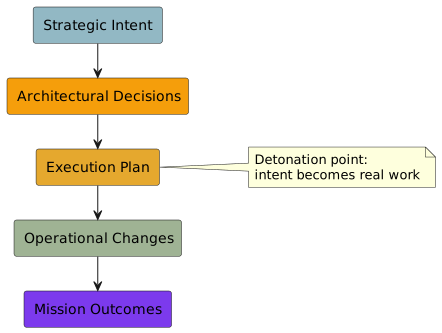
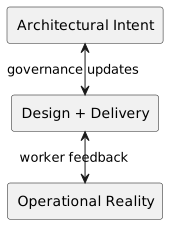
The joint control model should formalize decision rights across strategy, architecture, and delivery, create structured feedback loops from operations into governance, and define clear escalation thresholds for cost, schedule, risk, and mission drift.
Sustainability as an Operating Discipline
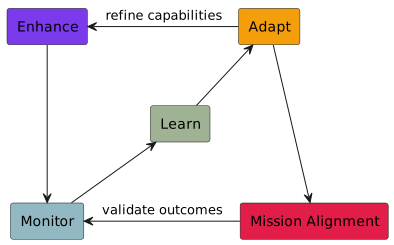
For this audience, sustainability means maintaining mission alignment under change pressure. Enhance should be run as a continuous control loop, not an end-state milestone.
A practical operating cadence begins by monitoring capability outcomes against intended mission effects, learning from friction and adoption barriers, and adapting architecture, policy, and delivery plans based on evidence. When material gaps or external shifts appear, teams should deliberately re-enter FORGE rather than force-fit incremental changes into an outdated plan.
Key Progress Indicators
Executives and enterprise architects should track one shared metric set so portfolio and architecture decisions are judged against the same evidence.
| Metric | Decision value |
|---|---|
Capability cycle time |
Measures elapsed time from approved intent to operational value realization. |
Adoption quality |
Measures the percentage of target users consistently operating in the new model. |
Outcome alignment |
Measures variance between intended and observed mission outcomes. |
Governance responsiveness |
Measures time from operational signal to governance decision update. |
Transformation efficiency |
Measures value achieved per unit of delivery cost and implementation complexity. |
Act Now
The next quarter should establish a visible operating rhythm that reinforces Enhance as an enterprise discipline instead of a project phase.
-
Establish a joint executive-architecture review cadence for each Enhance increment.
-
Require mission-outcome traceability for every major enhancement decision.
-
Implement formal feedback channels from frontline operations into governance boards.
-
Standardize go/no-go criteria that include adoption and policy conformance.
Learn More
-
Full lecture episode: The Explosion: Enhancing Capabilities through Architectural Intent
-
Series whitepaper: The FORGE Methodology: From Intent to Infrastructure